
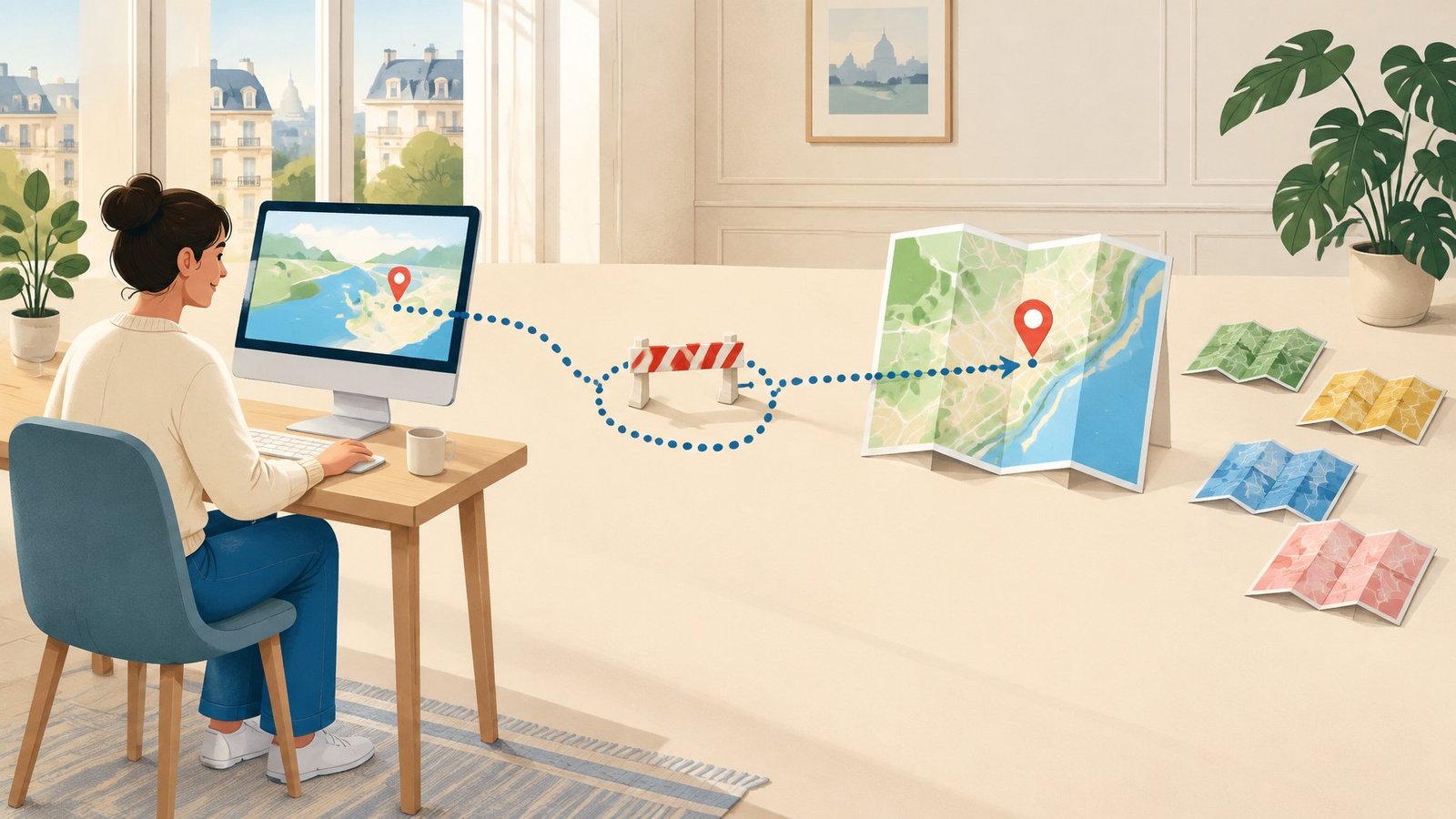
When the European Union forced Google to stop steering searchers to its own mapping service, people simply found another way to get there. A study of the change finds that searches for Google Maps jumped, while traffic to Google Maps stayed flat and competing map services gained nothing measurable.
The study is by Louis-Daniel Pape of Télécom Paris and the Center for Research in Economics and Statistics (CREST) at Institut Polytechnique de Paris, and Michelangelo Rossi of HEC Paris. It appears in the May 2026 issue of Marketing Science (volume 45, issue 3, pages 596 to 613).
One click removed
The EU’s Digital Markets Act targets large “gatekeeper” platforms and bans self-preferencing. Alphabet was designated a gatekeeper in September 2023 for services including Google Maps.
To comply, Google changed its desktop search page for EU users from January 2024. When someone searches for a place, shop or restaurant, the map shown in the results is no longer clickable and the shortcut to Google Maps is gone. A “directions” button remains. Mobile results were largely unaffected during 2024.
The idea was to remove Google Maps’ one-click advantage and give rival services a chance. The authors tested whether it worked by comparing 25 EU countries with 27 non-EU control countries, including the United States, the United Kingdom, Japan and Brazil, over 2023 and 2024. They used weekly search data from Google Trends and Glimpse, and monthly website traffic estimates from Semrush.
More searches, same destination
Searches for “maps” and “google maps” rose by more than 21% in the EU relative to the control countries. The generic “maps” query could in principle lead people to alternatives, but the authors note that Google Maps appeared among the top two results for that search in France, Germany, Italy and Spain.
The extra searches did not translate into extra visits overall. Desktop traffic to Google Maps showed no significant change, and mobile traffic, used as a placebo because it was not affected in 2024, also did not move.
What changed was the route people took. Organic search traffic to Google Maps from desktop users rose by about 40%, with no rise in people typing the address directly or using bookmarks. The authors read this as users who once clicked a map in their results now searching explicitly for “maps” or “google maps” first.
Visits also became a little less engaged. Average visit duration fell by 5% and the bounce rate rose by 16%.
Rivals stayed where they were
Searches for Bing Maps, Mappy and OpenStreetMap showed no significant change. Searches for Apple Maps rose somewhat, but the result did not hold across model specifications and the volumes were orders of magnitude smaller.
Traffic to Bing Maps showed no robust change either. The authors conclude that the act “had weak competitive effects,” reflecting Google Maps’ dominance in a market where alternatives remain limited.
They caution that Semrush and Glimpse estimates rely on proprietary methods, though their search results hold when using raw Google Trends data alone. They also note that users could restore the old layout with browser extensions or VPNs, but these appear to be little used.
Their policy suggestion is specific: the remaining “directions” button still steers users to Google’s own navigation, and changing choice architecture alone may not be enough unless alternatives are made more visible to users.
Study Details:
- Title: Is Competition Only One Click Away? The Digital Markets Act’s Impact on Google Maps
- Authors: Louis-Daniel Pape, Michelangelo Rossi
- Journal: Marketing Science, Vol. 45, No. 3, pp. 596-613
- Publication Date: May 2026
- DOI: 10.1287/mksc.2025.0159