
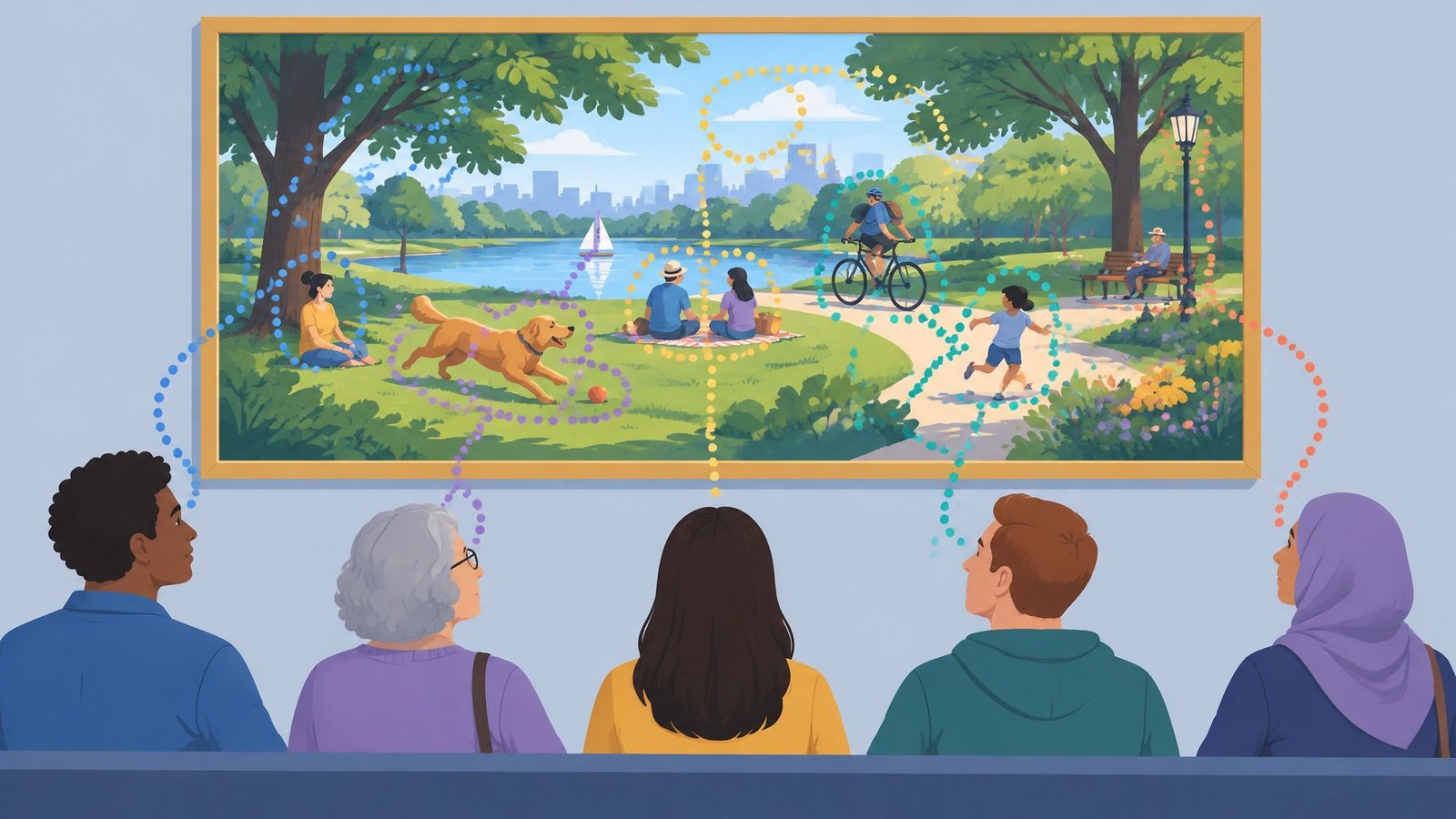
The way your eyes move over a picture is personal enough to pick you out of a crowd. Researchers who tracked where adults looked across 700 photographs could identify individuals from their gaze alone 52% to 63% of the time, when chance would be just 1% to 2%.
The team also found a link to autistic traits: people whose gaze on social scenes was more distinctive tended to report fewer of them.
The study was led by Sarah K. Crockford and senior author Michael V. Lombardo of the Laboratory for Autism and Neurodevelopmental Disorders at the Istituto Italiano di Tecnologia, with colleagues including researchers at the University of Trento. It was published in Psychological Science on February 3, 2026.
How a gaze fingerprint is measured
The discovery sample was 105 adults aged 18 to 50, tested at the institute’s lab in Italy, 52 women and 53 men. Each person freely viewed the same 700 photos of complex natural scenes, 3 seconds each, in two sessions about a week apart. A replication used a public data set of 46 mostly female adults tested in Germany about 16 days apart.
For every photo the researchers built a heat map of where each person looked. A person counted as “fingerprinted” when their own two sessions matched each other more closely than they matched anyone else’s.
Using similarity across all 700 photos, identification worked for 52.4% of people in the discovery group and 62.98% in the replication group. Restricting the comparison to subsets, such as images with faces, still gave 29% to 54% in the discovery group. Single photos were much weaker, at roughly 2% to 11%, but 660 of the 700 images still beat chance.
Barcodes that last for years
The team also turned each person’s hits and misses across the photos into a binary “gaze-fingerprint barcode.” Clustering treated nearly every barcode as unique, and 96 of 105 people in the discovery sample were fingerprintable on more images than chance would predict.
To check that the barcodes were not random noise, the researchers ran two preregistered follow-ups. Ten original participants returned after 1.87 to 5.16 years, and 3 of them had barcodes significantly similar to their old ones. In a short-term study with five sessions spread over about three months, barcodes stayed more alike than shuffled versions.
The autism link and its limits
Participants also filled in two standard autistic-trait questionnaires. Stronger gaze fingerprinting predicted lower autistic-trait scores, and the effect was specific to social images, those containing faces, rather than nonsocial scenes. A subgroup with less unique gaze scored higher on autistic traits, with a moderate effect size (Cohen’s d of 0.49).
The authors flag the limits themselves. The follow-up samples were small. The work used brief views of still pictures, not films. And the autism finding comes from people without an autism diagnosis, so “stronger statements about relevance to autism will require future experiments in clinically diagnosed autistic samples,” they write.
They also note a practical side: technologies that collect eye-gaze data at scale could, combined with other personal data, identify people by what they look at, which raises privacy questions.
Study Details:
- Title: Detection of Idiosyncratic Gaze-Fingerprint Signatures in Humans
- Authors: Sarah K. Crockford, Eleonora Satta, Ines Severino, Donatella Fiacchino, Andrea Vitale, Natasha Bertelsen, Elena Maria Busuoli, Veronica Mandelli, Michael V. Lombardo
- Journal: Psychological Science
- Publication Date: February 3, 2026
- DOI: 10.1177/09567976251415352