
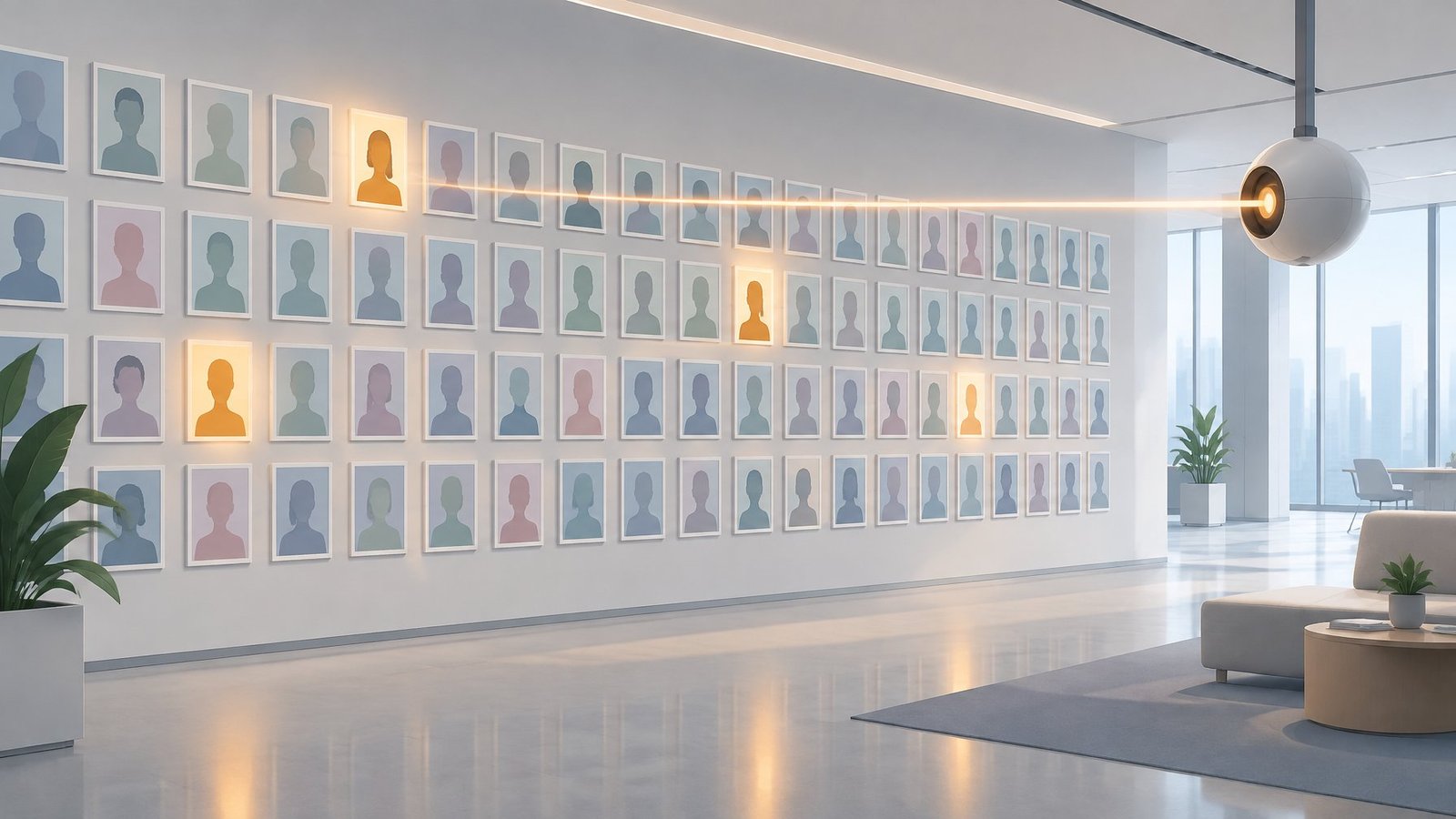
An algorithm that guesses personality from a single face photo turns out to predict how far MBA graduates get in their careers. The face-derived traits forecast school rank, pay, job hopping and promotions about as well as a person’s attractiveness or educational background do.
The study comes from Marius Guenzel and Shimon Kogan of Wharton, Marina Niessner of Indiana University and Kelly Shue of Yale. It was released as NBER Working Paper No. 34808 on February 9, 2026, under the title “AI Personality Extraction from Faces: Labor Market Implications.”
How the Photo Big 5 works
The team used LinkedIn data from Revelio Labs on people who earned a full-time MBA between 2000 and 2023 at one of the top 110 US programmes. After filtering for usable photos and US first jobs, the sample held 96,909 graduates: 70,593 men and 26,316 women.
Each profile photo went through an updated version of a neural network built by Kachur and colleagues in 2020. That model was trained on photos and self-reported Big 5 questionnaires from 12,447 volunteers, and it scores openness, conscientiousness, extraversion, agreeableness and neuroticism.
Its accuracy is modest. In held-out tests, photo-based scores correlated with people’s own questionnaire answers at between 0.14 and 0.36. The authors note that behavioural tests of personality rarely beat 0.3 against surveys either.
The researchers controlled for graduation year, age, an AI attractiveness score, facial expression, glasses, blurriness, signs of Photoshop and apparent age in the picture.
Personality and pay
Conscientiousness predicted attending a higher-ranked MBA programme, while extraversion pointed strongly the other way. Moving from the bottom to the top fifth of school-predicting profiles meant a 7.0% better MBA rank for men and 16.9% for women.
After graduation the pattern flipped for extraversion, which predicted higher pay for men alongside conscientiousness. Without controls, the top fifth of pay-predicting profiles earned 8.3% more for men and 11.8% more for women than the bottom fifth.
With all controls, including the MBA school, those gaps were 4.2% and 4.7%. The authors write that this is similar to the Black-White pay gap in their data, matches moving up roughly 9 to 12 places in MBA rankings, and exceeds the beauty premium.
People also sorted into jobs that suit their traits, and that match paid. For men, the pay premium for conscientiousness and agreeableness roughly doubled in occupations where demand for those traits was one standard deviation higher.
Turnover followed too. Graduates in the top fifth of tenure-predicting profiles stayed in their first job 20% longer for men and 37% longer for women. Agreeableness and conscientiousness meant staying put, while extraversion and neuroticism meant moving on.
Weakly linked to grades and test scores
Using photo directories and records from several leading US MBA programmes, the team found only modest correlations between the photo traits and GPA or GMAT scores. Adding those academic measures barely changed the link between photo traits and career outcomes.
Scores from LinkedIn photos also correlated strongly with scores from the same people’s younger, unedited school directory portraits.
The authors stress they cannot show that any trait causes success, and that pay and promotions are not the same as productivity. They also call face-based screening classical statistical discrimination, writing that it “violates autonomy and respect for individuality.”
Still, they point out that firms already use AI personality tools in hiring, which is why they wanted to measure how much such a system actually predicts.
Study Details:
- Title: AI Personality Extraction from Faces: Labor Market Implications
- Authors: Marius Guenzel, Shimon Kogan, Marina Niessner, Kelly Shue
- Journal: NBER Working Paper No. 34808
- Publication Date: February 9, 2026
- DOI: 10.3386/w34808