
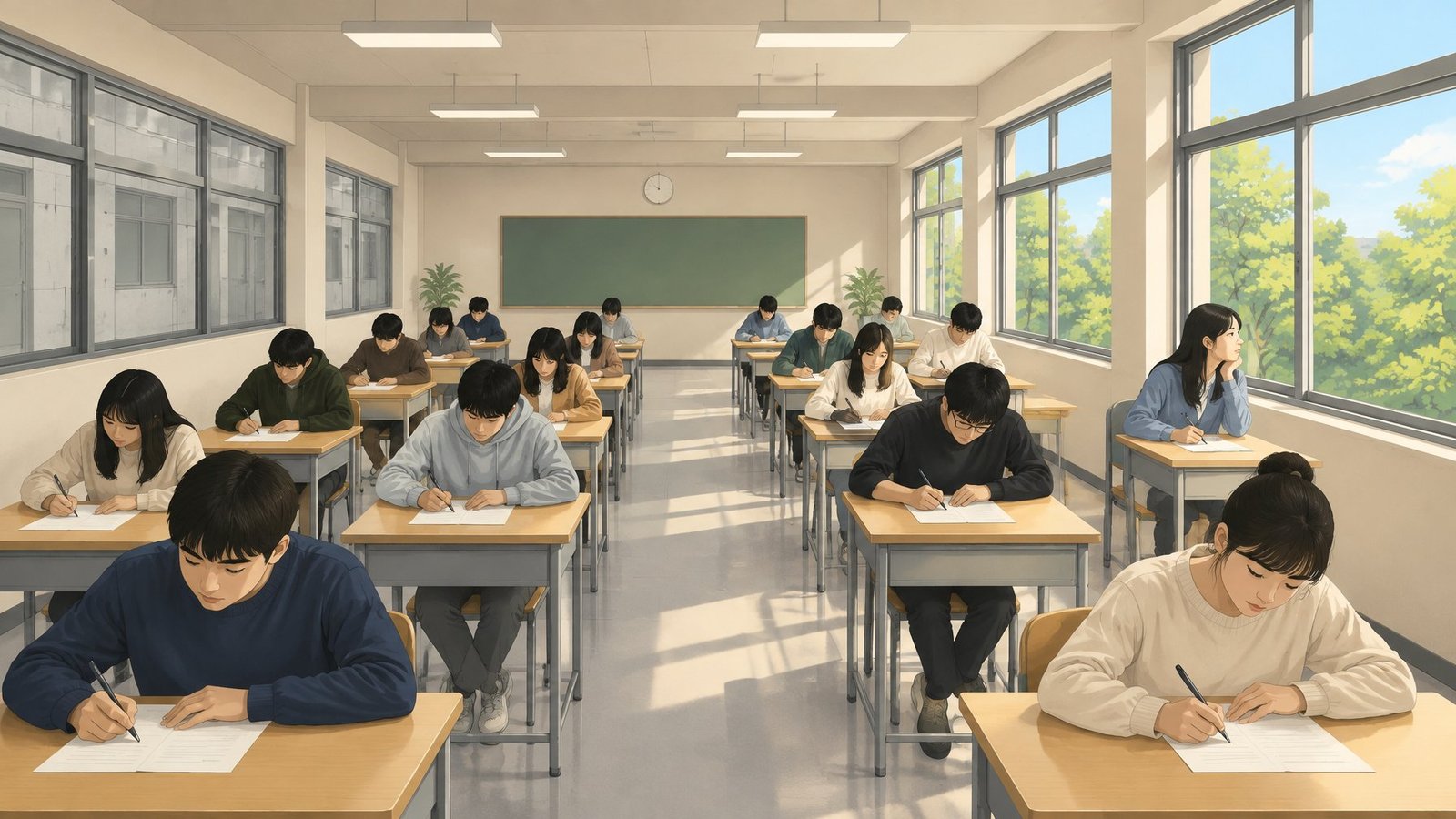
Where you sit during an exam can matter. At China’s college entrance exam, students who were randomly seated next to a window with an outside view scored 8.9% of a standard deviation higher than classmates seated in the middle of the room.
The study, “The cognitive benefit of a window view,” is by Xuan Li of Boston University and Xiang Zhou of Xiangtan University’s business school. It appears in the January 2026 issue of the Journal of Economic Behavior and Organization.
A natural experiment in the exam hall
To prevent cheating, some Chinese provinces randomly assign students to exam rooms and seats. Each room holds 30 students in five columns of six desks.
Two columns sit along windows, but they differ. In the rooms studied, the column next to the open corridor had its outside view blocked, while the column on the far side looked straight outdoors.
The authors used administrative data on more than 3,700 students from eight high schools who registered for the exam in a county in central China in 2019. Checks showed seat placement was unrelated to gender, ethnicity, age or urban background.
Because the province only returned scores for students who got college offers, the score analysis covers admitted students, more than 76% of the total. Seat position did not predict who was admitted.
A view helped, a window alone did not
Students seated beside a window with an outside view scored higher, while those beside a window facing the corridor did no better than students in the middle. The published paper puts the gain at 8.9% of a standard deviation.
In an earlier version of the paper, the authors translated the effect into roughly 9 points on the 750-point exam. In that province, they estimated, that could move a science-track student up by as many as 8,100 places among about 210,000 test takers.
The earlier version also found that students by the open window were 2.8 percentage points more likely to win a place at a first-tier university. Every seat in the window column showed a gain, so a few outliers were not behind the result.
Restoring tired attention
The authors link the effect to Attention Restoration Theory, the idea that looking at nature or the outdoors helps people recover their focus. The effect was similar for science and liberal arts students but stronger for boys.
Teachers’ written evaluations, submitted when students register for the exam, offered another clue. Students described as struggling to pay attention in class gained the most from a window seat.
Noise and natural light seemed less likely to explain the gap, since both window columns had glass and the corridor stayed quiet during the high-stakes exam. The authors suggest rotating seats during long tests so no student is stuck with the worst spot.
Study Details:
- Title: The cognitive benefit of a window view
- Authors: Xuan Li, Xiang Zhou
- Journal: Journal of Economic Behavior & Organization, Vol. 241, Article 107358
- Publication Date: January 2026
- DOI: 10.1016/j.jebo.2025.107358