
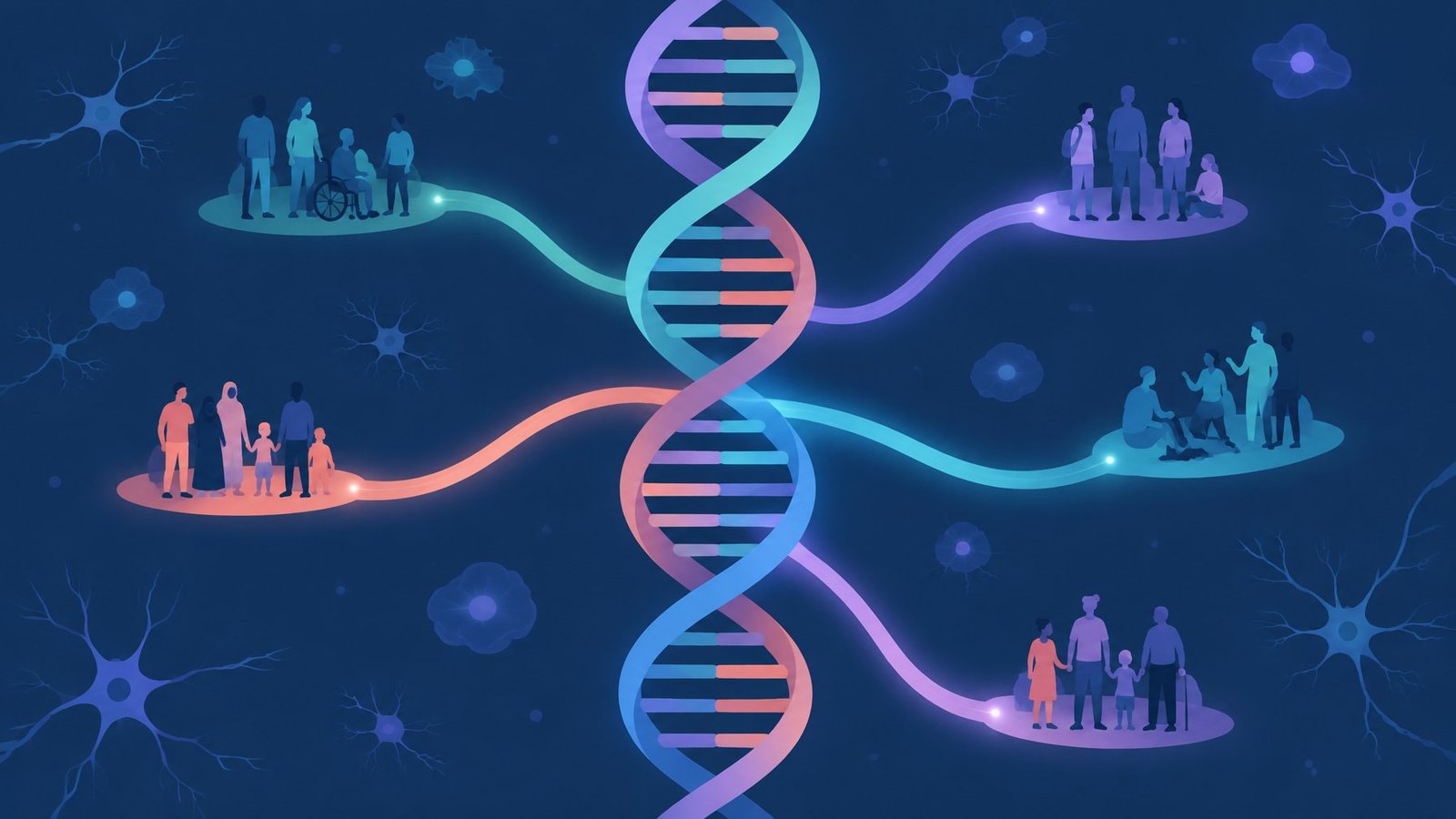
Psychiatric diagnoses that look separate in the clinic share much of their genetic roots. A study of 14 disorders found that just five underlying genetic factors account for around two thirds of the genetic variance of each disorder on average.
The work is the third major analysis from the Cross-Disorder working group of the Psychiatric Genomics Consortium, led by Andrew D. Grotzinger of the University of Colorado Boulder with hundreds of co-authors from institutions including Vrije Universiteit Amsterdam, the University of Oslo, the Mayo Clinic and Massachusetts General Hospital. It was published in Nature on December 10, 2025.
A million cases, five clusters
The team pooled genome-wide association data on 1,056,201 cases across 14 childhood- and adult-onset conditions. These were ADHD, anorexia nervosa, autism, bipolar disorder, major depression, OCD, schizophrenia and Tourette’s syndrome, plus six newly added conditions: alcohol-use disorder, anxiety disorders, PTSD, nicotine dependence, opioid-use disorder and cannabis-use disorder.
Using a method called genomic structural equation modelling, the researchers found the overlap was best described by five factors:
- a compulsive factor, defined by anorexia, OCD and, more weakly, Tourette’s and anxiety
- a schizophrenia and bipolar factor
- a neurodevelopmental factor, defined by autism and ADHD
- an internalizing factor, defined by PTSD, depression and anxiety
- a substance-use factor covering opioids, cannabis, alcohol and nicotine
The median share of genetic variance left unexplained by these factors was 33.5%. Tourette’s syndrome stood out as the most genetically distinct, with 87% of its variance unexplained.
Shared loci and a hotspot on chromosome 11
The researchers identified 238 genetic loci linked to at least one of the five factors, most of them for the schizophrenia-bipolar factor (102) and the internalizing factor (150). Ten were entirely new to genetics research.
Disorders within the same factor were almost indistinguishable at the level of individual variants. When the team searched for loci that separate the cases of one disorder from another, more than 99% of the hits came from pairs belonging to different factors.
Splitting the genome into 1,093 regions, they found 101 hotspots where several disorders share local genetic correlation. The strongest, on chromosome 11, involved 8 of the 14 disorders and contains a gene cluster including the dopamine receptor gene DRD2.
Different brain cells behind different clusters
Genes tied to the shared factors were most active in the developing brain before birth and in early life, pointing to early neurodevelopment. Signal shared across all 14 disorders was enriched for broad processes such as gene regulation.
The clusters then diverged. The schizophrenia-bipolar factor was enriched in genes expressed in excitatory neurons, while the internalizing factor was linked to oligodendrocytes, the cells that insulate nerve fibres. The internalizing and substance-use factors were the only ones genetically correlated with household income.
The authors note that the main analyses were limited to people of European-like genetic ancestry, because data for other groups remain far smaller. They also say estimates could be inflated by assortative mating or misdiagnosis, though sensitivity checks suggested misclassification had a modest effect.
They point to drugs such as SSRIs, which already work across several disorders, as a model for treatments aimed at the shared signal each factor captures.
Study Details:
- Title: Mapping the genetic landscape across 14 psychiatric disorders
- Authors: Andrew D. Grotzinger, Josefin Werme, Wouter J. Peyrot, Oleksandr Frei, Christiaan de Leeuw, Lucy K. Bicks, Qiuyu Guo, Michael P. Margolis, Brandon J. Coombes, Anthony Batzler, Vanessa Pazdernik, Joanna M. Biernacka, Ole A. Andreassen, and the Cross-Disorder Group of the Psychiatric Genomics Consortium (469 authors in total), including Phil H. Lee, Kenneth S. Kendler, Jordan W. Smoller
- Journal: Nature
- Publication Date: December 10, 2025
- DOI: 10.1038/s41586-025-09820-3