
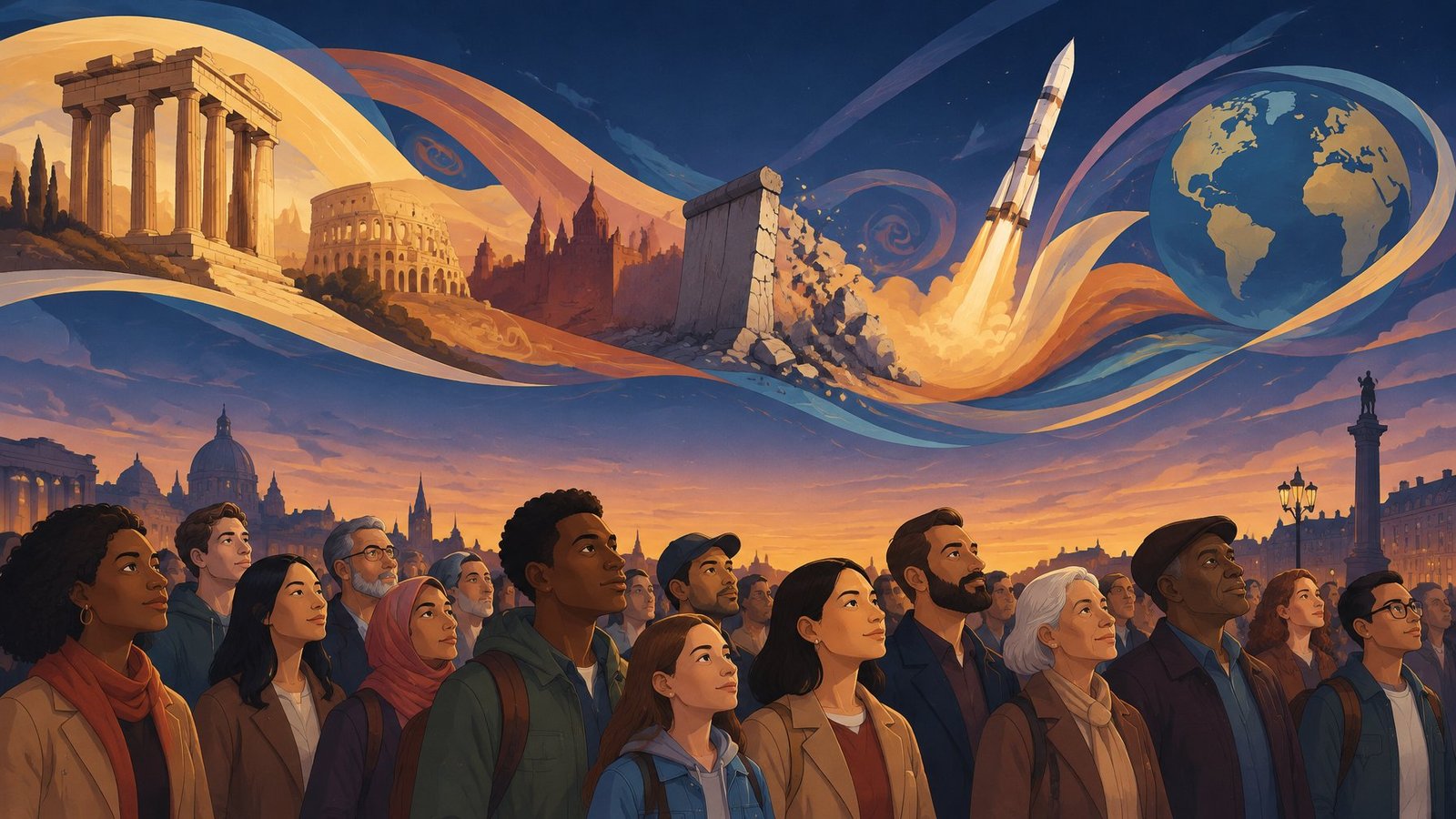
Most people never shape history, but everyone lives through it. A set of studies from China and the UK suggests that simply feeling like a witness to a historic moment makes people sense more meaning in their lives, and look harder for it.
The paper, “Being present: Witnessing landmark historical events boosts meaning in life,” was published online in the Journal of Personality and Social Psychology on December 15, 2025.
Its authors are Yige Yin, Yuling Wang, Xiaohan Wu and Tonglin Jiang of Peking University, Xiaoqi Sun of Hunan Normal University, Joshua Hicks of Texas A&M University, and Tim Wildschut and Constantine Sedikides of the University of Southampton.
What the Queen’s death did on Weibo
The first study used social media. The team collected Weibo posts from 10,956 non-verified users who mentioned the death of Queen Elizabeth II on September 8 or 9, 2022, spanning six weeks before and after, for a final set of 2,317,527 posts.
Using word dictionaries, they flagged phrases such as “end of an era” to sort users into those who felt they were witnessing history (1,197 users) and those who did not (7,358). They then tracked words about the meaning or purpose of life.
At the peak of attention to the Queen’s death, the odds of a meaning-related post were 73% higher for the “witnessing history” users than for others. Outside that peak the gap was only 15%.
Experiments and historical sites
Three experiments then tested cause and effect, together with a field study, involving 1,945 participants overall. In one design, people wrote about a societal event that made them feel they were witnessing history, while a control group wrote about a societal event that concerned them.
Those reminded of witnessing history reported more presence of meaning, the sense that life is meaningful, and more search for meaning. A field study found similar effects from visiting historical sites, a more indirect way of witnessing history.
Supplementary studies found that Google searches for “meaning in life” rose after landmark historical events, whether good or bad, and replicated the effect in a UK sample.
Why it works
The authors propose two routes. Feeling connected to history explained the boost in presence of meaning, while a broadened perspective, stepping back from short-term personal concerns, explained the increased search for meaning.
The Weibo study was correlational and relied on word lists, which the authors acknowledge cannot capture deeper reflection. That is why they followed it with the controlled experiments.
The researchers argue that cultivating historical awareness and preserving heritage sites could help people find meaning during turbulent times.
Study Details:
- Title: Being present: Witnessing landmark historical events boosts meaning in life
- Authors: Yige Yin, Yuling Wang, Xiaohan Wu, Xiaoqi Sun, Joshua A. Hicks, Tim Wildschut, Constantine Sedikides, Tonglin Jiang
- Journal: Journal of Personality and Social Psychology
- Publication Date: December 15, 2025
- DOI: 10.1037/pspi0000511