
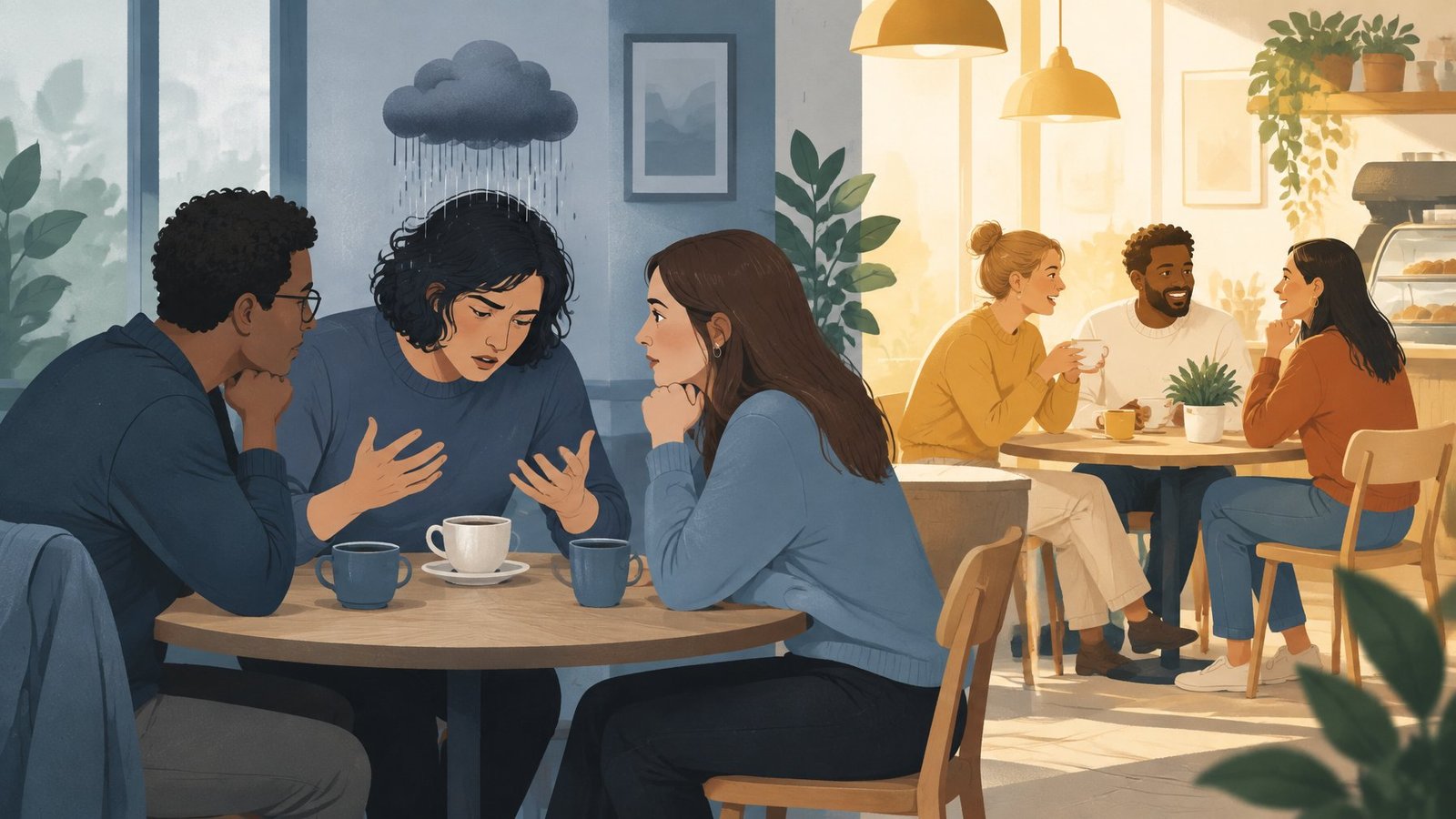
The usual picture of unhappy people is one of withdrawal. A cross-country study finds the opposite when it comes to politics: people who describe themselves as unhappy are more likely to argue about politics with friends and to try to get others to vote or act.
The study is by Eszter Farkas and Gabriella Szabó of the ELTE Centre for Social Sciences, Institute for Political Science, in Budapest. It was published online in Acta Politica on October 22, 2025.
Three kinds of political talk
The authors used the seventh wave of the World Values Survey, collected between 2017 and 2021, covering roughly 58,000 respondents in 44 countries. Happiness was measured with a single question: taking all things together, are you very happy, rather happy, not very happy or not at all happy?
They looked at three behaviours that involve influencing other people: frequently discussing politics with friends, encouraging others to take action on political issues, and encouraging others to vote. Multilevel logistic regression models allowed each country its own baseline and controlled for age, gender, education, unemployment, political interest, reliance on social media or friends for news, and whether the interview took place during the pandemic years of 2020 and 2021.
The less happy, the more engaged
Across all three behaviours, the less happy respondents said they were, the more likely they were to take part. People who answered “not very happy” or “not at all happy” were more likely to engage than those who said “rather happy” or “very happy.” The pattern held in a robustness check using country fixed effects.
The other predictors behaved as expected. Getting news through social media, being interested in politics, being male, older or better educated all raised the odds of political interaction, and unemployment lowered them. The authors note that those groups tend to report higher happiness, which makes the unhappiness result stand out more.
In the authors’ words, the findings show “unhappy people are among the influential citizens politically.” They suggest unhappy people may see political talk as a form of self-expression, or lean on friends for support in difficult political times.
What the data cannot say
The survey cannot separate ordinary unhappiness from clinical depression, which may well cause withdrawal. It says nothing about what people actually said in these conversations.
Most importantly, the design cannot establish direction. The authors acknowledge that the causation could run the other way, with frequent political arguments making people less happy, and say only repeated surveys of the same people or experiments could settle it.
Study Details:
- Title: Less happiness, more political interactions? Cross-country evidence of the interrelations between political interactions and self-reported lack of happiness
- Authors: Eszter Farkas, Gabriella Szabó
- Journal: Acta Politica
- Publication Date: October 22, 2025
- DOI: 10.1057/s41269-025-00404-7