
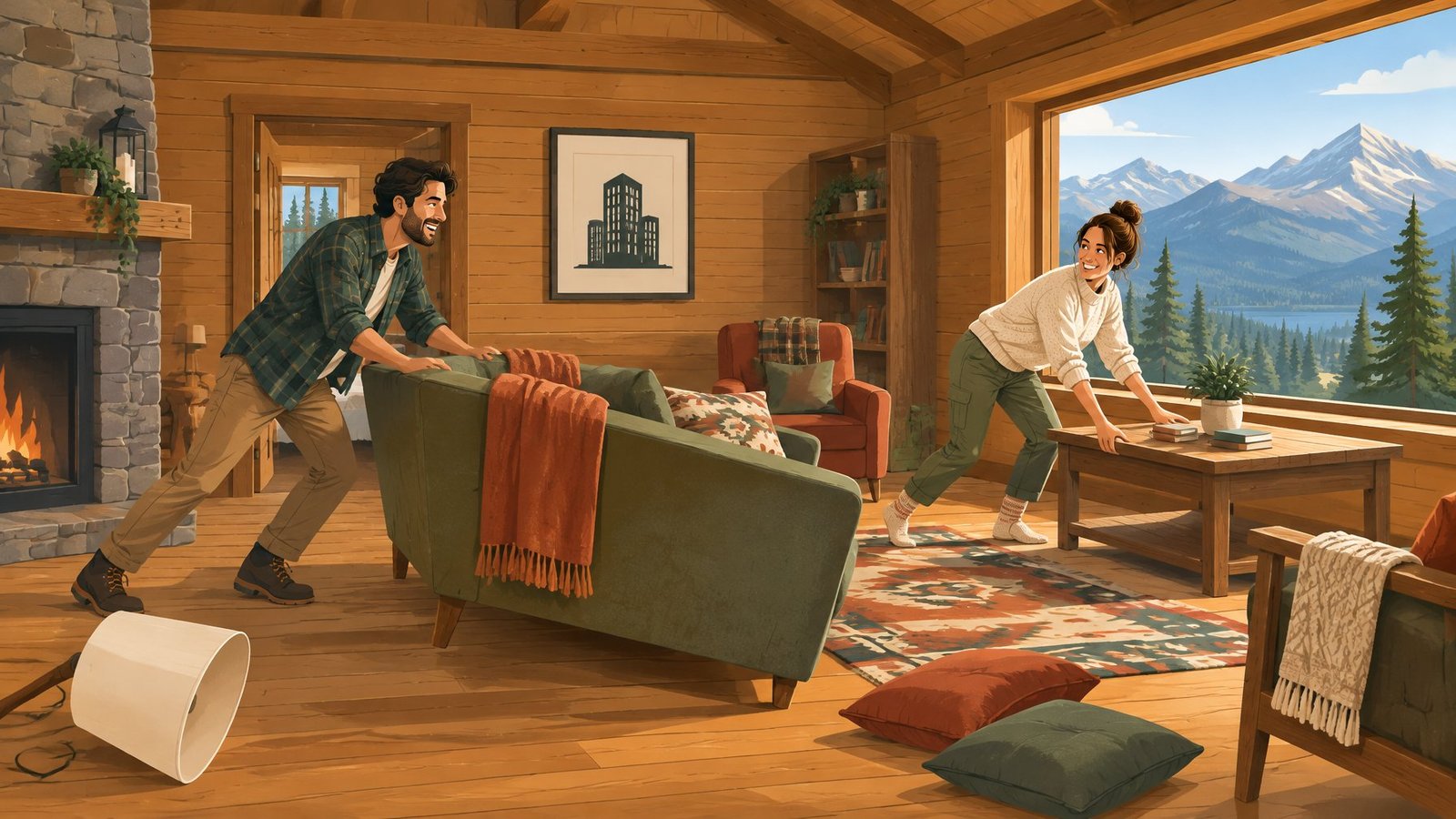
Rent a cabin from a company and you are more likely to rearrange it than if you rent the same cabin from a person. People feel more ownership over a rental when the owner is a business, and that feeling shows up in how freely they treat the place.
The study, by Nirajana Mishra of Northeastern University and Sarah C. Whitley, was published online in the Journal of Marketing on September 15, 2025.
Platforms such as Airbnb now carry listings from individuals and from companies side by side. The authors asked whether that difference changes how guests behave, even when the product is identical.
Off-road driving, moved sofas and marked books
The researchers ran nine main experiments across car, holiday home and book rentals. In the first, 300 online participants imagined renting a sedan on Kauai from either “Apex Rental” or a person called Alex Smith.
Those renting from the company felt the car was more their own and were more comfortable taking it down a rugged, unpaved logging road to a trailhead. Feelings of ownership explained the link.
A second study with 401 participants used a mountain cabin. Renters from a company were more likely to say they would move the furniture. They did not feel any less responsible for the cabin, which ruled out the idea that company renters simply care less.
The third test measured real behaviour. In a university lab, 304 participants answered questions about a specially printed poetry book, with scrap paper and pens provided. When the book was stamped as belonging to a rental company, 25.81% made marks in it, compared with 13.42% when it was labelled as belonging to a person.
Small habits with real costs
The authors call these actions territorial behaviours: marking a rental as your own, and reacting angrily when your claim seems threatened, for example by leaving a poor review when amenities are restricted.
To gauge their cost, they analysed comments from Airbnb hosts. In 153 comments about guests moving furniture, 64.7% mentioned lost time. In 218 comments about parties, 52.8% cited time, and 17.4% mentioned property damage. A conservative estimate put the cost of an extra 15 minutes of cleaning per stay at $502.20 a year for a single host.
How hosts can push back
Later studies showed the effect depends on how connected the provider seems to the property. Weakening that sense of connection amplified territorial behaviour, while strengthening it reduced it. A final study tested house rules set by the provider, designed to limit how much a guest feels the place is theirs.
For companies renting on these platforms, the implication is direct: guests treat a faceless listing as more theirs to use, so signalling a real connection to the property can protect it.
Study Details:
- Title: Psychological Ownership and Territorial Behaviors in Rental Transactions: Why “Who” You Rent from Matters
- Authors: Nirajana Mishra, Sarah C. Whitley
- Journal: Journal of Marketing
- Publication Date: September 15, 2025
- DOI: 10.1177/00222429251382533