
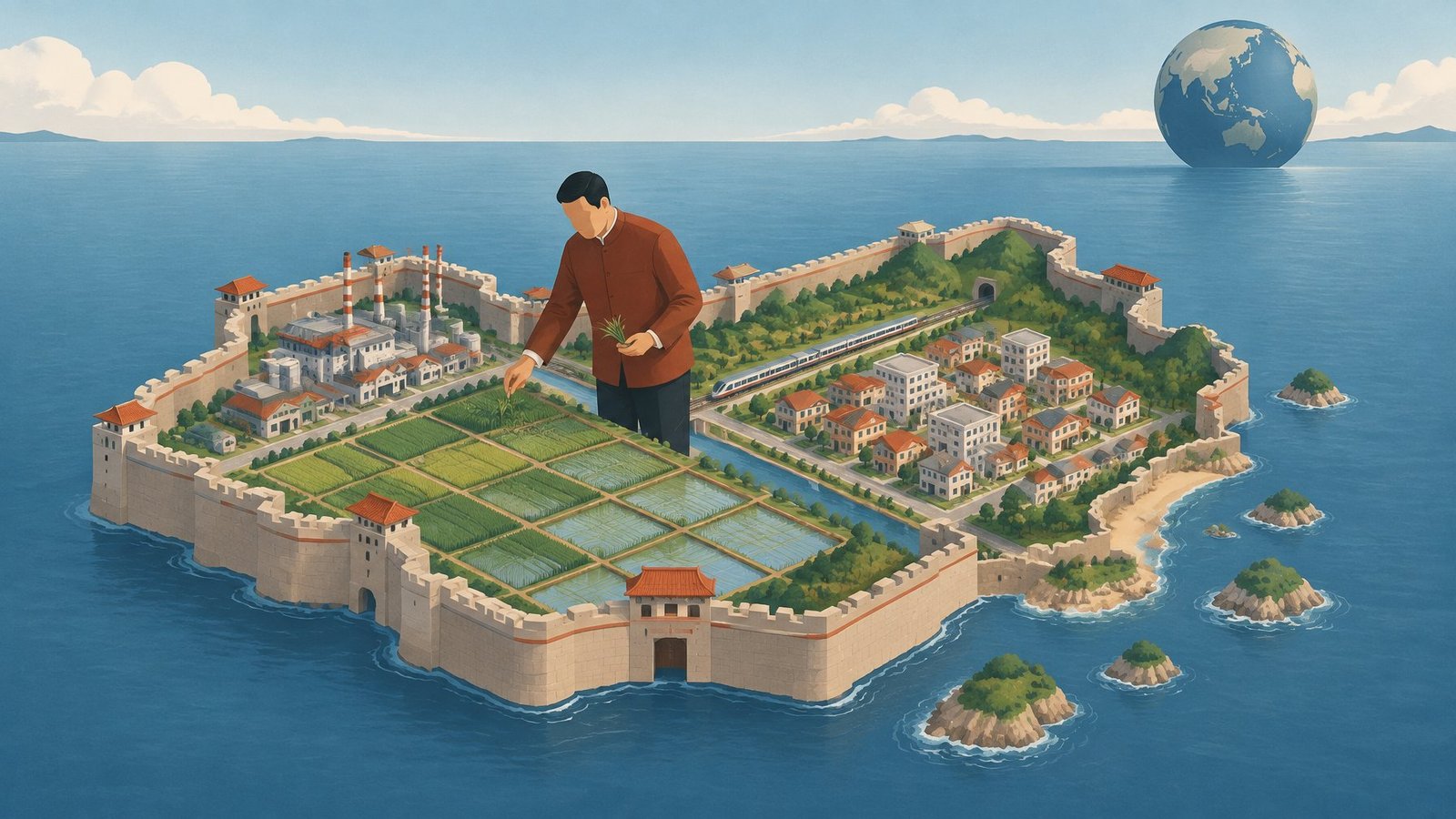
When the Chinese Communist Party talks about “struggle”, it is mostly talking about its own economy and its own corruption, not about the United States. That is one of the central findings of a study that read thousands of official Chinese texts to test a question dominating Washington: what does China actually want?
The answer, according to political scientists David C. Kang, Jackie S. H. Wong and Zenobia T. Chan, is far narrower than the conventional wisdom holds. Their article, “What Does China Want?”, appeared in the Summer 2025 issue of International Security, published in August 2025.
The authors argue that China is “a status quo power concerned with regime stability” and that its aims are unambiguous, enduring and limited. China cares about its borders, its sovereignty and its foreign economic relations, they write, and almost all of those concerns are regional.
Reading the party’s own words
To avoid cherry picking, the team used computer-assisted text analysis on three of the most authoritative Chinese sources: the party newspaper People’s Daily, the policy magazine Qiushi, and speeches by Xi Jinping and other senior officials.
First they collected 12,208 People’s Daily articles from 2012 to 2024 containing the word “struggle”, a core Marxist term in party language. Between 68 and 85 percent of these articles addressed domestic issues, chiefly the economy and corruption. Disputes in the East and South China Seas made up only a fraction. A topic model trained on the same corpus gave consistent results.
Next they tracked the phrase “rise of the East, decline of the West”, which has alarmed many Western observers. Since Xi took office in 2012, it appeared in only 32 People’s Daily articles. The authors found it was used mainly to justify domestic policies such as China’s pandemic response and its model of modernization, not to frame geopolitical competition.
Finally they hand coded 176 Xi speeches from 2012 to 2024 that mention the United States. The dominant theme was cooperation, even when Xi addressed Taiwan or the South China Sea. A co-occurrence analysis of 3,984 Xi speeches and a separate review of 114 English-language speeches pointed the same way.
Old claims, not new ambitions
The second part of the argument is historical. The authors describe China’s core concerns as “trans-dynastic”: Taiwan, Tibet, Xinjiang and Hong Kong were priorities of the Qing dynasty long before the Communist victory in 1949. The Qing administered Taiwan as part of Fujian from 1683 and made it a province in 1886.
Even the contested nine-dash line in the South China Sea predates the People’s Republic. It began as an eleven-dash line on a 1948 map published by the Republic of China, and two dashes were dropped in 1953.
The authors also note what is missing from official discourse. Words like “leader” and “hegemon” do not appear as aspirations, and Xi’s 2021 centenary speech and the party’s November 2021 historical resolution contain no call for global leadership.
What the authors do and do not claim
The team acknowledges the obvious objection: leaders say things that do not reflect their real preferences, and stated goals may be empty rhetoric. Their reply is that these positions have been repeated consistently before and after 2012 and are taught in Chinese schools from primary level to graduate programs.
Their policy conclusions are pointed. They argue that China does not pose the military threat the conventional wisdom claims, that a hostile US posture in the Pacific may create needless tension, and that the two countries could cooperate in overlooked areas.
They also argue that Washington’s focus on war fighting neglects economic and diplomatic arenas where much of the real competition with China takes place.
Study Details:
- Title: What Does China Want?
- Authors: David C. Kang, Jackie S. H. Wong, Zenobia T. Chan
- Journal: International Security, Vol. 50, No. 1, pp. 46-81
- Publication Date: August 2025
- DOI: 10.1162/isec.a.5