
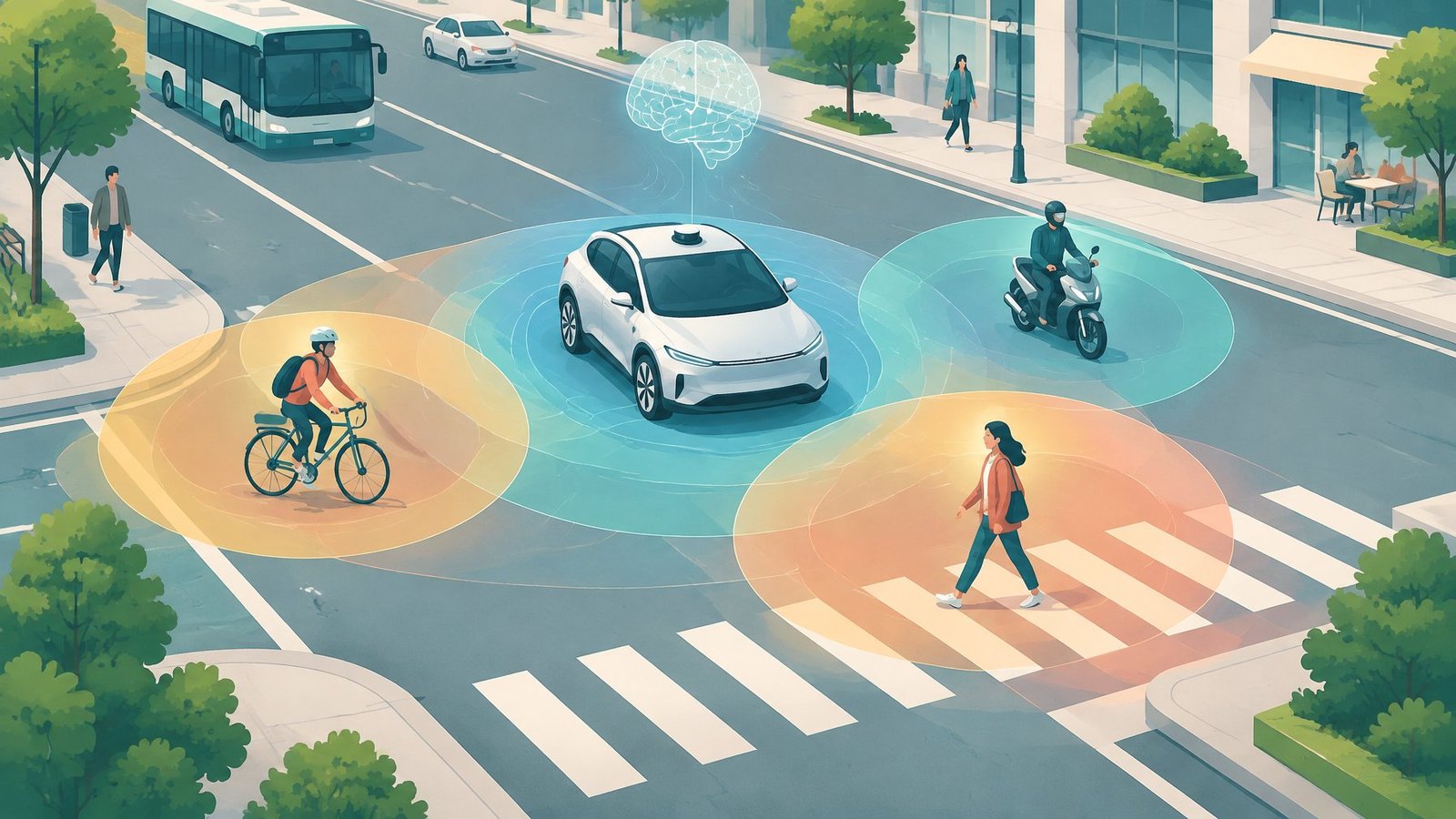
Self-driving cars could share risk on the road more fairly by borrowing a trick from the human brain. Researchers built a decision scheme inspired by the brain’s “cognitive map” and found that, across 2,000 simulated traffic scenarios, it cut overall risk by 26.3% and risk to pedestrians, cyclists and motorcyclists by 22.9%.
The study was led by Hongliang Lu of the Hong Kong University of Science and Technology, with Meixin Zhu of Southeast University in Nanjing and Hai Yang of the Hong Kong University of Science and Technology as corresponding authors, and co-authors from the Beijing Institute of Technology, Tsinghua University, Tongji University and the University of Washington. It was published online in PNAS on May 19, 2025.
From trolley problems to everyday risk
Debates about the ethics of self-driving cars often focus on rare life-or-death dilemmas, such as whether to hit a wall or a pedestrian. The authors instead follow a newer approach that treats ethics as a question of how risk is distributed among everyone on the road in ordinary driving.
The gap they target is that current systems usually weigh each road user’s risk one pair at a time. A skilled human driver, by contrast, manages several risks at once, for example protecting a pedestrian first while accepting a little more risk with a nearby car, then shifting attention once the pedestrian is safe.
How the cognitive encoding works
The team first assesses the risk each road user poses to the car, based on collision probability and likely harm. They then apply “social concern” weights by road user category, so that more vulnerable people, such as cyclists, can be given higher protection priority. The paper does not set what those weights should be, leaving them to be adjusted for different cultures and regions.
The weighted risks are then fed into a model of the brain’s cognitive map called successor representation, combined with a method known as active inference. This predicts how the risks interact in space and time and turns them into a single “behavioral belief” that guides which path the car chooses.
They tested the scheme by adding it to an existing ethical planner called EthicalPlanner, which already balances risk using principles such as minimizing overall risk and protecting the worst-off. For a fair comparison, all road users were given equal weight in the main tests.
Safer, fairer and a bit faster
The evaluation used 2,000 benchmark scenarios from the CommonRoad platform, including real-world recordings and safety-critical situations from many regions.
With cognitive encoding, overall risk fell by 26.3% and risk to vulnerable road users by 22.9%. When collisions did occur, the car’s protection of itself improved by 8.3%, protection of all road users by 17.6% and protection of vulnerable road users by 51.7%.
Driving did not get slower as a result. Average speeds rose by 13.9% and computation time fell by 7.9%. After excluding crashes caused by faulty scenario recordings or other road users, the car completed 96.3% of 1,685 filtered scenarios.
The authors note limits. CommonRoad replays recorded traffic, so other road users cannot react, which meant a principle about shared responsibility could not be tested. They also say it remains an open question whether their model fully captures how human cognition works, and that society has yet to agree on how much priority each type of road user should get.
Study Details:
- Title: Empowering safer socially sensitive autonomous vehicles using human-plausible cognitive encoding
- Authors: Hongliang Lu, Meixin Zhu, Chao Lu, Shuo Feng, Xuesong Wang, Yinhai Wang, Hai Yang
- Journal: Proceedings of the National Academy of Sciences
- Publication Date: May 19, 2025
- DOI: 10.1073/pnas.2401626122