
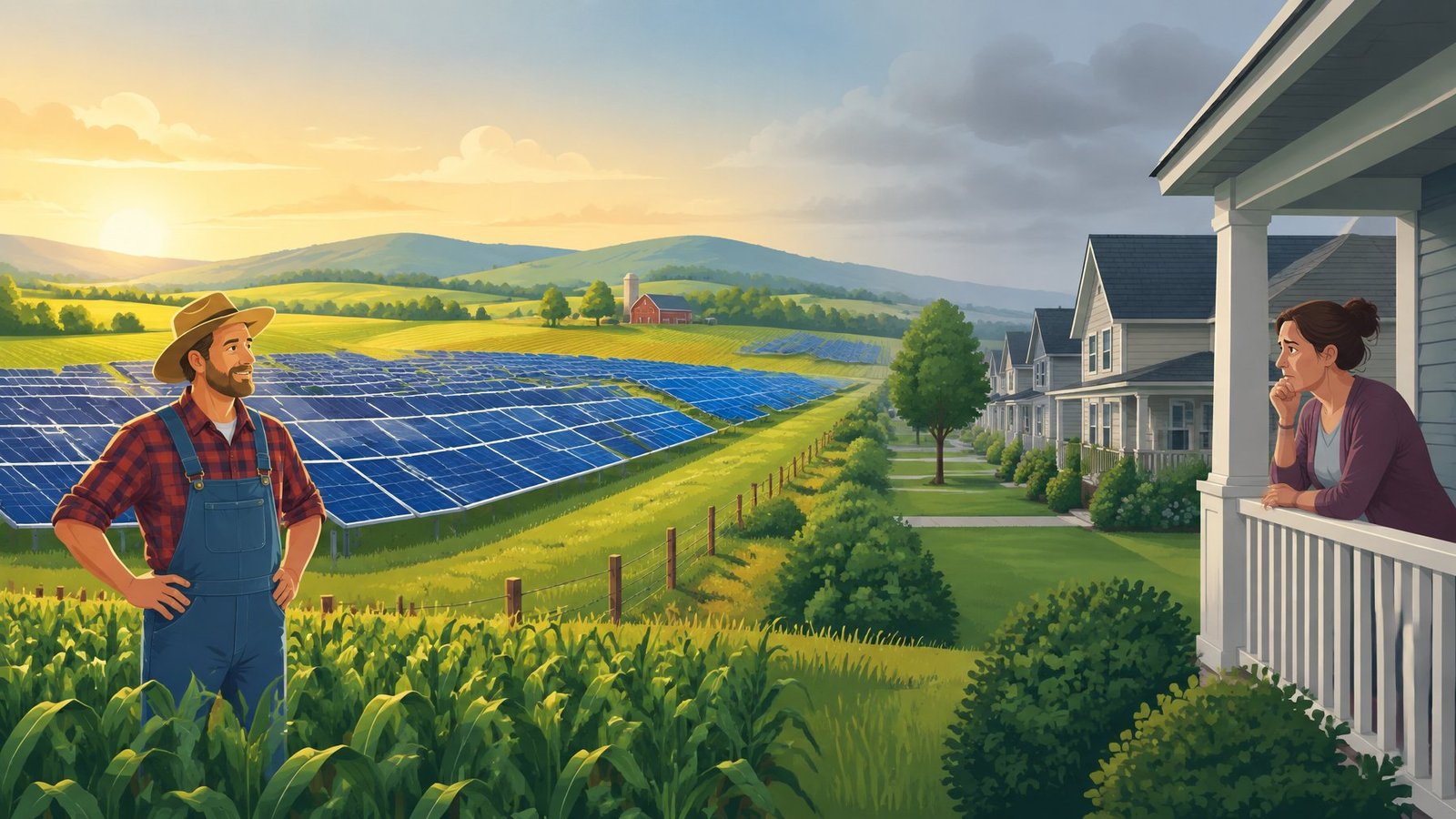
A large solar farm is good news for the owner of a nearby field and bad news for the owner of a nearby house. Across the United States, farmland and vacant land within 2 miles of a big solar installation sold for about 19.4% more after it was built, while homes within 3 miles lost about 4.8% of their value.
The nationwide study was led by Chenyang Hu, Zhenshan Chen, Wei Zhang, Xi He and Darrell Bosch of Virginia Tech, with Pengfei Liu of the University of Rhode Island. It was published online in the Proceedings of the National Academy of Sciences on June 9, 2025.
Local opposition is one of the main brakes on new solar projects, and lower property values are among neighbours’ leading worries. Until now, those costs had not been measured at national scale.
8.8 million sales around 3,699 solar sites
The team combined the US Large Scale Solar Photovoltaic Database, which lists 3,699 facilities built between 1986 and 2021, with CoreLogic property records, keeping only arm’s-length sales. That gave about 8.8 million transactions, including roughly 8.3 million home sales within 6 miles of a site, from 15 years before each installation through 2020.
They used a difference-in-differences design, comparing price changes close to a site with changes for similar properties 5 to 6 miles away. They also built a database of which homes could actually see each solar farm, a first for solar studies, and analysed homes on lots under five acres, agricultural or vacant land over five acres, and large-lot homes separately.
Proximity matters more than the view
For homes, being close was the main driver. Without a view of the panels, a solar farm cut sale prices by up to 7.2% within half a mile. With a view, the hit reached 7.9%. The effect faded with distance and disappeared beyond 3 miles.
Within 3 miles, visible sites cut home values by about 5.2% and invisible ones by about 4.6%, a difference that was not statistically significant. Homes with more exposure, or facing the panels from the south, did not suffer more, and neither did homes near tracking panels that might cause more glare.
Timing mattered. The loss became pronounced after installation, held roughly steady, and faded after about nine years, possibly because buyers less bothered by solar farms moved in.
Land behaved differently. The 19.4% rise for agricultural and vacant land within 2 miles likely reflects demand for future solar leases, the authors say, since expanding an existing site is cheaper than building a new one. For homes on more than five acres, the two effects seemed to cancel out, leaving no measurable change.
Politics and perception shape the losses
Where a site was built made a big difference. In heavily Democratic counties, with over 65% Democratic votes in 2016, the effect on homes was slightly positive and not significant, while more conservative counties saw a significant loss of about 5.4%. Solar farms built on old brownfield sites were linked to higher nearby home values, while those built on greenfield land were linked to lower ones. Sites in the Northeast had the most negative effects.
Because the details of the view made little difference, the authors conclude that the losses mainly reflect negative perceptions of solar farms as industrial land uses that alter rural scenery. They do not rule out physical causes, such as vegetation and soil management.
A rough calculation in the paper puts the climate benefit of existing large solar sites at about $22.2 billion a year, against about $4.1 billion a year in lost home value, the largest cost. The authors sketch a compensation plan as an example, setting payments at 5.2% of annualised property value for nearby homes, and say any real plan should be based on studies of comparable sites.
Study Details:
- Title: Impact of large-scale solar on property values in the United States: Diverse effects and causal mechanisms
- Authors: Chenyang Hu, Zhenshan Chen, Pengfei Liu, Wei Zhang, Xi He, Darrell Bosch
- Journal: Proceedings of the National Academy of Sciences
- Publication Date: June 9, 2025
- DOI: 10.1073/pnas.2418414122