
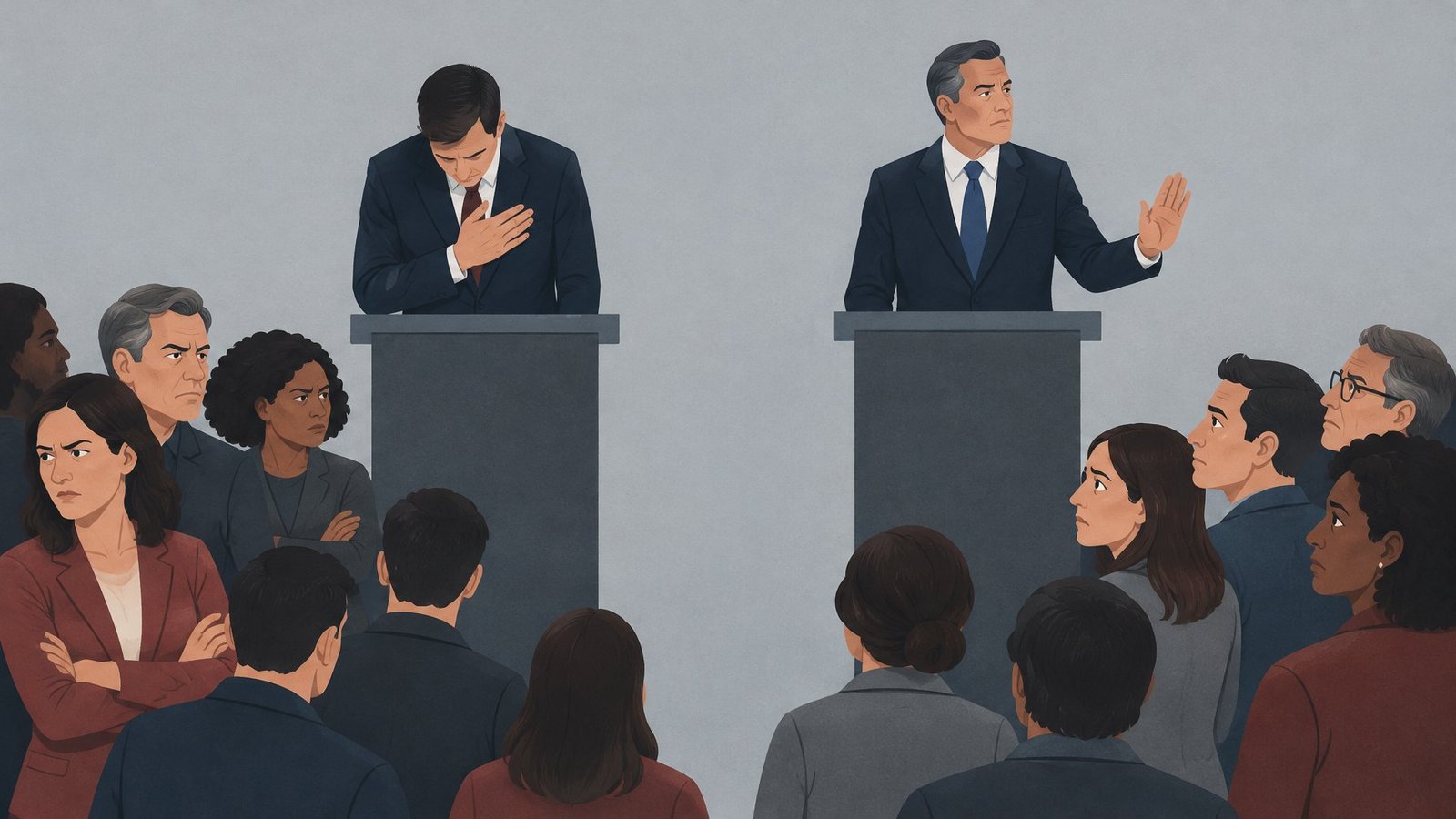
When a politician is caught up in a sex scandal, saying sorry is a losing strategy. Across a series of experiments, American voters consistently punished incumbents who apologized and went easier on those who flatly denied everything.
The study is by Bence Hamrak and Gabor Simonovits of Central European University in Vienna, Alex Rusnak of Comenius University in Bratislava and Ferenc Szucs of Stockholm University. It was published online on November 27, 2024, in the British Journal of Political Science and is open access.
The authors start from a puzzle. Politicians accused of sexual misconduct almost never apologize, even when the evidence looks strong, and the few who do often seem to pay for it.
A fictional congressman and 10,000 voters
The researchers ran three online survey experiments with more than 10,000 American adults. Each participant read a news-style story about a sex scandal involving a fictional member of Congress, John Miller.
Miller then either admitted the accusation and apologized, or denied everything and called the story ridiculous. Participants were asked how serious the accusation was, whether they believed it, and whether Miller should resign.
The first experiment, with 7,880 people, varied the accusation across five levels, from a long extramarital affair through sexting, harassment and sexual assault to rape. It also varied Miller’s party, making him a member of the respondent’s own party, the other party, or neither.
A second experiment with 998 people measured attitudes before and after Miller’s response. A third with 1,244 people added a piece of evidence supporting the charges, shown either before or after his statement.
Denial wins, and wins bigger as charges get worse
Apologies made people far more convinced the accusation was true, while denials only modestly reduced belief. Support for resignation was lower after a denial in every scenario.
The gap grew with the seriousness of the charge. Compared with an apology, a denial lowered support for resignation by 5.5 points for an extramarital affair, but by 18.6 points for rape.
Even for the scandals voters saw as least serious, apologizing never paid off. The second experiment showed denials reliably helped compared with saying nothing, while apologies earned no reward for minor scandals and actively hurt as the charges became more serious.
Partisanship shifted baseline judgements, since people saw accusations against their own side as less serious and less credible. But apologies did not win more favour from a politician’s own supporters than from the other side.
Even proof did not make sorry pay
The third experiment created what the authors thought would be ideal conditions for an apology, with evidence confirming the charge. An apology still had only a small and statistically insignificant softening effect.
Being caught lying barely mattered either. Voters who heard a denial and then saw the evidence backed resignation only about 1 percentage point more than those who saw the evidence alone. When a denial came after the evidence, it actually cut resignation support by about 4 points, by planting doubt.
The authors acknowledge that hypothetical scenarios with an unknown politician may not capture how voters react to real, familiar figures. They also note that their data do not show directly why voters dislike apologies.
Their conclusion is stark: in most cases, apologies “are simply not politically viable communication strategies.”
Study Details:
- Title: Why Politicians Won’t Apologize: Communication Effects in the Aftermath of Sex Scandals
- Authors: Bence Hamrak, Gabor Simonovits, Alex Rusnak, Ferenc Szucs
- Journal: British Journal of Political Science
- Publication Date: November 27, 2024
- DOI: 10.1017/S0007123424000292