
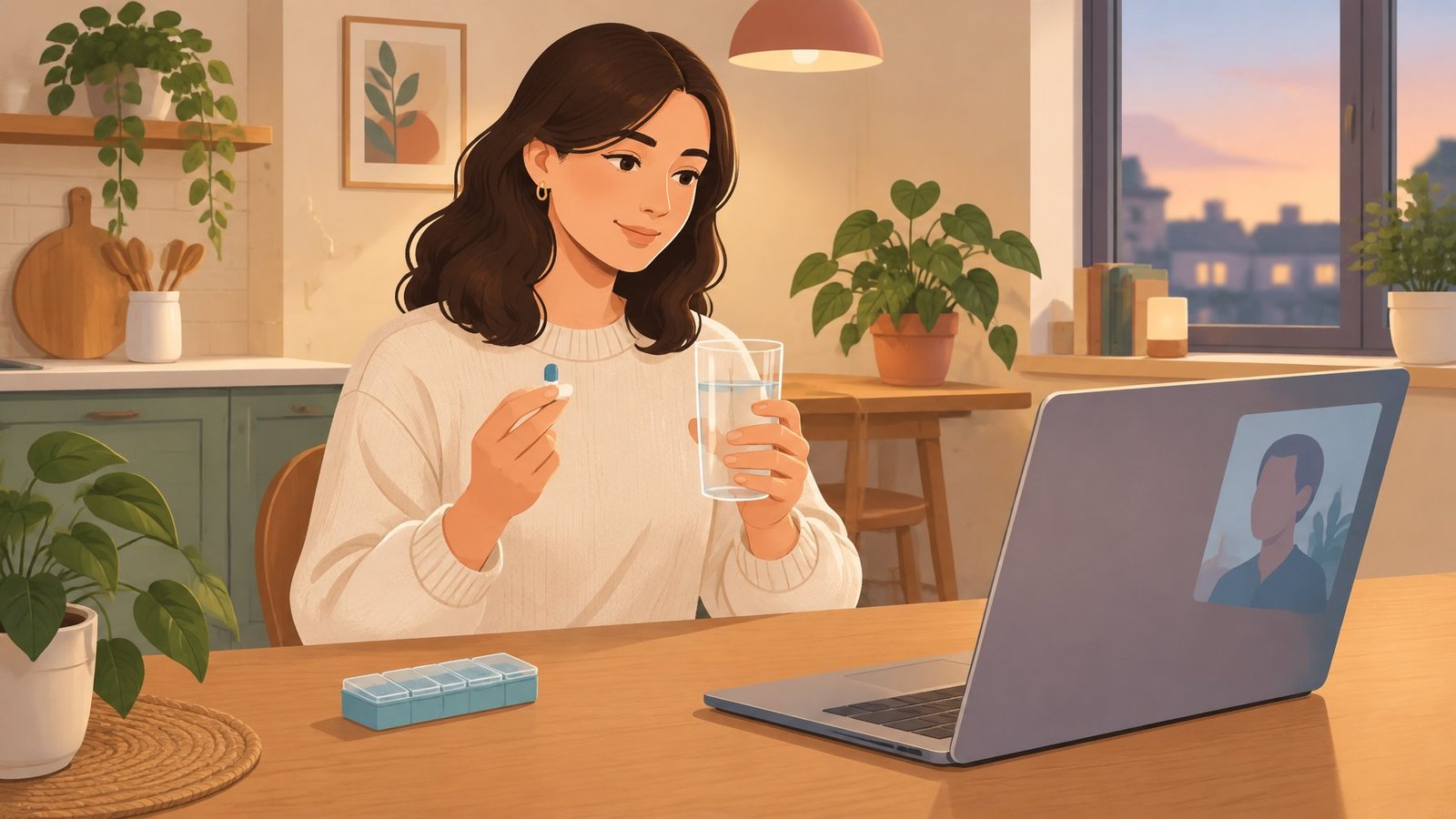
Placebos usually work because people believe they are getting real medicine. A new trial found that young adults under prolonged pandemic stress felt markedly better after two weeks of taking pills they were told contained nothing at all.
The study was led by Darwin Guevarra of Miami University in Ohio and the University of California San Francisco, with Christopher Webster, Jade Moros and Jason Moser of Michigan State University and Ethan Kross of the University of Michigan. It was published online on August 14, 2024, in the open-access journal Applied Psychology: Health and Well-Being.
A trial run entirely over Zoom
The researchers recruited Michigan residents aged 18 to 30 who reported moderate COVID-related stress, excluding anyone with a diagnosed mental health condition or taking psychiatric medication. Of 382 people screened, 64 were randomly assigned to either the placebo group or a control group that only completed assessments. After dropouts, 61 were analysed. Most were young women, with an average age of 21.
Everything happened remotely. People in the placebo group were mailed blue and white capsules containing only microcrystalline cellulose, an inert fibre. Over Zoom they watched two short videos explaining placebo effects and how placebos can work without deception, and saw evidence from earlier studies. They were then told to take one pill in the morning and one in the evening for two weeks. Adherence was high, averaging 92.5%.
Bigger drops across the board
Both groups improved over the two weeks, but the placebo group improved considerably more on every main outcome.
Depression scores in the placebo group fell from 22.69 to 12.93, while the control group went from 20.75 to 18.31. Overall stress fell from 22.52 to 15.00 with placebos, against 20.34 to 17.78 in controls. Anxiety dropped from 25.62 to 19.00, compared with 23.69 to 21.81. COVID-related stress fell from 34.93 to 22.28, versus 35.13 to 28.34.
The authors note that the effect sizes were comparable to those reported for a self-guided online cognitive behavioural therapy program, although that program ran for longer. Participants rated the placebo routine as easy to use, acceptable and appropriate.
People expected the pills to help, but their expectations did not significantly predict how much they improved. The authors suggest other mechanisms may be involved, such as conditioning from past experiences with real treatments.
Caveats from the authors
The trial was small and mostly made up of young, white women. Because pills had to be posted, the placebo group knew their assignment before baseline measures were taken. The placebo group also spent about 15 extra minutes with researchers watching videos and receiving instructions, and the control group had no matching activity, so extra attention could account for some of the effect.
The authors call for larger trials in other stressful situations and in clinical populations. For now, their result is a two-week routine of inert capsules, taken openly as placebos, that left the young adults who used it reporting substantially less depression.
Study Details:
- Title: Remotely administered non-deceptive placebos reduce COVID-related stress, anxiety, and depression
- Authors: Darwin A. Guevarra, Christopher T. Webster, Jade N. Moros, Ethan Kross, Jason S. Moser
- Journal: Applied Psychology: Health and Well-Being
- Publication Date: August 14, 2024
- DOI: 10.1111/aphw.12583