
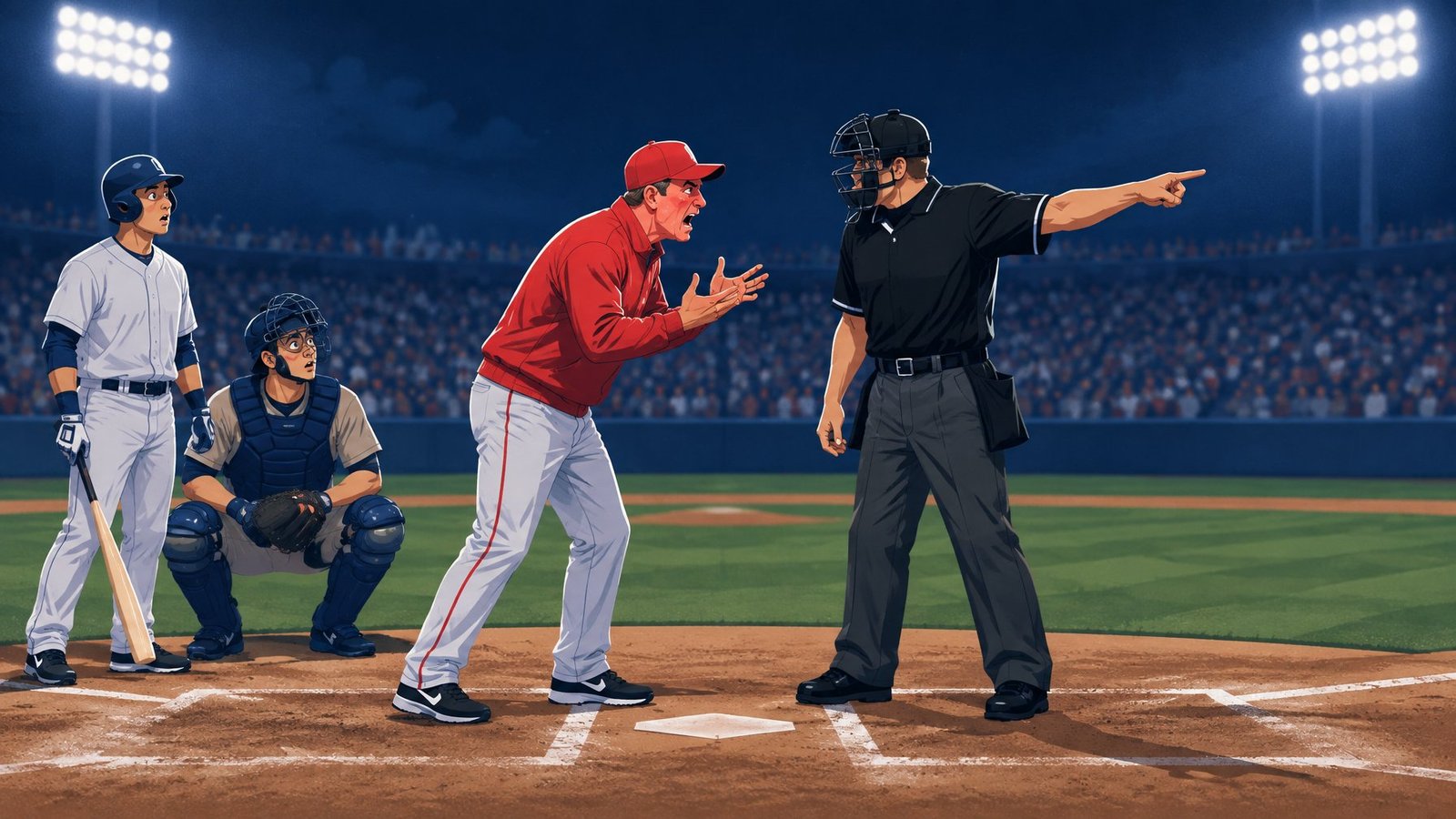
Screaming at an umpire about balls and strikes gets a player or coach thrown out of the game. It also seems to pay off for the rest of the team. After such an ejection, Major League Baseball umpires called fewer strikes on the complaining team’s batters and more strikes on the opposing team’s batters.
The study is by Joël Guérette, Caroline Blais and Daniel Fiset of the Université du Québec en Outaouais. It was published online in Psychological Science on February 20, 2024, and appeared in the journal’s March 2024 issue.
Every pitch after an ejection
The researchers collected every MLB ejection from the 2010 through 2019 seasons, ending before the pandemic brought games without spectators. Their final sample held 1,204 ejections from 1,001 games, involving 110 home-plate umpires.
From those games they pulled pitch-tracking data and kept only pitches the batter did not swing at, so the umpire had to make a call. That left 153,255 pitches.
To judge each call fairly, they first built a model of how likely any pitch is to be called a strike based on its location, the count, the season and the pitch type, using games without ejections. That model correctly predicted 90.58% of umpires’ strike calls. They then compared what umpires did before and after an ejection, for the ejected team and its opponent.
A two-sided advantage
For ejections over strike-zone complaints, the odds that a pitch to the complaining team would be called a strike fell after the ejection, by about 30% in one analysis (odds ratio 0.698). At the same time, the odds of a called strike against the opposing team’s batters rose by about 24% (odds ratio 1.238).
Before the ejection, umpires had been calling strikes in a way that disadvantaged the team that later complained. After it, the balance tipped the other way. The authors describe this as “a two-sided advantage for a team.”
Not an apology for the ejection
One possible explanation is that umpires feel bad about weakening a team and try to make up for it. The authors tested this in several ways and found little support.
Ejections for other kinds of verbal abuse, or for aggression toward the other team, produced no change in strike calls. The effect appeared only when the complaint was specifically about the strike zone.
The value of the person ejected did not matter either. All-Star status, number of All-Star appearances, years in the league and wins above replacement made no difference. Ejected coaches, who matter less to the outcome than players, produced a slightly larger benefit for their team.
The authors suggest umpires experience verbal aggression as a social punishment and shift toward the aggressor’s view to avoid more of it.
The complaints were often justified
The authors note a key caveat. In their data, the complaining team often had a point, since calls before the ejection really did go against it. Laboratory studies will be needed to see whether aggression still works when the grievance is unfounded.
They also note that MLB umpires are the best in their field and the most able to recognise their own mistakes. Officials in lower leagues, other sports or with less experience may react differently, and data on ejection reasons are not available outside the major leagues.
Study Details:
- Title: Verbal Aggressions Against Major League Baseball Umpires Affect Their Decision Making
- Authors: Joël Guérette, Caroline Blais, Daniel Fiset
- Journal: Psychological Science
- Publication Date: February 20, 2024
- DOI: 10.1177/09567976241227411