
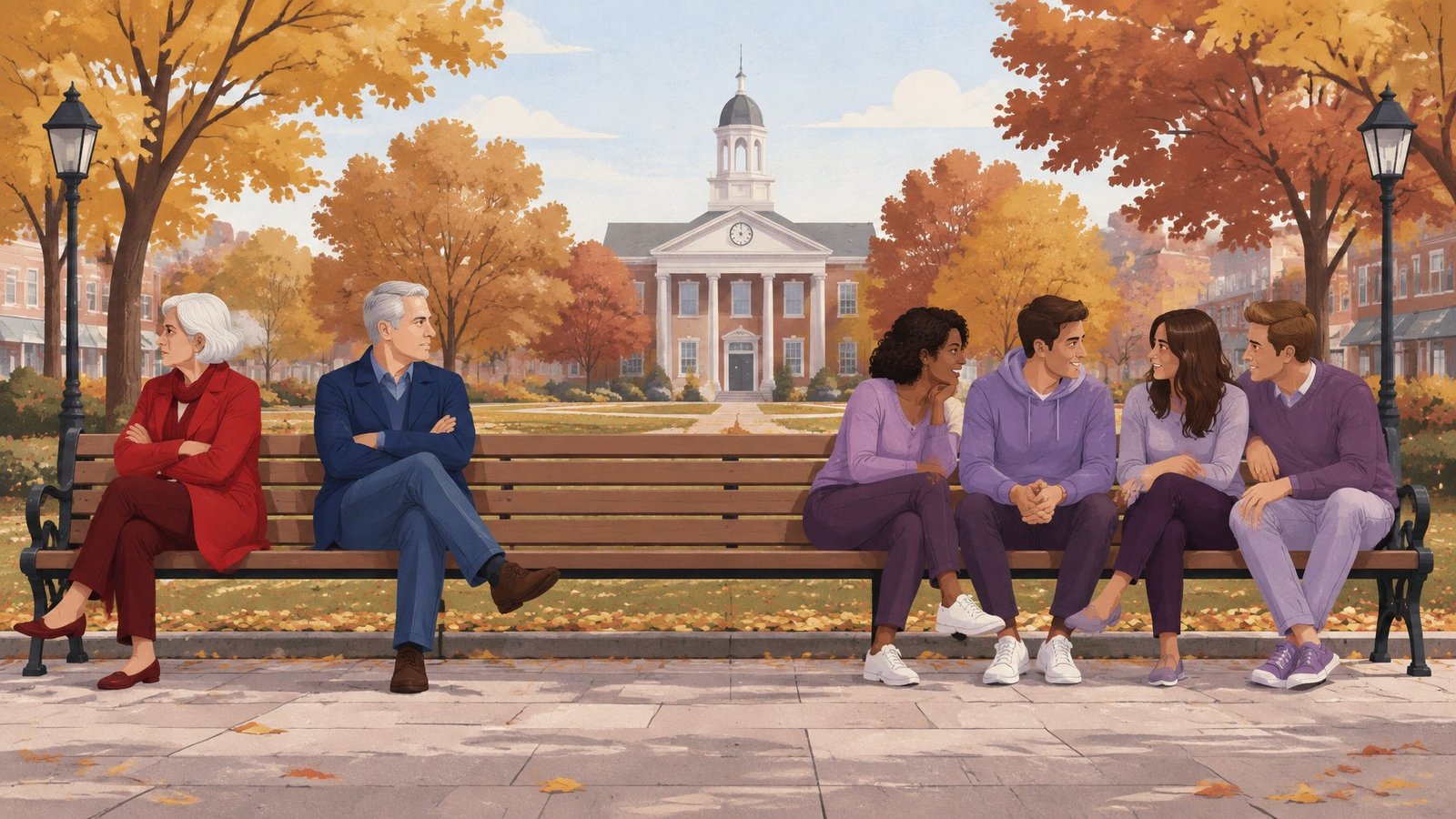
America’s political divide is growing, but not because young people are replacing their more moderate elders. A study of five decades of survey data finds that newer generations are, on several issues, less polarized than the generations before them, and that the rise in polarization comes from people of all ages lining up their views with their party.
Thomas Jocker and Wouter van der Brug of the University of Amsterdam and Roderik Rekker of Radboud University and the University of Gothenburg reported the findings in “Growing Up in a Polarized Party System: Ideological Divergence and Partisan Sorting Across Generations,” published online in Political Behavior on February 21, 2024.
The authors expected the opposite. Political views tend to form in early adulthood, so generations that came of age while party elites were pulling apart might be expected to carry more polarized views for life.
Two kinds of polarization
The team separated two things that are often lumped together. Ideological divergence is how far people’s views spread apart. Partisan sorting is how closely people’s issue positions line up with their party identity, so that Democrats hold liberal views and Republicans conservative ones across the board.
They drew on the General Social Survey and the American National Election Studies, covering 1972 to 2021, and looked at five areas: social welfare, race and gender, culture and morality, immigration, and whether people call themselves liberal or conservative. Statistical models separated the effects of age, of the survey year and of the generation people were born into, from the Greatest generation (born 1910 to 1927) to Millennials (1981 to 1996). Gen Z was left out because there were too few respondents.
Sorting rose within every generation
Partisan sorting increased strongly over time on every issue. Sorting on liberal versus conservative self-placement rose from 0.25 in 1974 to 0.78 in 2021, and sorting on immigration went from 0.00 in 2008 to 0.49 in 2020. Ideological divergence grew far less, mainly on self-placement and social welfare.
But these increases were “clearly driven by changes within generations rather than by generational replacement,” the authors write. Baby Boomers were the most sorted generation on most issues, while Millennials were among the least, and the second least sorted on social welfare. Millennials were also one of the least ideologically diverged generations, and older generations tended to be more diverged overall.
Newer generations were also significantly more liberal than older ones on every issue dimension. The authors argue that an electorate becoming more diverse, better educated, less Protestant and more liberal tends to dampen polarization over time, although rising education pushes sorting up.
The limits of the finding
The authors caution that their data show correlations, not causes, and that some results shifted between datasets: in the election study data, Millennials came out as the most sorted generation on race and gender, though not by a significant margin. They also found that people grow slightly more conservative and more polarized as they age, roughly until their late 20s.
Their conclusion is that the year matters far more than the birth cohort. Polarization in the US has been driven by shifts that hit every generation at once, and as Boomers are replaced, the newcomers entering the electorate are, on many issues, less divided than the people they replace.
Study Details:
- Title: Growing Up in a Polarized Party System: Ideological Divergence and Partisan Sorting Across Generations
- Authors: Thomas Jocker, Wouter van der Brug, Roderik Rekker
- Journal: Political Behavior, Volume 46, pages 2263-2286
- Publication Date: February 21, 2024
- DOI: 10.1007/s11109-024-09917-x