
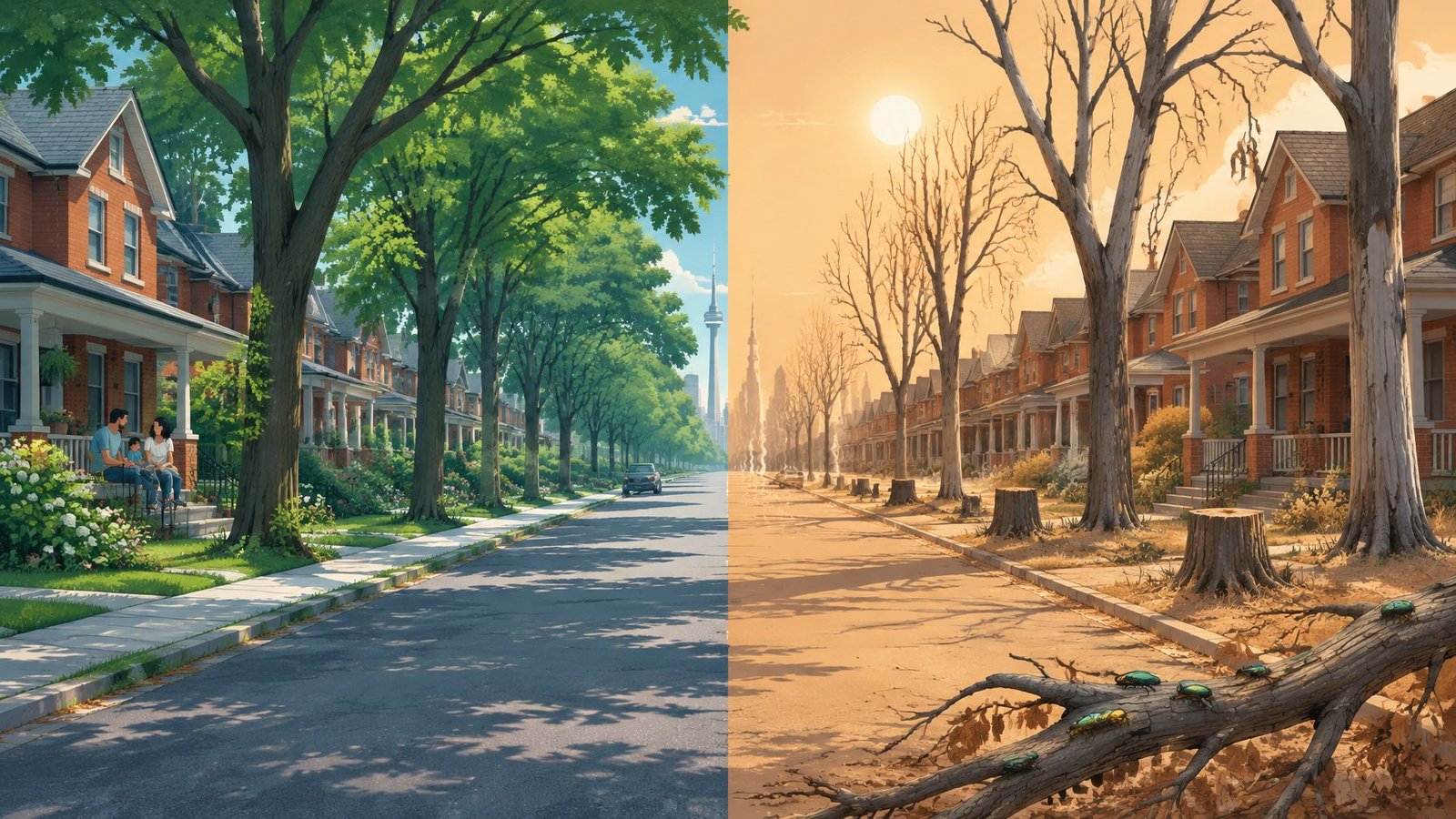
A single street tree is worth real money to the people who live near it. When an invasive beetle wiped out ash trees across Toronto, the neighbourhoods that lost the most canopy saw home prices fall by about 7%.
The estimate comes from economists Lu Han and Christopher Timmins of the University of Wisconsin, Stephan Heblich of the University of Toronto and Yanos Zylberberg of the University of Bristol. Their paper, “Cool cities: The value of urban trees,” was released as an NBER working paper on January 22, 2024, and revised in April 2024.
A beetle as a natural experiment
Measuring what trees are worth is tricky. Leafy streets often come with good schools and other perks, so a simple comparison of prices would overstate the value of the trees themselves.
The authors used the Emerald Ash Borer, an insect accidentally imported from Asia, to get around that problem. The beetle feeds only on ash trees, and Toronto expected to lose most of its 860,000 ash trees within a decade of the first signs of infestation around 2007. That came to roughly 8% of the city’s tree canopy.
Because ash trees had been planted unevenly, often to replace elms killed by Dutch elm disease decades earlier, some postal codes lost far more cover than others for reasons unrelated to local house prices. The team combined city canopy surveys from 2007 and 2018, a register of every city-managed tree across Toronto’s 45,000 postal codes, property sales from 2007 to 2020 and monthly electricity and gas meter readings.
One tree adds 0.45% to property prices
Adding one tree to a postal code raised property prices there by 0.45%. Put another way, each extra percentage point of tree cover lifted values by about 1%.
Neighbourhoods where ash made up most of the city-managed trees before the infestation lost 7 percentage points of canopy and saw a 7% drop in property prices. The authors found no sign that prices in these areas were already moving differently between 2002 and 2006.
The researchers also found that the extra benefit of a new tree was much larger in areas that already had plenty of cover, which they argue helps explain why tree-poor neighbourhoods tend to stay that way.
Cooler summers and lower power bills
Part of that value is shade. Each additional percentage point of tree cover cut the average July and August land surface temperature in a postal code by 0.05 degrees Celsius and reduced summer energy use by about 2.5%, worth around CAD 5 per household per month.
Scaled up, the authors calculate that the energy savings from one tree across a typical postal code of about 20 households exceed CAD 100 a year. That is an order of magnitude more than the roughly CAD 4.20 annual maintenance cost per tree given in Toronto’s 2011 Parks and Forestry budget proposal.
Yet the cooling effect explains only a small share of what buyers pay. Even under an extreme warming scenario, the authors estimate climate change would at most double the energy-saving premium by 2050, still “one order of magnitude too small” to explain the price premium. The rest is amenity: people simply value living among trees.
Study Details:
- Title: Cool cities: The value of urban trees
- Authors: Lu Han, Stephan Heblich, Christopher Timmins, Yanos Zylberberg
- Journal: NBER Working Paper No. 32063
- Publication Date: January 22, 2024
- DOI: 10.3386/w32063