
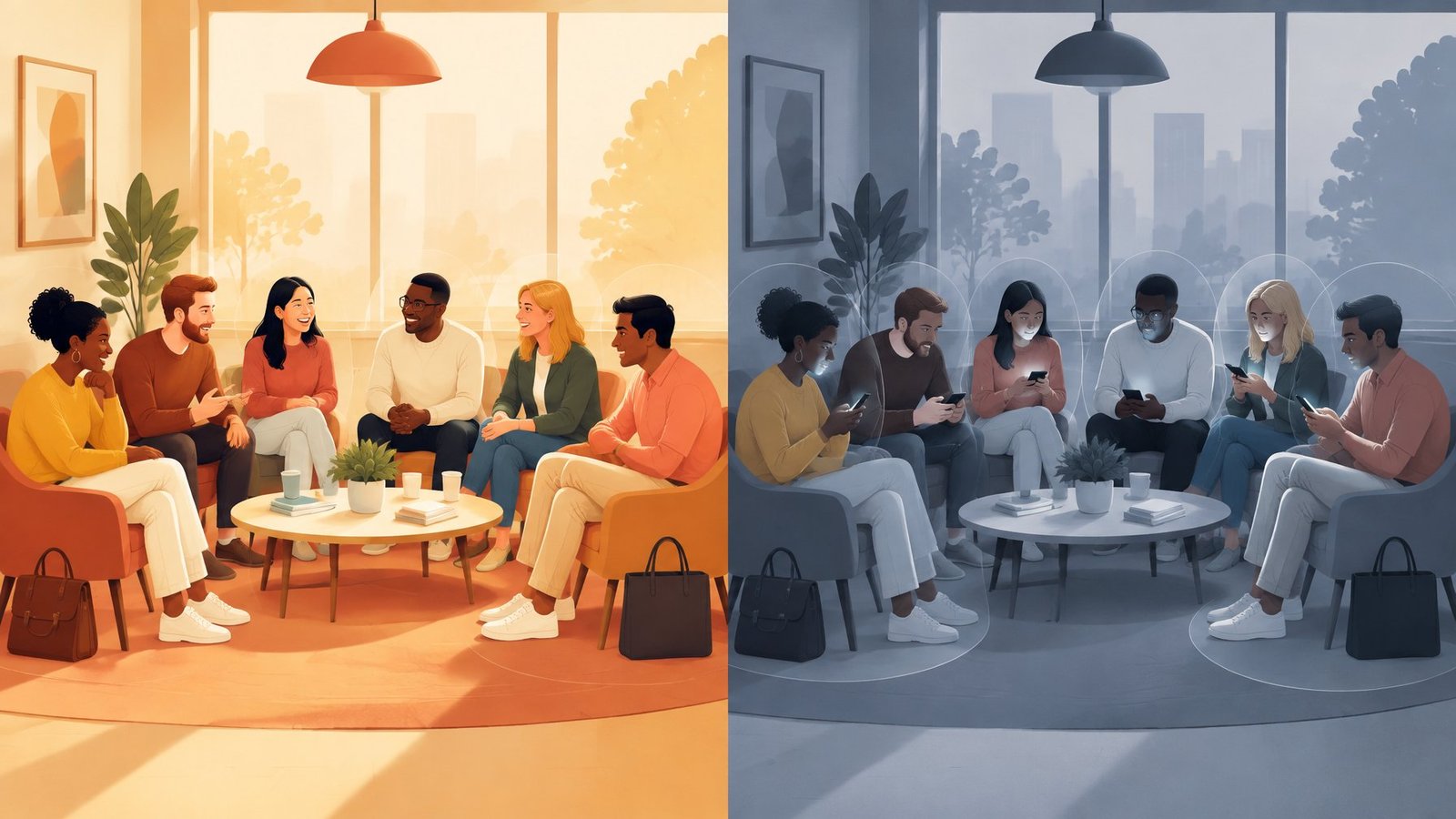
Strangers who spent 20 minutes together without their phones behaved more honourably toward each other afterwards. In a trust game, people who had waited phone-free sent back 116% of the amount their partner had invested, while those who had kept their phones returned only 91%.
The experiment was run by Sandy Campbell, a PhD candidate at UC Berkeley’s Haas School of Business, and Uri Gneezy, a behavioural economist at UC San Diego’s Rady School of Management. It was published online in the Journal of Economic Psychology on February 22, 2024.
A waiting room with or without phones
Between October 2019 and February 2020, the researchers brought groups of six students into a lab at UC San Diego and sat them around a table. One by one, each was taken out for paperwork, so everyone waited roughly 20 minutes with the others.
In half the groups, participants had to switch off their phones and put them in their bags. In the other half they could use them freely. Nobody was told to talk; they could interact as they wished. The final sample was 240 people in 40 groups.
Then everyone played a classic trust game with a randomly chosen, anonymous partner from the room. An investor received $5 and could send any part of it to a partner; the amount sent was tripled. The partner then chose how much to send back. Returning more than was sent is a sign of trustworthiness.
More reciprocity, same trust
Partners in the phone-free groups returned on average 1.16 times what investors had sent, compared with 0.91 times in the phone groups. The difference just missed conventional significance on a two-sided test (p = .060), but the authors had preregistered a directional prediction, and it was significant when they pooled the data with an earlier pilot. In dollar terms, phone-free partners sent back $4.10 on average versus $3.50.
Investors’ trust did not differ: they sent about $3.46 without phones and $3.48 with them, as the researchers had predicted based on the pilot.
There was a twist. Phone-free investors who had not spoken to anyone sent only $2.55, less than any other group, while those who had chatted sent $3.66. The authors suggest that sitting in silence with no phone to hide behind is awkward, but once someone breaks the ice the experience improves.
Phones crowd out small talk
Without phones, 82.5% of participants said they had spoken to someone in the room, against 62.5% of those with phones. When asked to recall names, years and majors of others, participants got only about 4 of 15 right on average; many said they had talked about the weather or about taking part in experiments rather than swapping personal details.
The authors argue that by removing the need to talk to strangers, smartphones may widen the social distance between people who share a room, and with it the willingness to repay trust.
Study Details:
- Title: Smartphone use decreases trustworthiness of strangers
- Authors: Sandy Campbell, Uri Gneezy
- Journal: Journal of Economic Psychology
- Publication Date: February 22, 2024
- DOI: 10.1016/j.joep.2024.102714