
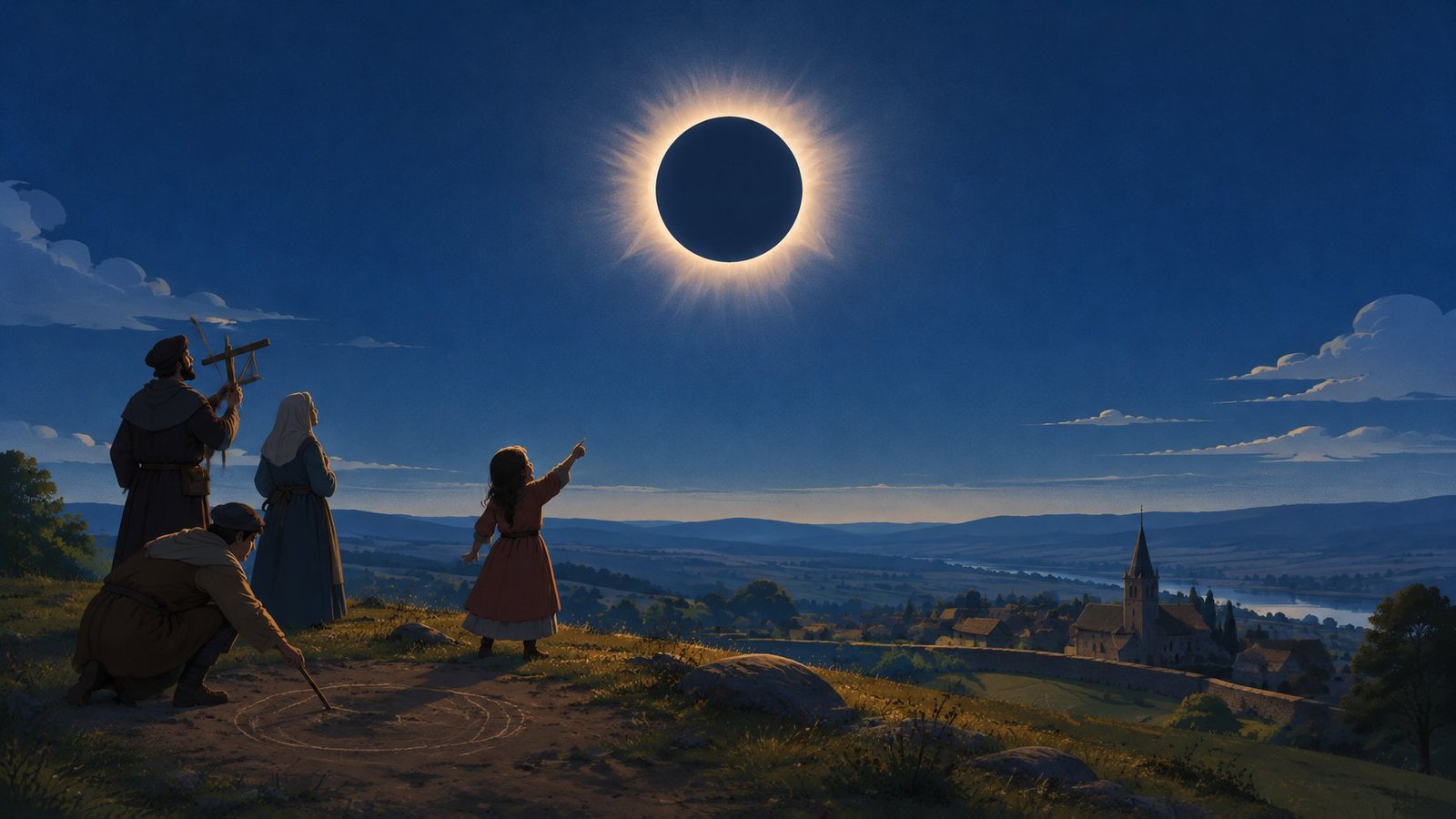
Societies that witnessed more total solar eclipses grew denser and more technologically complex, and people who saw one as children were more likely to become scientists, according to a study that links curiosity to long-run economic development.
Anastasia Litina of the University of Macedonia and Èric Roca Fernández of Université Clermont Auvergne published “Solar Eclipses and the Origins of Critical Thinking and Complexity” in The Economic Journal on December 27, 2023.
Why eclipses
The authors propose that inexplicable natural events spark curiosity, and that the mental effort of trying to understand them builds human capital and technology over time.
Total solar eclipses suit the test because they are among the most impressive natural phenomena, turning day into night, and yet harmless. Earthquakes, eruptions and floods also pose puzzles, but their destruction diverts effort to rebuilding.
Using a catalogue of eclipses from 1999 BCE to 3000 CE, the authors mapped paths of totality onto the homelands of more than a thousand ethnic groups in Murdock’s Ethnographic Atlas, onto historical polities in the Seshat database, and onto countries.
Denser, more complex societies
More eclipses went with higher population density. Moving a society from the 10th to the 90th centile of eclipse exposure shifted its predicted population density from the lowest level to the top category, cities of more than 50,000 people.
Exposed societies also showed signs of more intricate thinking and more developed technology. The authors looked at written language, the playing of strategy games rather than games of luck or strength, the accuracy of folk explanations for eclipses, and the number and complexity of tasks a society undertook.
Folklore carried the mark. Moving from the 10th to the 90th centile of eclipse exposure raised the predicted number of eclipse mentions in a society’s tales from 4.04 to 5.38. Words related to curiosity also became more common, by around 13% of the sample average.
Eclipse children and science careers
For individuals, the authors used Wikidata records of 150,260 people born between 1600 BCE and 1800 CE and checked whether a total eclipse was visible from their birthplace between the ages of 5 and 15.
Those exposed were about 7.19% or 3.96% more likely to become scientists, depending on how the sample was weighted. For comparison, 8.62% of the people in the data followed a scientific career.
One example in their data is the Swedish scholar Johannes Browallius, born in Västerås, which lay in the path of totality of the eclipse of May 3, 1715, when he was eight. He later worked as a physicist, botanist and priest, among other roles.
Eclipse exposure did not make people more likely to enter religious occupations, and religion-related words in folklore did not rise with eclipses, which the authors take as evidence that religion is not the channel. A set of placebo tests also points to curiosity.
The paper was previously circulated under the title “The Terror of History: Solar Eclipses and the Origins of Critical Thinking and Complexity”.
Study Details:
- Title: Solar Eclipses and the Origins of Critical Thinking and Complexity
- Authors: Anastasia Litina, Èric Roca Fernández
- Journal: The Economic Journal
- Publication Date: December 27, 2023
- DOI: 10.1093/ej/uead117