
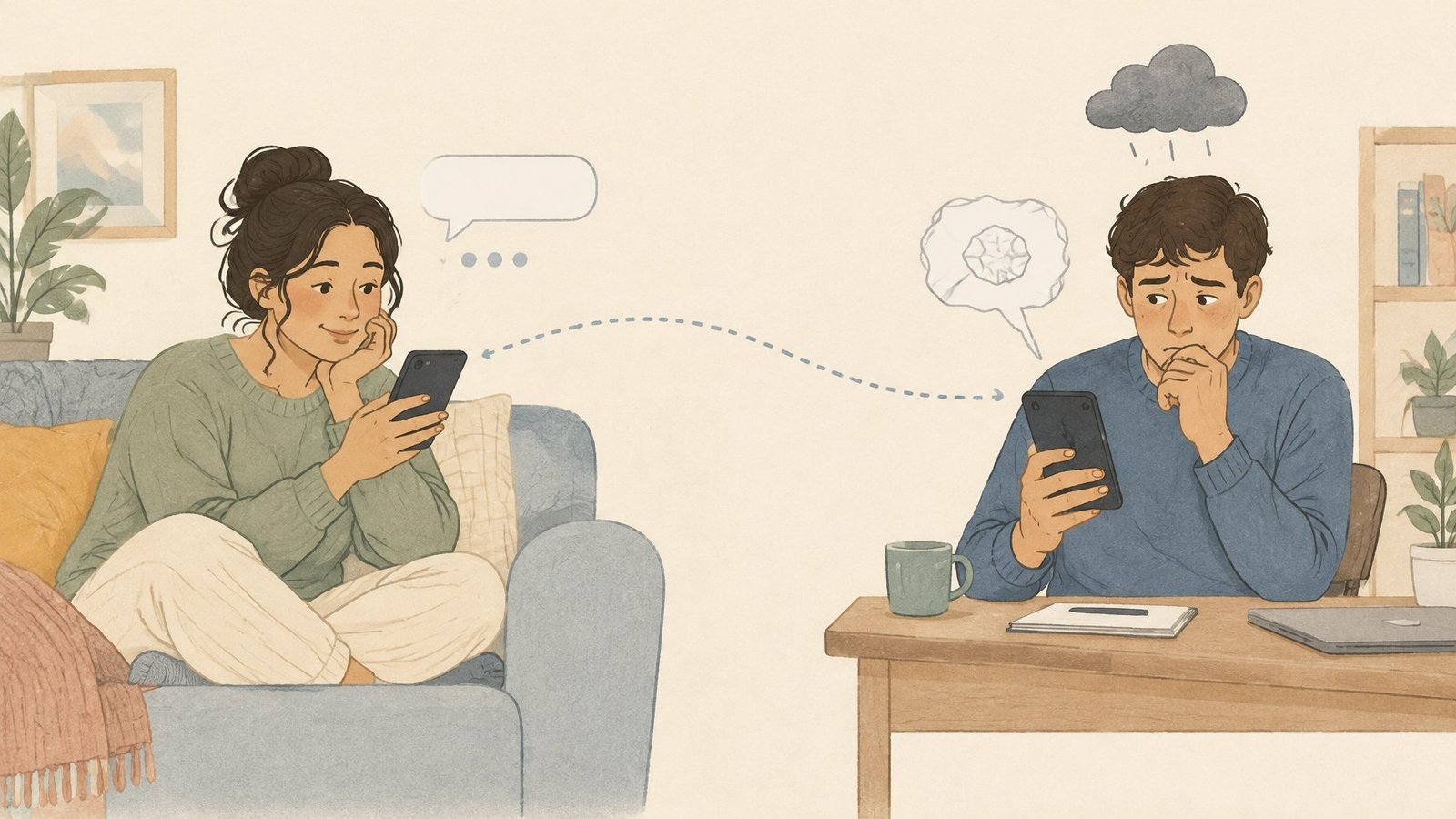
People who stop answering messages usually feel worse about it than the person left waiting realizes. Across three studies with more than 1,100 participants, those who had been ghosted consistently underestimated the guilt and discomfort of the person who went quiet.
The gap was largest when the silence was accidental. It shrank when the ghoster sent even a brief reply such as “Sorry, but I can’t talk right now.”
The study, titled “The Pain of Ghosting? People Underestimate How Bad Their Conversation Partners Feel About Not Responding,” was written by Sophia Li and Juliana Schroeder of the University of California, Berkeley, Haas School of Business and Coral Zheng of the University of Cambridge Judge Business School. It was published online in Personality and Social Psychology Bulletin on August 31, 2026.
Looking at the other side of the silence
Most research on ghosting asks how it feels to be ghosted. Li, Zheng and Schroeder asked the reverse: does ghosting hurt the ghoster, and does the other person see it?
They used a broad definition. Ghosting, in their view, is any unexplained silence in which at least one person thinks the other may never reply, whether or not the relationship actually ends.
Three ways of testing it
In the first study, 195 adults recruited online checked their phones and recalled the last time they had stopped replying to someone, or someone had stopped replying to them. The other person was an acquaintance or casual friend, not a close friend or family member.
On a scale from 1 (not bad at all) to 5 (extremely bad), ghosters rated their own feelings at 2.27 on average. People who had been ghosted guessed the ghoster felt 1.56. Ghosters reported more guilt and sadness than expected, but also more relief.
The less deliberate the ghosting, the worse the ghoster felt, and the ghosted side did not pick up on this. Among accidental cases, the gap roughly doubled: 2.62 against a guess of 1.50.
In the second study, 601 people imagined a text exchange with a friend they did not know well. Imagining that they had ghosted the friend, people rated their bad feelings at 3.23, while those imagining being ghosted predicted 1.94. With a short reply instead of silence, the gap narrowed to 2.33 against 1.82.
The short reply also changed how people explained the silence. When ghosted, they split evenly between thinking the friend was busy, bored or annoyed with them. After a short reply, 58 percent assumed the friend was simply busy.
A live test with mixed results
The third study staged ghosting in real time. After an eight-minute online chat between strangers, one person could skip a second conversation, leaving the partner waiting alone in the chat window for five minutes. In 175 pairs, someone did skip.
Here the overall gap disappeared. It returned only among participants who saw the skip as ghosting. Many ghosters did not see it that way: they rated their behavior as less of a ghosting than their partners did.
Ghosted partners also badly misjudged interest. They thought the ghoster had little wish for a friendship, rating it 1.53 on a five-point scale, while ghosters themselves put it at 2.58.
What the results do and do not show
All participants lived in the United States, and the authors note that norms about indirect communication vary between cultures. The live study involved strangers who expected never to meet again, and ghosting cannot be freely assigned in real relationships, so the studies mostly capture early-stage or brief connections.
The authors argue that underestimating a ghoster’s distress may make people less willing to reconnect. Their practical advice is modest: a quick acknowledgment, even a perfunctory one, helps both sides read each other more accurately.
Study Details:
- Title: The Pain of Ghosting? People Underestimate How Bad Their Conversation Partners Feel About Not Responding
- Authors: Sophia Li, Coral Zheng, Juliana Schroeder
- Journal: Personality and Social Psychology Bulletin
- Publication Date: August 31, 2026 (online)
- DOI: 10.1177/01461672261478732