
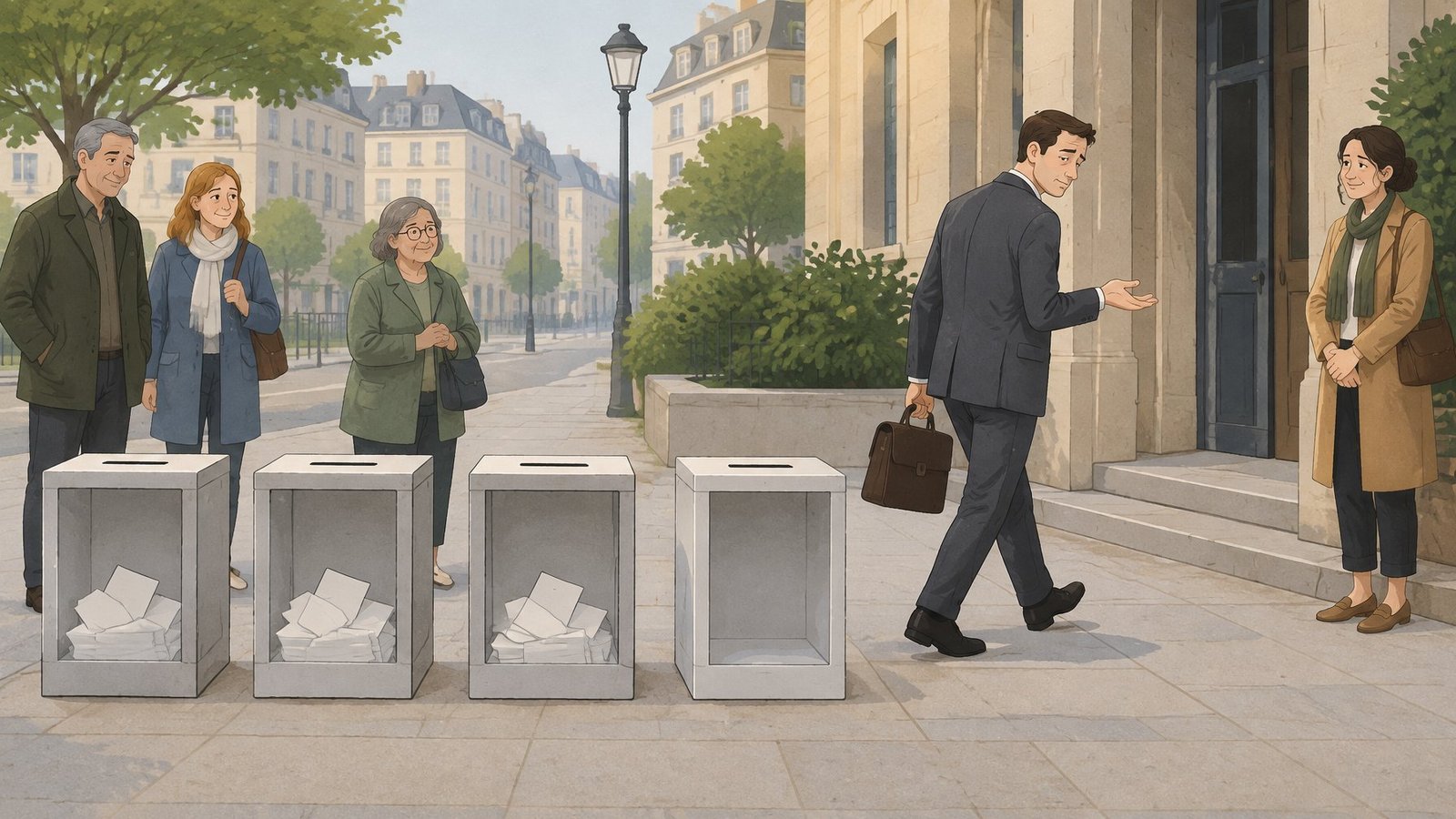
The more often people are asked to vote, the easier it becomes to forgive someone who stays home. In a survey experiment across five European countries, each extra election made abstaining look more acceptable.
The study is by Filip Kostelka of the European University Institute in Florence and the University of Essex. It was published online on June 19, 2025, in the British Journal of Political Science.
Earlier research had shown that frequent elections depress turnout and help explain its decline worldwide, but not why. Kostelka tested one explanation: that frequent elections weaken the social norm that good citizens vote.
The story of Peter
The pre-registered experiment ran online from November 21 to December 11, 2023, in Czechia, France, Poland, Romania and Slovakia. All five hold many kinds of elections. Quota samples gave about 2,450 respondents per country, 12,221 in total.
Each respondent read one of five short stories about Peter, a regular voter who felt busy at work and skipped a legislative election. In the control version, that was the only election of the year.
In three versions, Peter had already voted once that year, in a presidential, municipal or European Parliament election. In the fifth, he had already voted in three elections before skipping the fourth.
Respondents rated Peter’s decision on a scale from 0, totally unacceptable, to 10, totally acceptable.
Each election lowers the bar
In the control group, acceptance averaged 4.48. Any prior election raised it by 0.21 points, about 4.5%, and by 0.27 points, about 6%, among respondents who passed a check showing they had read the story closely.
Three earlier elections raised acceptance by 0.40 points, about 9%. The gap between one prior election and three was statistically significant, showing the effect builds up.
The type of earlier election did not make a significant difference. A European Parliament election, often seen as low stakes, pushed acceptance up about as much as a presidential one.
No group was immune
People who see voting as a civic duty and people interested in politics were less forgiving of Peter overall. But they were just as sensitive to election frequency as everyone else.
The same held for women, older and more educated respondents, and people who had voted in the last legislative election. All were less approving of abstention, yet equally moved by the number of elections.
The results held when any one country was dropped and when basic demographic controls were added.
Kostelka argues the experiment probably understates the real effect. People judge others more harshly than themselves, Peter had a reasonable excuse, and the election he skipped was a high-profile legislative race, the kind least hurt by frequent voting in earlier research.
Study Details:
- Title: Understanding Voter Fatigue: Election Frequency and Electoral Abstention Approval
- Authors: Filip Kostelka
- Journal: British Journal of Political Science, Volume 55
- Publication Date: June 19, 2025
- DOI: 10.1017/S0007123425000171