
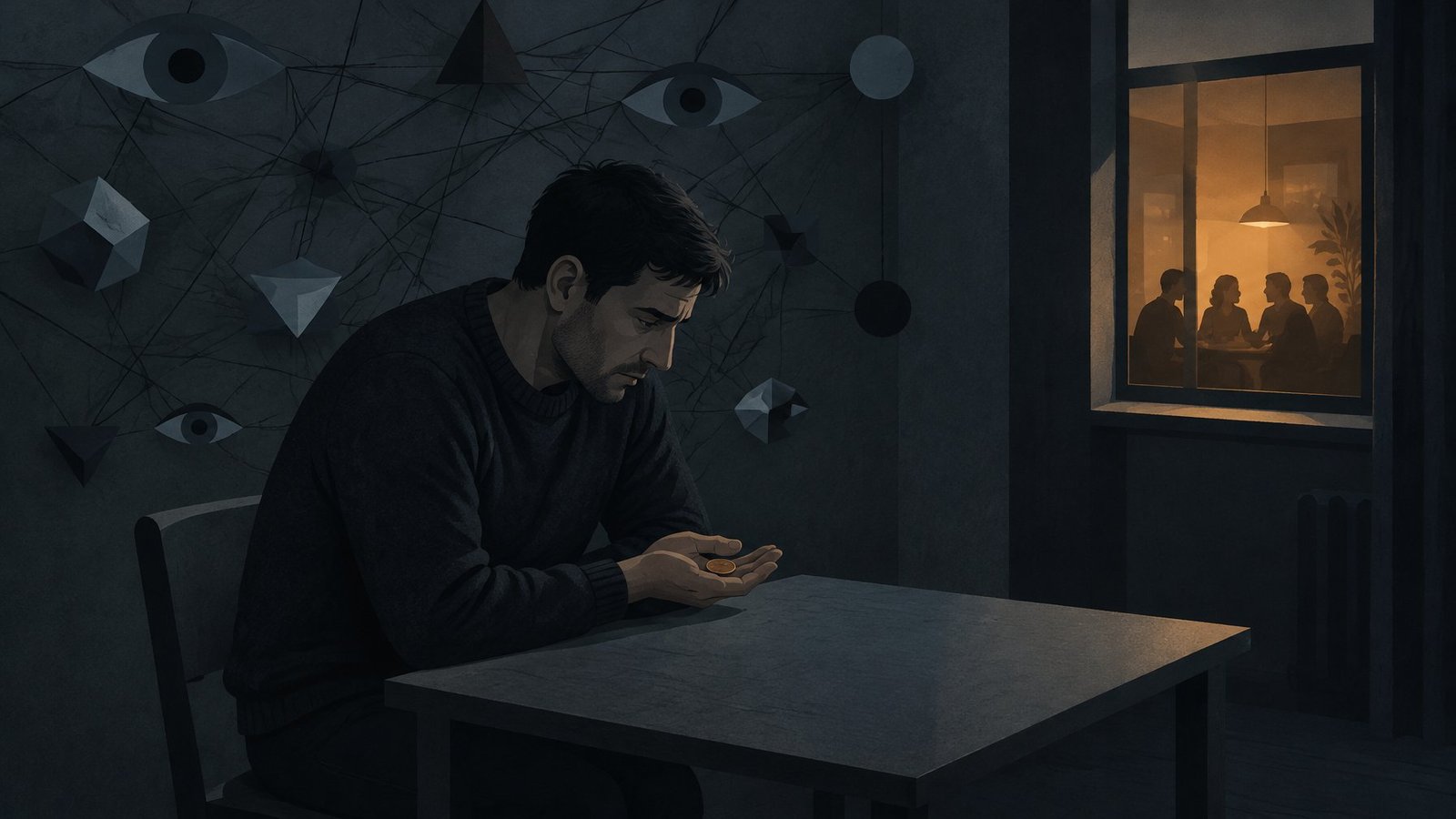
Feeling lonely goes hand in hand with conspiracy thinking, and conspiracy thinking goes hand in hand with a willingness to break the rules. Three British studies traced that chain all the way to an actual decision to refuse a small tax payment.
The research was conducted by Daniel Jolley and Rebecca Thomas of the University of Nottingham and Jenny Paterson of Northumbria University. It appeared in the September 2023 issue of Social Psychology.
From loneliness to rule-breaking
The first two studies surveyed 578 and 577 UK adults recruited through Prolific in July 2022. Participants rated how often they felt they lacked companionship, how often they had been ignored or excluded, and how far they agreed with statements such as the idea that seemingly unconnected events are often the result of secret activities.
They also rated non-normative political intentions, items ranging from refusing to pay taxes, fees or rents “to weaken the system” to violence against people in power.
In both studies, lonelier people scored higher on conspiracy thinking, and conspiracy thinking was in turn linked to stronger norm-breaking intentions, even after accounting for age, gender and political orientation. In the first study, being ostracised was linked to loneliness at the start of that chain, but this did not replicate in the second.
The second study also tested whether a strong sense of local community or self-compassion would weaken the link between loneliness and conspiracy beliefs. Neither did.
The 5 pence test
The third study, run in August 2022, added an experiment and a real behaviour. Of 234 participants included in the analysis, 131 were asked to recall and describe the loneliest period of their life, while 103 in a control group skipped that exercise.
Participants were then told their 80 pence payment carried 5 pence of VAT that legally had to go to the government. They could pay it, or refuse and take home 85 pence instead. The researchers later paid the VAT themselves and gave everyone the extra 5 pence.
Recalling a lonely time did make people feel lonelier. On its own, though, it did not change conspiracy beliefs, intentions or tax refusal: 48 people in the lonely group refused the VAT, compared with 44 in the control group, not a significant difference.
The chain showed up in a further, exploratory analysis. People made to feel lonelier reported more conspiracy thinking and stronger belief in specific claims, such as the government hiding vaccine harms. Those beliefs, in turn, were associated with norm-breaking intentions and with refusing to pay the VAT. The authors describe this as one of the first links between conspiracy beliefs and a measured behaviour.
Small effects, cautious claims
The authors stress that apart from the loneliness manipulation itself, the links are cross-sectional, so they cannot establish causality or rule out the reverse direction. The effect sizes were small, suggesting other factors are involved, and they caution against stretching a 5 pence VAT decision too far.
Still, the behaviour they measured was one participants knew to be a legal obligation, and that is the detail the authors highlight: the people who believed in conspiracies were more likely to pocket money that was owed to the state.
Study Details:
- Title: Refusing to pay taxes: Loneliness, conspiracy theorizing, and non-normative political action
- Authors: Daniel Jolley, Jenny L. Paterson, Rebecca Thomas
- Journal: Social Psychology
- Publication Date: September 2023
- DOI: 10.1027/1864-9335/a000529