
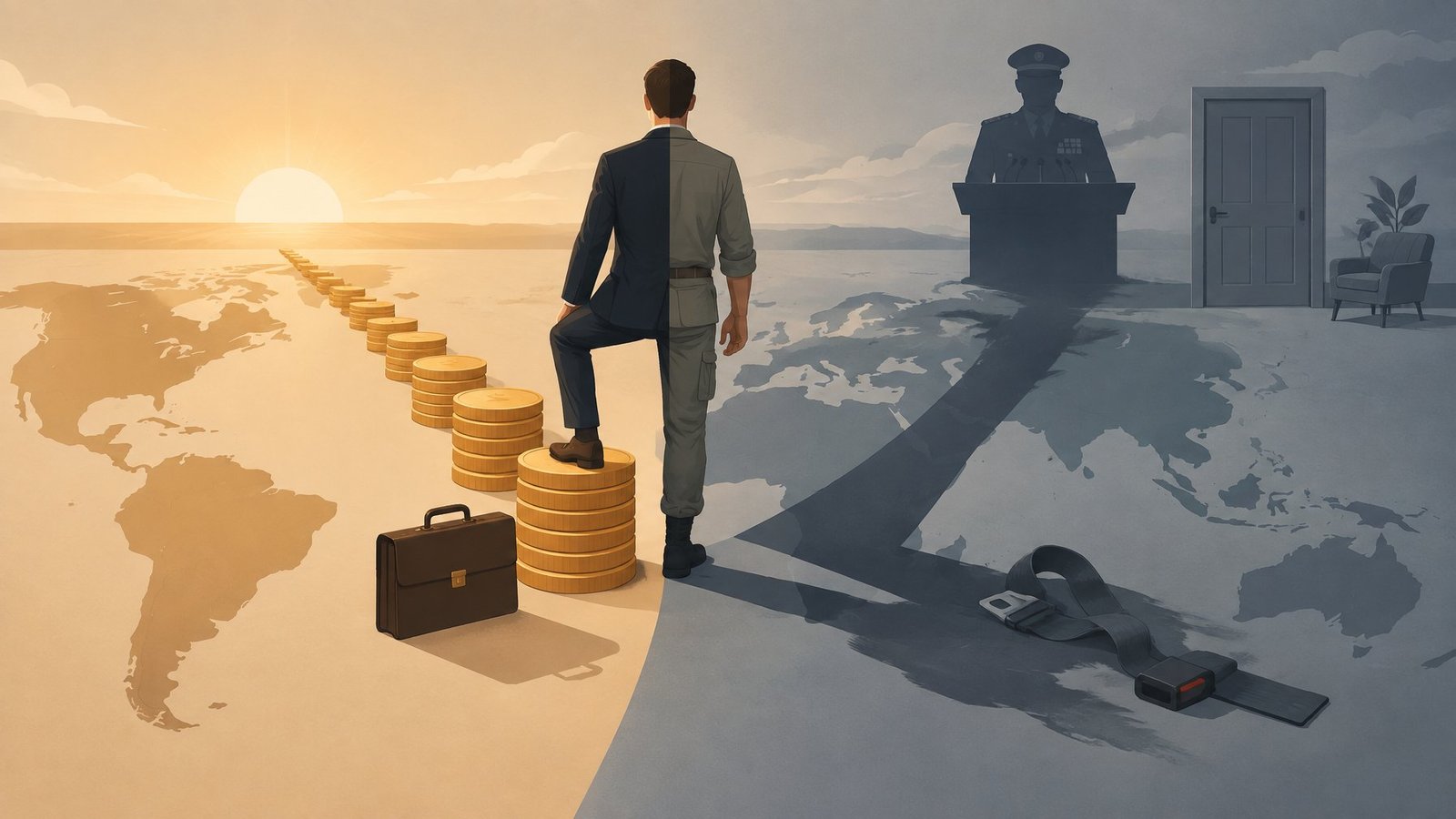
Men who sign up most strongly to traditional ideas of manhood work longer hours and earn a little more. They also take more risks with their health, report more depression and are more open to strongman rule and military government, according to a survey of 125,147 people in 70 countries.
The study, “Masculinity Around the World”, is by Ralph De Haas (EBRD, KU Leuven and CEPR), Victoria Baranov (University of Melbourne and CEPR), Ieda Matavelli (CERGE-EI and UNSW) and Pauline Grosjean (UNSW, Sciences Po and CEPR). It was released on August 7, 2026 as CESifo Working Paper No. 12906 and has not yet been peer reviewed.
Five statements that measure manhood
The team built what they call the Global Masculinity Survey. It combines face-to-face interviews from the Life in Transition Survey, run by the EBRD and the World Bank, with online surveys in 32 countries that collected 80,549 responses in late 2024 and mid 2025. Together the countries cover two thirds of the world population and 85% of global GDP.
Adherence to masculinity norms was measured with five statements drawn from a standard psychology scale. Respondents said how far they agreed that winning is the most important thing, that violent action is sometimes necessary, that asking for help bothers them, that they love it when men are in charge of women, and that it matters to them that people think they are heterosexual.
Adherence was strongest in North and Sub-Saharan Africa, the Middle East and South Asia, and weakest in Scandinavia and post-socialist south-eastern Europe. Among Western countries, men in the United States scored highest on winning, violence and self-reliance. Younger men scored higher than older men, while education made little difference.
More pay, worse mental health, less love for democracy
For every one standard deviation rise in a man’s score, earnings were about 3% higher and willingness to work longer hours rose by 5.2 percentage points. These men were also 2.4 percentage points more likely to work in agriculture, mining, construction, manufacturing or transport, a 7% increase on the average.
The health picture ran the other way. The same rise came with higher stated willingness to take risks, less seatbelt use, a 5.3 percentage point lower willingness to see a mental health professional and depression scores 0.15 standard deviations higher.
Politics showed the sharpest links. Men with higher scores were 3.6 points less likely to call democracy a good way to govern and 9 points more likely to back strongman leadership. Support for army rule rose by 7.3 points, a 23% increase on a baseline of 32%.
Women scored lower than men in every country. Differences in these norms accounted for 25% of the gender gap in willingness to work more, 23% of the gap in stated risk tolerance and 61% of the gap in support for a strong leader.
War and recession in early adulthood leave a mark
The authors also looked at where these attitudes come from. Men who lived through war in late adolescence or early adulthood scored 0.09 standard deviations higher, mostly on violence, winning and self-reliance. Living through a recession at that age raised scores by 0.08 standard deviations.
The researchers stress that the main results are correlations. In their words, the evidence “should not be interpreted as establishing a causal effect of masculinity norms on the outcomes considered.”
One pattern cuts against a common assumption: across countries, stronger masculinity norms went with higher GDP per capita, while traditional views on women’s roles went with lower GDP per capita.
Study Details:
- Title: Masculinity Around the World
- Authors: Ralph De Haas, Victoria Baranov, Ieda Matavelli, Pauline Grosjean
- Journal: CESifo Working Paper No. 12906
- Publication Date: August 7, 2026
- DOI: 10.65864/lce8ok8qlw