
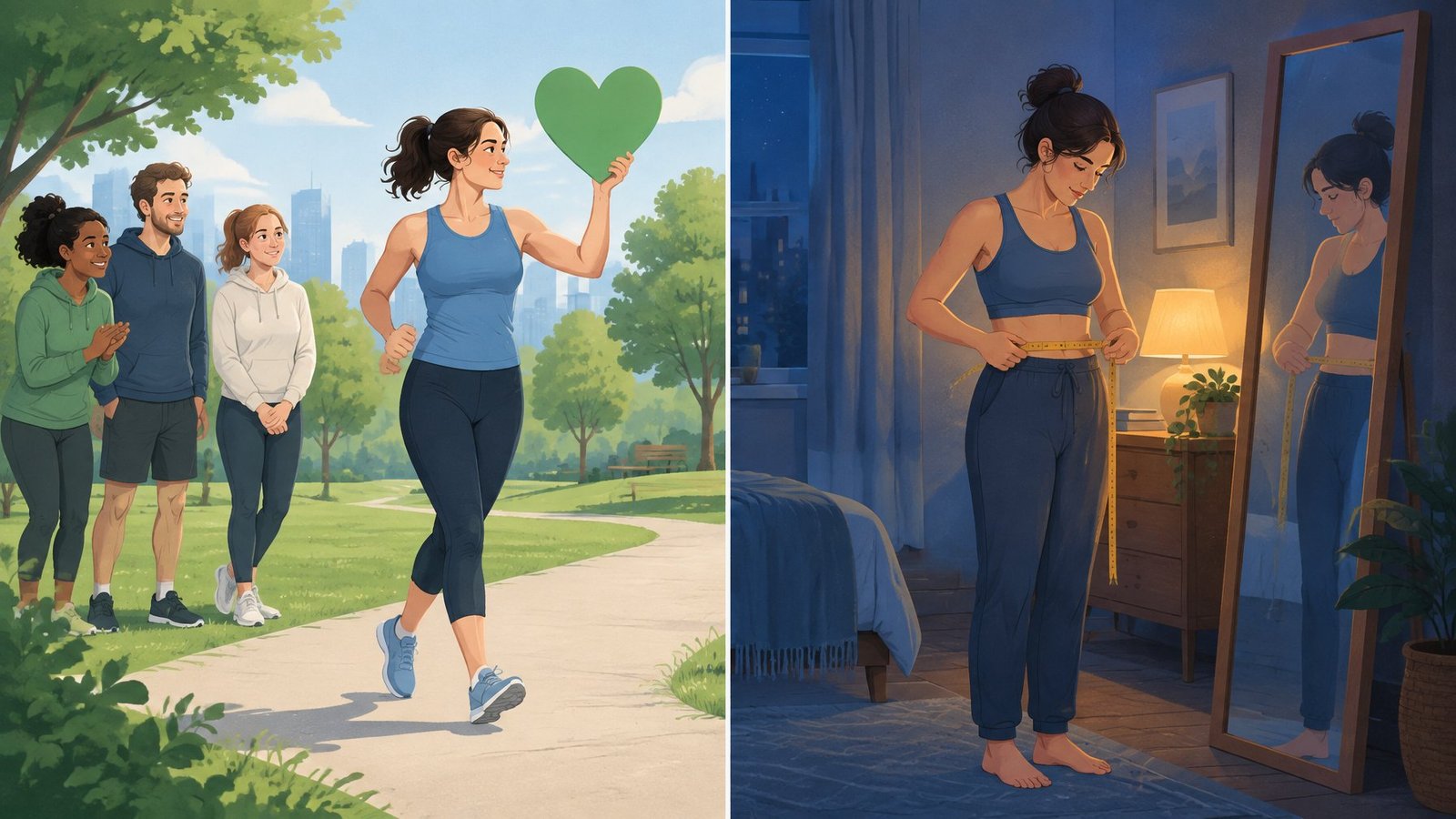
Many people who diet and exercise to look better tell the world they are doing it for their health. A set of experiments on Pinterest, Instagram and Facebook found that people hide appearance goals when others can see their choices, and switch back to them when they believe no one is looking.
The paper, “Health as an Alibi: The Virtuous Framing of Appearance Pursuits”, is by Stephanie C. Lin of INSEAD, Kaitlin Woolley of Cornell University’s SC Johnson College of Business and Peggy J. Liu of the University of Pittsburgh. It was posted to SSRN on October 28, 2025, and has been accepted for publication in Personality and Social Psychology Bulletin.
A gap between motives and values
Two pilot studies set up the puzzle. In anonymous surveys of 86 Singaporean undergraduates and 301 U.S. online workers, people said appearance motivated their diet and exercise more than their values said it should. Health motives, in contrast, were seen as the more virtuous reason.
The authors open with a line from the 2023 film Barbie that captures the bind: “You have to say you want to be healthy, but also you have to be thin.” Their argument is that people solve it by laundering vanity through the language of health.
Private boards, public comments
In Study 1a, 405 active Pinterest users chose fitness images framed either around appearance (a “beach body” challenge) or health (an “endurance” challenge) and actually pinned them to a public or private board. Appearance-framed posts went to the private board 52% of the time, against 42.5% for health-framed ones.
Study 1b, with 194 users, found a bigger gap: 53.5% of appearance posts were made private versus 27.5% of health posts. The effect was strongest among people who wished they cared less about their looks and among those more afraid of being judged.
In Study 2, 400 Instagram users picked a free workout class by commenting on one of two posts, “Workouts for a Trim Body” or “Workouts for a Healthy Heart”. When told their comment would be prominently shown to followers, 39% chose the trim-body class. When told it would be buried among many, 50% did.
A near-real choice on Facebook
Study 3 asked 798 Facebook users to choose between a “Trim Body Program” and a “Heart Health Program” whose title would appear on their timeline either privately or publicly. Interest in the appearance program dropped when the title would be visible, and people said their choice then reflected their “virtuous” reasons more than their actual ones.
Study 4 recruited 1,020 people from a pre-screened pool who believed a real app would post to their Facebook timelines. With the title hidden, 59.7% chose the trim-body program. With the title public, only 39.3% did. By the authors’ estimate, about one third of people motivated by appearance switched to “health” once their choice would be seen.
A simple values reminder also worked in private. When participants first wrote down why they believed they should exercise, choice of the appearance program fell to 49.6%, even though nobody would see it. Being observed by others still had the larger effect.
The authors found no consistent moderation by age, gender or body mass index, which argues against the idea that heavier participants were simply avoiding attention to their bodies. They note that the values prompt itself may have created some pressure, but argue a similar nudge could be built into real fitness programs.
Study Details:
- Title: Health as an Alibi: The Virtuous Framing of Appearance Pursuits
- Authors: Stephanie C. Lin, Kaitlin Woolley, Peggy J. Liu
- Journal: SSRN working paper (accepted at Personality and Social Psychology Bulletin)
- Publication Date: October 28, 2025
- Link: https://papers.ssrn.com/sol3/papers.cfm?abstract_id=5667050