
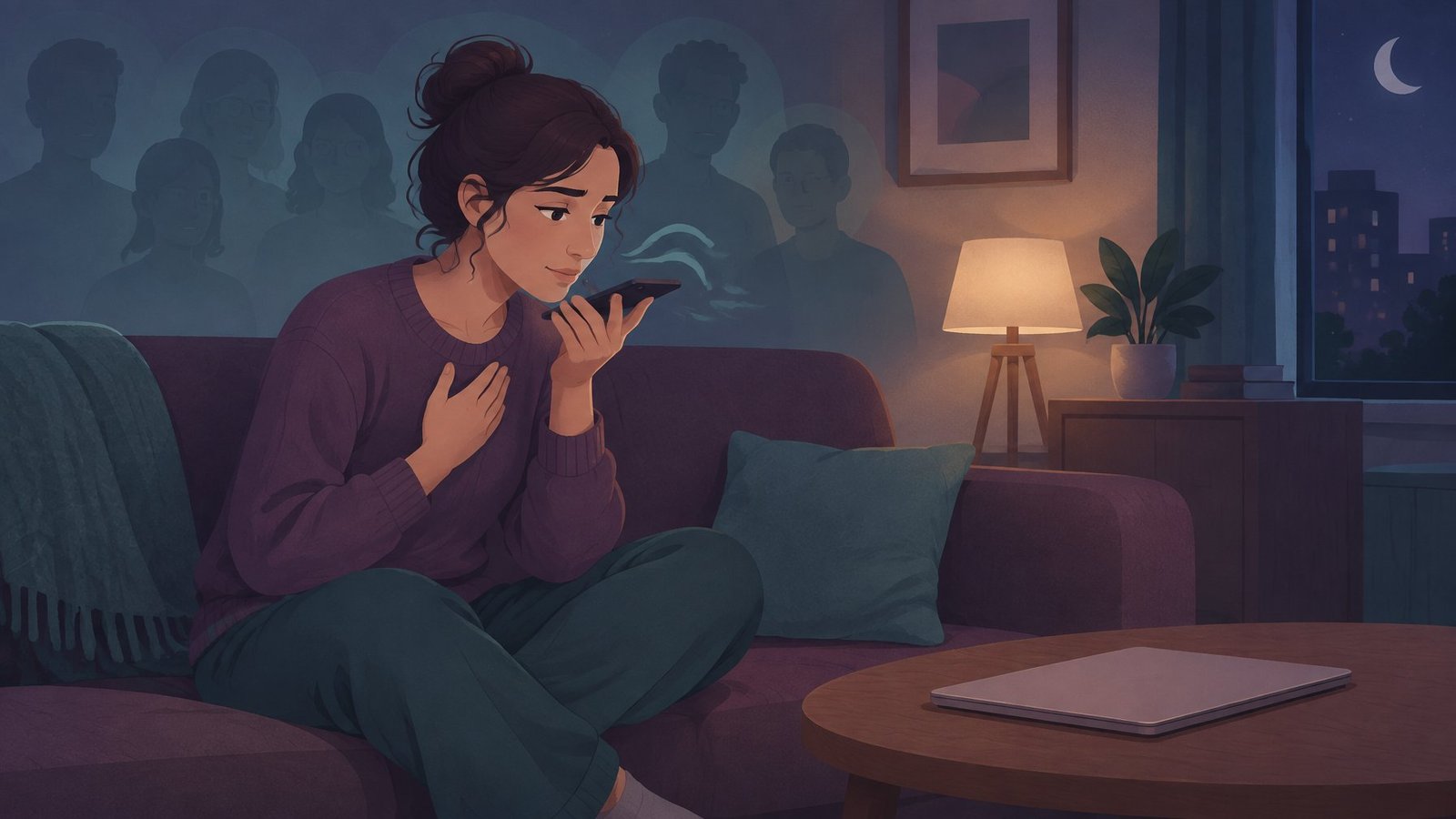
Speaking to a machine is not the same as typing to one. A series of experiments finds that when people talk to voice technology, they act as if someone is listening: they worry more about how they come across, sound more upbeat and reveal less about their problems.
The paper, “The Social Nature of Voice Technology,” is by Maximilian Gaerth, Shiri Melumad and Robert J. Meyer of the Wharton School at the University of Pennsylvania. Gaerth is also an incoming assistant professor at Emory University’s Goizueta Business School. The working paper is dated June 3, 2025, and is available on SSRN.
Five experiments, 6,188 people
The authors argue that because speech evolved for talking with other people, saying something out loud automatically triggers self-presentational concerns, even when the listener is a computer. They tested this in five experiments with 6,188 participants, four of them preregistered.
In the first, 1,482 online participants composed a message to a friend about something from their past week, either typing it or dictating it with voice-to-text. Most were alone while doing the task.
Those who dictated reported more concern about how their words would come across, scoring 4.48 on a 7-point scale compared with 4.17 for typists. Their messages were also more positive by two standard sentiment measures, even after accounting for dictated messages being longer.
A second study with 2,165 participants added a third group who typed a message they were told would be posted publicly on social media. Making typists imagine an audience raised their concerns and made their messages more positive, mirroring what speaking did on its own.
Less disclosure to ChatGPT
Another study asked 986 people to submit health-related queries to a simulated large language model. Those who dictated their ChatGPT-style queries disclosed fewer negative personal problems than those who typed them, according to the paper’s abstract.
Two further studies looked at purchases. When people chose between brands of personal health products by speaking rather than clicking, they were willing to pay more to avoid picking an embarrassing option. One version used participants’ own in-home voice assistants.
Not just slower thinking
One alternative explanation is that people simply think harder when speaking. But dictating a message to a friend actually came with less reported deliberation than typing, and the effect of self-presentation held after accounting for deliberation.
The authors note a measurement challenge: concerns were reported after participants finished their messages, and expressing negativity could itself raise those concerns. Their models allowed for this two-way relationship.
The finding matters as voice use grows. The paper cites an estimate of more than 7 billion WhatsApp voice messages sent per day in 2024, and research showing spending rose after shoppers adopted voice ordering.
Study Details:
- Title: The Social Nature of Voice Technology
- Authors: Maximilian Gaerth, Shiri Melumad, Robert J. Meyer
- Journal: University of Pennsylvania (Wharton) Working Paper, SSRN
- Publication Date: June 3, 2025
- DOI: 10.2139/ssrn.5296839