
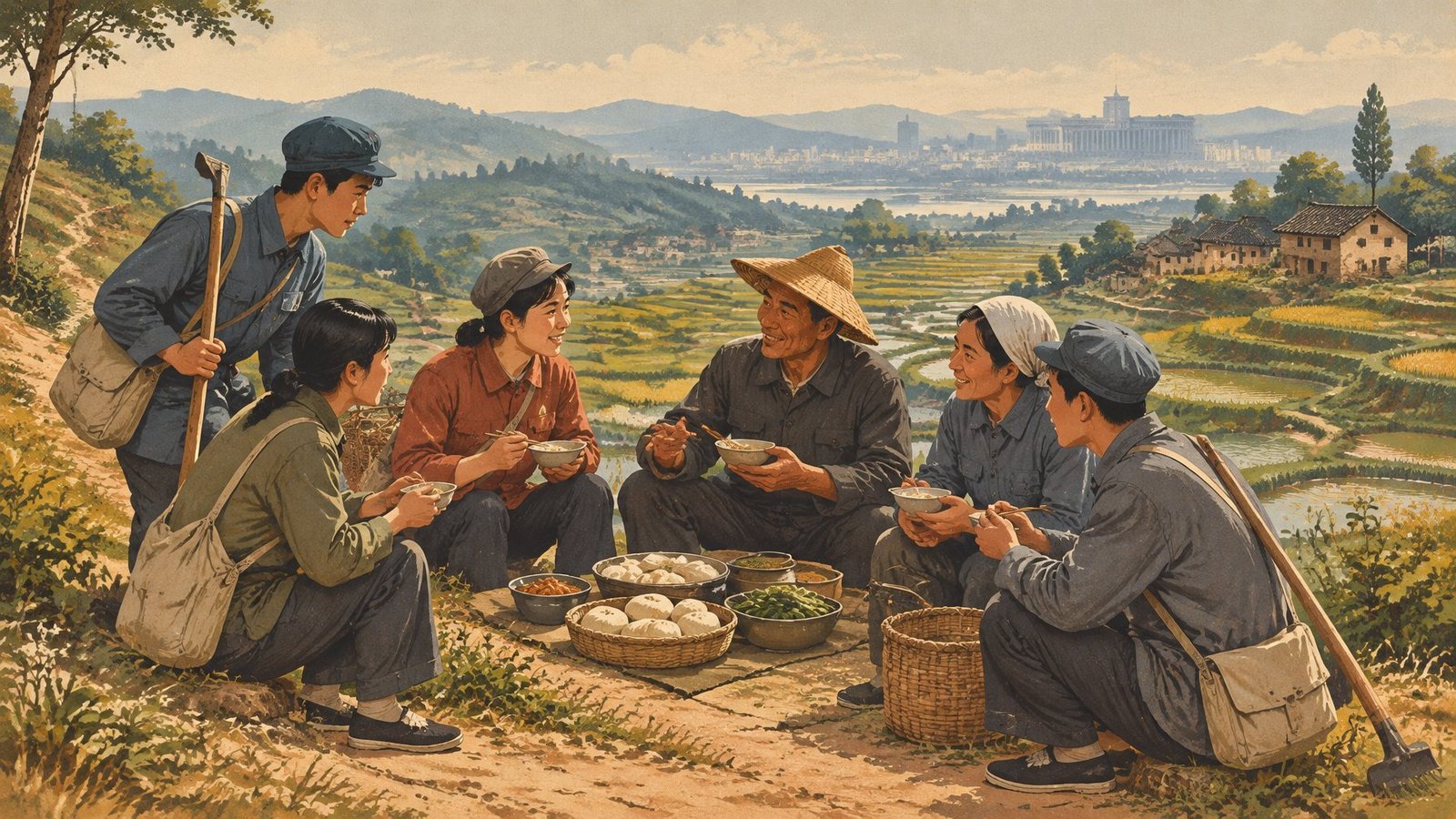
People who were forcibly sent to the countryside as teenagers during China’s Cultural Revolution became more generous toward others but more skeptical of the state. Decades later, they are more risk averse, more altruistic and more likely to return kindness, yet less likely to back redistribution or trust the government.
The study is by Sheryl Ball, Suqin Ge and Alec Smith of Virginia Tech, Wei Wang of Henan University of Economics and Law, and Xiaomeng Zhang of Nanjing Audit University. It appears in the April 2026 issue of the Journal of Economic Behavior & Organization and was published online on February 25, 2026 (doi.org/10.1016/j.jebo.2026.107496). An earlier version was posted as a preprint dated February 5, 2025.
The sent-down movement relocated about 17 million urban youths, mostly aged 16 to 19, to villages between 1967 and 1978. Mao Zedong said they would be re-educated by poor farmers. Many lived for years without electricity or running water, working long days of manual labor far from their families.
A birthday that decided who went
Comparing people who were sent down with those who were not is tricky, because the selection was not random. Some volunteered, and well-connected families could shield their children. The researchers instead exploit the unexpected end of the movement in 1977.
Urban students were usually sent down after finishing junior high school. Those born before September 1, 1961 graduated in time to be among the last cohort sent; those born just after did not. The working paper reports that this cutoff creates a jump of more than 30 percentage points in the chance of having been sent down, which the authors use in a fuzzy regression discontinuity design.
The survey was run between March and July 2019 through the Sojump online platform. After exclusions, it covered 1,821 people born with urban household registration, about 24% of whom said they had been sent down. Questions on risk, patience, altruism, reciprocity and trust came from the Global Preference Survey, alongside measures of trust in government and support for redistribution.
Collectivist values, but not toward the state
Those sent down score higher on altruism and positive reciprocity, outcomes in line with the movement’s stated aim of instilling collectivist values. But they also trust the government less and are less supportive of income redistribution.
The authors note that this mix of more personal altruism and less support for redistribution is perhaps not surprising given the drop in trust in government. In the working paper, effects were similar across education and income groups, but women became more risk averse and less trusting of government than men after being sent down.
The researchers describe it as evidence that a deliberate government effort to change citizens’ preferences can work, while also producing the opposite of what the state wanted: a generation that is kinder to others and cooler toward the state.
Study Details:
- Title: Youth reeducated: The economic preference impacts of China’s sent-down movement
- Authors: Sheryl Ball, Suqin Ge, Alec Smith, Wei Wang, Xiaomeng Zhang
- Journal: Journal of Economic Behavior & Organization
- Publication Date: February 25, 2026
- DOI: 10.1016/j.jebo.2026.107496