
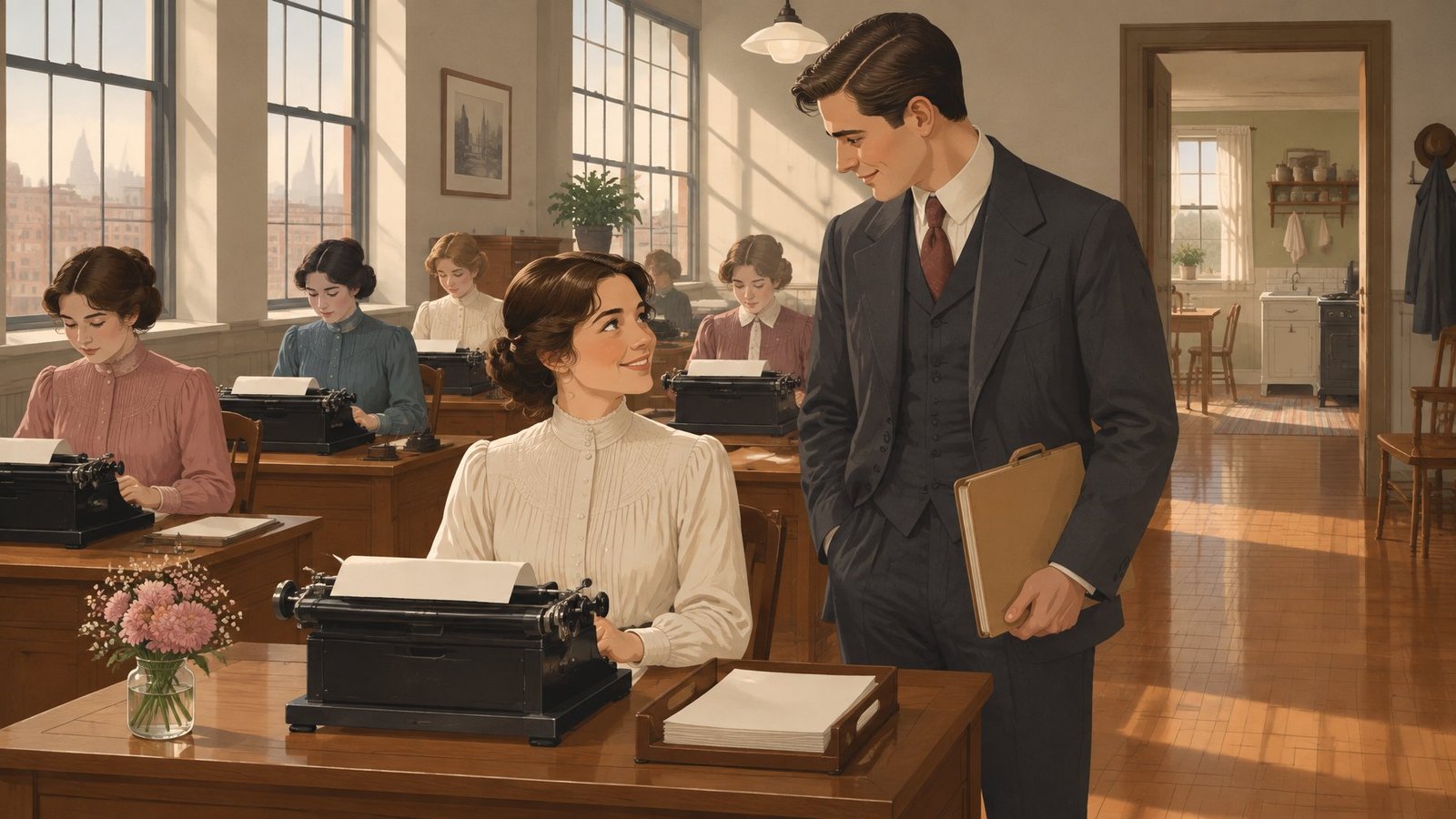
The typewriter did more than speed up office paperwork. A new economic history paper finds that it drew more than a million American women into the labor force, lowered marriage and birth rates, and gave many women a route to marry into wealthier families.
The paper, by Myera Rashid of Northwestern University’s Department of Economics, is a working paper whose current version is dated April 5, 2026. It is available from the author as “Keys to Upward Mobility: Typewriter Adoption and Women’s Economic Outcomes.”
A machine that created women’s jobs
Commercial typewriters arrived in US offices in the 1880s and replaced handwritten secretarial work, mostly done by men. Women made up only 12% of secretaries and typists in 1880, but 75% of typists by 1900. By 1940, more than 1.1 million women worked as typists, nearly 9% of all employed women.
To separate the typewriter’s effect from other changes, Rashid used historical complete-count censuses and a “shift-share” design. It combines each county’s industry mix before the typewriter with national shifts in demand for typists from 1880 to 1920, so that places with more typist-heavy industries received a larger predicted shock.
Work up, marriage and births down
A 1 percentage point increase in the predicted share of typists raised the share of women in the labor force in 1920 by 0.75 points. By Rashid’s back-of-the-envelope estimate, women’s participation would have been 3.65 points lower without the typewriter, about 1.16 million fewer working women out of 31.7 million of working age. The effect persisted to 1940.
The shift also reached women who were not typists. As White women left unpaid housework for offices, demand rose for paid household workers, and the same 1 point increase raised the share of Black women in the labor force by 1.7 points.
Family life changed too. The typewriter shock reduced the share of women who were married by 0.4 points and the share with children by 0.6 points. That implies 650,000 more married women and 920,000 more women with children in 1920 if the typewriter had never arrived, reflecting both delayed and forgone marriage and childbearing.
A separate test using counties that had Women’s Christian Associations before 1880, which offered some of the first typing courses for women, produced consistent results.
The office as a “meeting technology”
The paper’s most striking result concerns marriage. Following young White women from the 1920 to the 1940 census, Rashid compared each woman’s father’s income rank with that of her eventual husband.
Among women whose fathers sat at the 25th percentile of income, those who worked as typists married men ranked 18.4 percentiles higher on average than the husbands of non-typists. The pattern held when comparing sisters, and it did not appear for teachers, a white-collar job with similar pay.
Using the shift-share measure, women in counties with a 1 point greater predicted rise in typists married husbands ranked 1.27 percentiles higher. Future husbands of typists were also more likely to hold white-collar jobs in the same county in 1920, consistent with couples meeting at work.
Rashid calls the typewriter a “meeting technology”: it put young women in offices beside higher-earning men, and for many, the path upward ran through those offices.
Study Details:
- Title: Keys to Upward Mobility: Typewriter Adoption and Women’s Economic Outcomes
- Authors: Myera Rashid
- Journal: Working paper, Northwestern University
- Publication Date: April 5, 2026
- Link: https://drive.google.com/file/d/1b34XIcXh5r0YiS8tnFYqk-jjN23Puk7i/view