
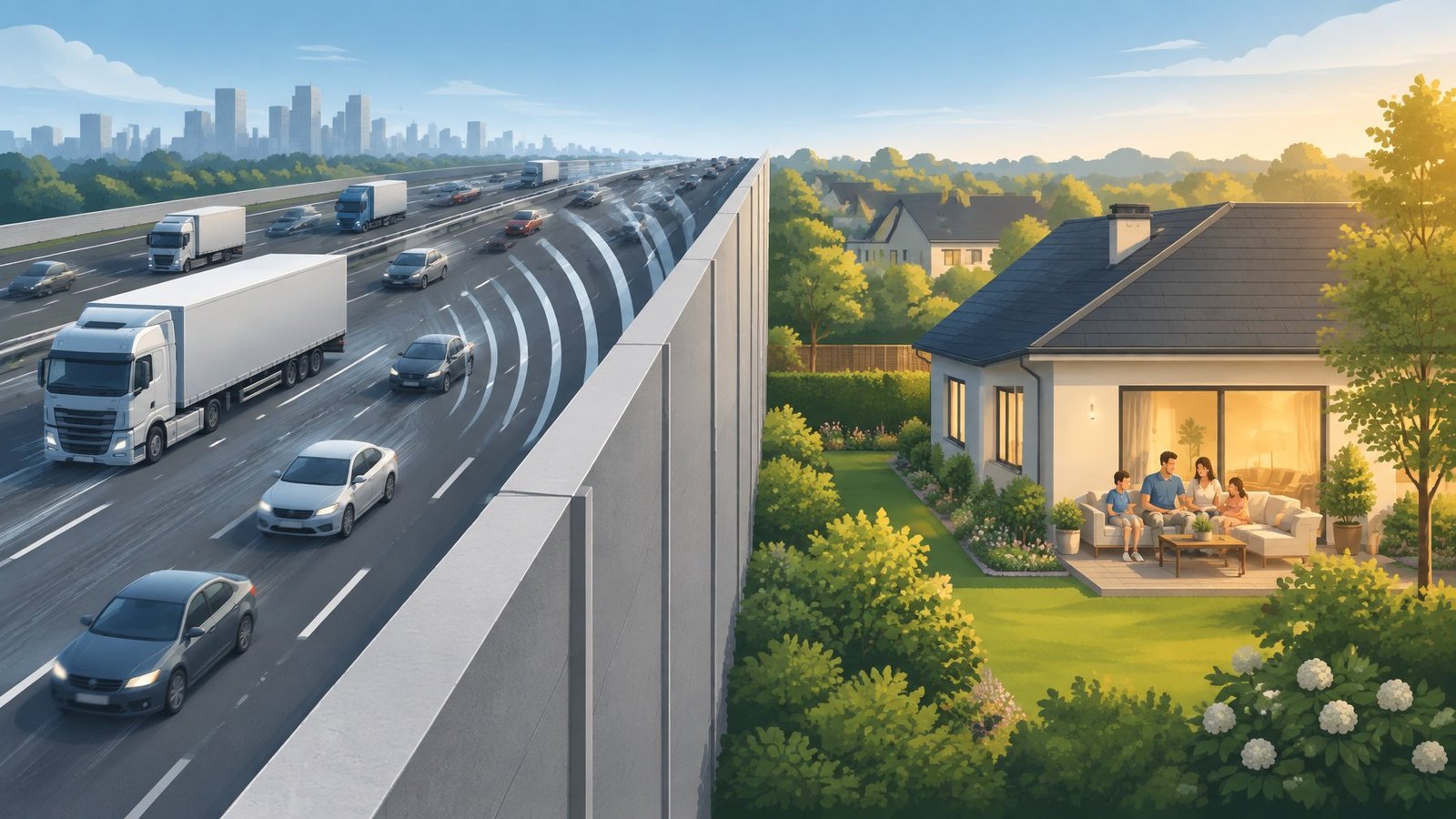
Living next to a busy road has a price, and homebuyers pay it. When noise barriers went up along Florida highways, nearby house prices jumped 6.8%, a premium that implies traffic noise costs the United States about $110 billion.
The estimate comes from economists Enrico Moretti of the University of California, Berkeley and Harrison Wheeler of the University of Toronto. Their paper was released as NBER Working Paper No. 34298 in September 2025.
More than 42 million Americans are exposed to medium or high levels of traffic noise, which has been linked to hypertension, stroke, depression and low birth weight. Yet its economic cost has received little attention, the authors write.
Walls that act like an experiment
The researchers used sound barriers as a natural experiment, because these walls are engineered to cut noise and little else. Florida keeps the most detailed records: the state inventory covers every barrier built from 1988 to 2023, including its expected noise reduction, and also lists barriers that were proposed but never built.
The sample includes 1,143 barriers that were built and 497 that were proposed but not built. Built barriers cost $741,000 on average and were expected to cut noise near the road by about 7 decibels.
The team matched these to CoreLogic housing transactions from 1990 to 2022. They compared price changes for homes within 500 metres of the road with homes 500 to 1,500 metres away, and also compared areas that got a barrier with matched areas where one was only proposed.
An immediate and lasting jump in prices
In the five years before construction, prices near and far from the road moved in step. After a barrier went up, homes within 100 metres gained 6.8% almost immediately, and the gain largely persisted. The effect shrank with distance and disappeared beyond 400 metres.
Bigger noise reductions produced bigger price gains, but with diminishing returns: the effect levelled off at around 10 decibels. That link let the authors put a price on each decibel of quiet.
The authors checked whether the walls might simply be blocking pollution or ugly views. They found little evidence of either: price effects were not larger downwind of traffic, and not smaller where trees or buildings already hid the road.
Who carries the cost
Combining the per-decibel price with a national noise map, the authors estimate the total cost of traffic noise at $110 billion. The burden is heavier in tracts with lower incomes, higher poverty and larger Black populations, which the authors call a “regressive” externality.
Costs vary widely between cities. Among the 10 most populous, Boston has the highest cost per resident at $1,310, more than 13 times Atlanta’s $100, reflecting both noise exposure and property values.
The figures translate into policy numbers. A tax covering the noise caused by an average petrol or diesel vehicle over its lifetime would come to $974. Replacing all such vehicles with quieter electric cars would cut roadside noise by about 7.1 decibels, worth an estimated $77.3 billion nationwide.
Some of that is already being banked. The authors put the noise benefits of electric vehicles on the road in 2023 at $276 million in San Francisco county and $265 million in Santa Clara county.
Study Details:
- Title: The Traffic Noise Externality: Costs, Incidence and Policy Implications
- Authors: Enrico Moretti, Harrison Wheeler
- Journal: NBER Working Paper No. 34298
- Publication Date: September 2025
- Link: https://www.nber.org/papers/w34298