
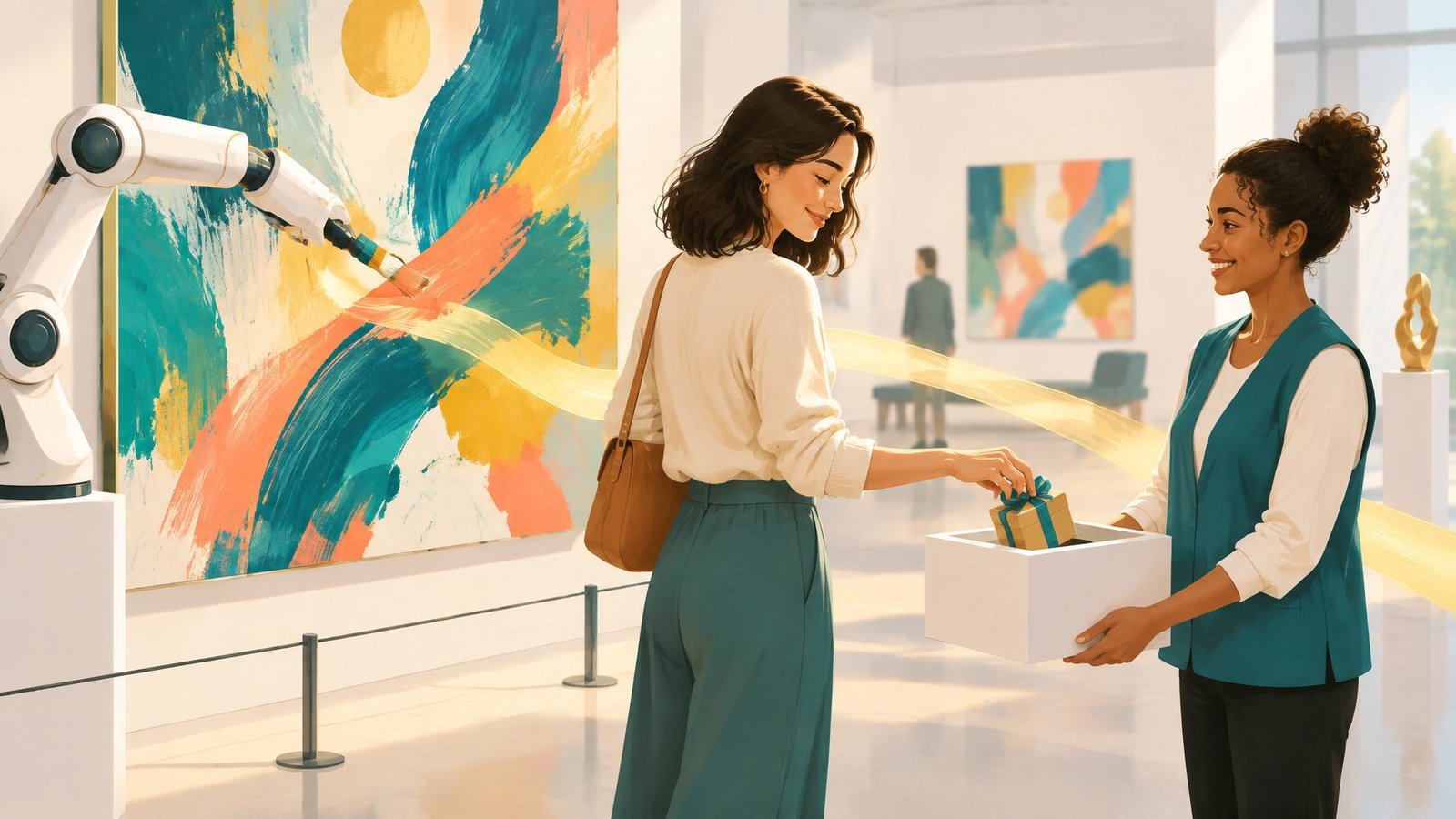
Looking at paintings made by artificial intelligence can make people more generous. In four experiments with 1,293 participants in China and the United States, people who viewed art attributed to AI were more charitable afterward than people who viewed the same kind of art attributed to a human artist.
The study is by Ziniu Jin and Xiaobo Tao. It was published online in Psychology of Aesthetics, Creativity, and the Arts on July 13, 2026.
A threat to feeling human
Participants saw paintings labeled as created either by AI or by a person, then made a charitable choice or reported how willing they were to donate. Across the studies, AI-attributed paintings increased charitable behavior compared with human-attributed ones.
The authors traced the effect to what they call perceived human identity threat. Art made by a machine can challenge people’s sense that creativity is something distinctly human, and doing good for others appears to be one way people reaffirm their own humanness.
When the effect fades
The researchers found two limits. The boost shrank when it was emphasized that a human creator had played the leading role in the AI-assisted process.
It also weakened when the charity appeal was self-centered rather than focused on helping others.
The authors see a practical lesson for museums, online art platforms and charities: be transparent about AI authorship, and design donation appeals responsibly when AI art and fundraising appear side by side.
Study Details:
- Title: A masterpiece from machine: When experiencing artificial intelligence paintings promote charitable behavior
- Authors: Ziniu Jin, Xiaobo Tao
- Journal: Psychology of Aesthetics, Creativity, and the Arts
- Publication Date: July 13, 2026
- DOI: 10.1037/aca0000889