
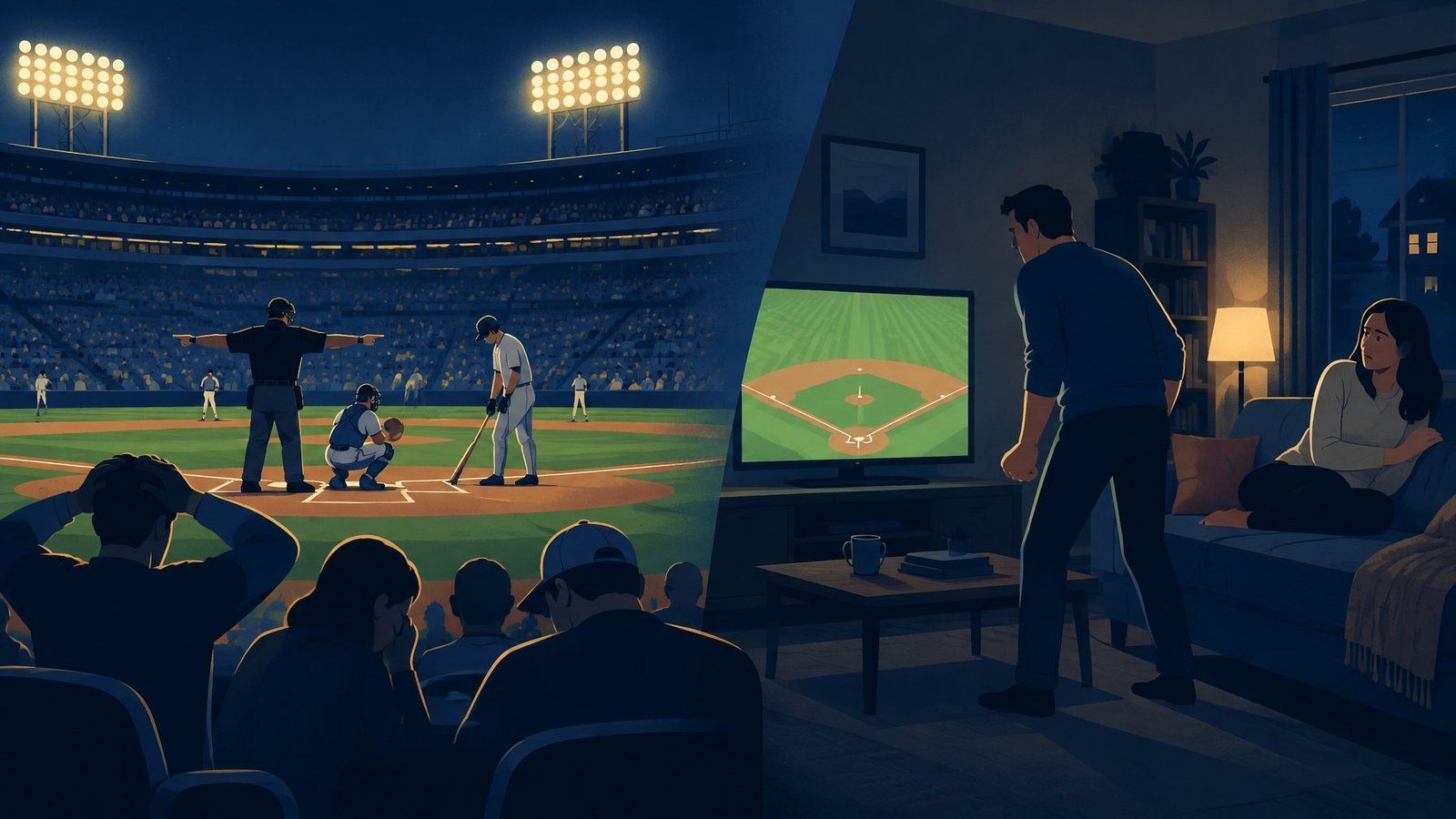
A bad night behind home plate can follow fans home. Reports of domestic violence rise after baseball losses in games officiated by highly inaccurate umpires, especially when the missed calls favoured the opposing team, according to a study in the Eastern Economic Journal.
The paper, by economist Kalvin Mudrow of Georgia College & State University, was published online on March 26, 2026, and appears in the journal’s April 2026 issue.
Measuring every missed call
Major League Baseball tracks the location of every pitch relative to the strike zone. Mudrow used that Baseball Savant data to score each home plate umpire’s game: the share of called pitches judged wrongly. The average umpire in the sample missed about 10.5% of calls, with individual games ranging from under 1% to nearly 29%.
He also measured which side the errors helped, by calculating how much the wrong calls shifted each team’s expected runs.
Crime data came from the National Incident-Based Reporting System. Domestic violence was defined, following earlier work on football and basketball, as male-to-female assault or intimidation by a spouse, partner or boyfriend, counted between 6 p.m. and 6 a.m. after each game. Because many police agencies do not report to that system, the sample covered the home counties of nine teams, including Cleveland, Detroit, Kansas City and Milwaukee, between 2009 and 2019.
Umpires are assigned in advance and their accuracy on a given day is hard to predict, so the study treats a poorly called game as a chance event. Models controlled for temperature, air quality, attendance, team records, game end times and holidays, with fixed effects for county, year, month and day of the week.
Losses plus bad calls, not bad calls alone
After wins, umpire accuracy made no difference. After losses, each percentage point of extra inaccuracy was linked to about 0.4% more domestic violence reports. In the preprint version of the paper, that implied an increase of a little over 4% for a typical umpire in a loss, and about 12% for the most inaccurate umpire.
The effect was concentrated among the very worst umpires, the top 5% for inaccuracy. It was driven by missed calls that helped the other team, which Mudrow reads as a sign of loss aversion among fans. The rise appeared in the hours after the game.
The pattern was strongest in regular season games, on Thursdays and Saturdays, and in September. No similar effect showed up for female-to-male violence or for other crimes such as larceny, robbery or vandalism.
The study counts reports, so it misses victims who never call the police. Mudrow argues this is not a threat as long as reporting is unrelated to umpire accuracy.
He points to a policy angle: more accurate umpiring could carry social benefits beyond the ballpark. MLB’s own pitch-tracking technology already measures exactly where the strike zone is.
Study Details:
- Title: Balls and Strikes: The Effects on Domestic Violence
- Authors: Kalvin Mudrow
- Journal: Eastern Economic Journal, April 2026, pages 367-390
- Publication Date: March 26, 2026
- DOI: 10.1057/s41302-026-00321-3