
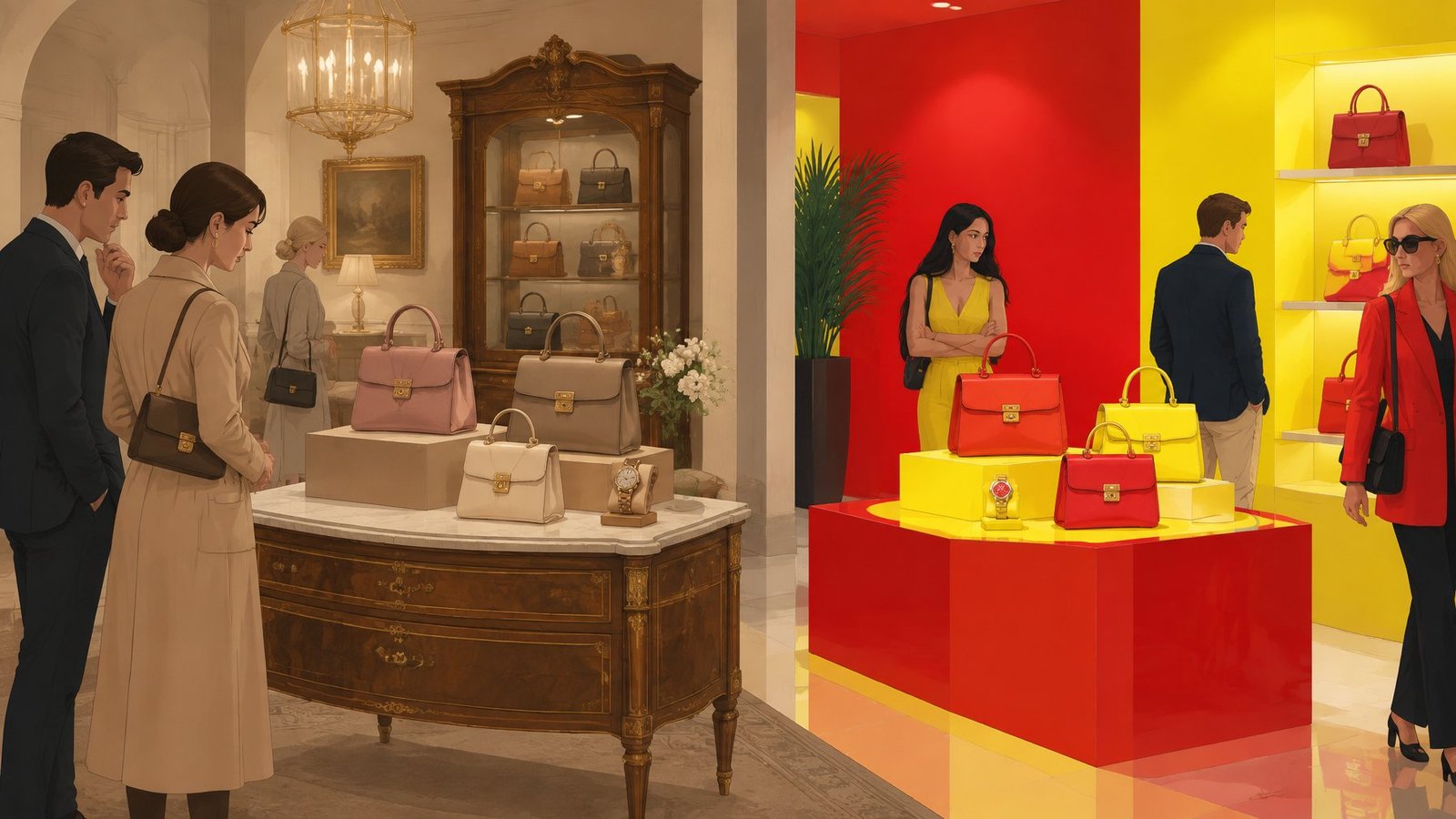
Luxury brands look more prestigious when their products come in faded, muted colors rather than bright ones. Shoppers link low saturation with the passage of time, read it as a sign of a long heritage, and rate the brand as higher status.
The research comes from Xinyue Zhou of the University of Macau, Chunqu Xiao of Shaoxing University, Sunyee Yoon of the University at Buffalo and Hong Zhu of Nanjing University. It was published online in the Journal of Consumer Research on April 26, 2025, and appears in the April 2026 issue. The article is available at doi.org/10.1093/jcr/ucaf029.
The authors start from a puzzle. Quiet luxury is fashionable, yet brands such as Ferrari and Fendi use vivid signature colors. A scan of 1,806 women’s bags from three luxury and three non-luxury brands found luxury bags were not significantly less saturated, and a survey of 26 fashion designers and managers showed no consensus on which works better.
Seven studies, from a lab to a boutique
In the first study, 893 Chinese adults saw a luxury watch at one of nine saturation levels, from 10% to 90%. Perceived status fell as saturation rose. Ratings were highest at 10% and 20% saturation (about 5.4 on a 7-point scale) and dropped sharply between 20% and 30%. The 90% version scored lowest, at 4.37.
A second study with 395 Prolific participants showed the effect is specific to luxury. A muted watch raised status ratings when it was described as luxury, but made no difference for an unlabelled brand.
A third study pinned down why. Muted colors raised “continuity heritage”, the sense that a brand has a history and survives trends, and that perception carried the effect on status. Other explanations, including lower visual flashiness and lower arousal, did not account for it.
When muted colors stop working
The advantage shrank when a fictional brand displayed a recent founding year (“since 2020”) instead of an old one (“since 1910”). It reversed when the brand presented itself as innovative: then vivid colors earned higher status ratings.
The money test took place over two weeks in January 2025 in a multi-brand luxury boutique in China. Using an incentive-compatible bidding method, 242 shoppers stated what they would pay for a handbag shown in high or low saturation. Average bids were 3,159.92 yuan for the muted version and 2,537.95 yuan for the vivid one.
A dress-up game released on WeChat in summer 2023 measured real choices. Among 218 players, 80.28% picked a muted luxury bag for a high-end banquet, compared with 54.13% for a trip to a local shopping center.
The authors note that most studies used single products and specific hues, and that other hues, brightness levels or categories could shift the threshold. Their practical advice is specific: heritage brands should lean muted, while brands selling innovation, such as high-tech luxury, may do better with bold color.
Study Details:
- Title: The Color of Status: Color Saturation, Brand Heritage, and Perceived Status of Luxury Brands
- Authors: Xinyue Zhou, Chunqu Xiao, Sunyee Yoon, Hong Zhu
- Journal: Journal of Consumer Research
- Publication Date: April 26, 2025
- DOI: 10.1093/jcr/ucaf029