
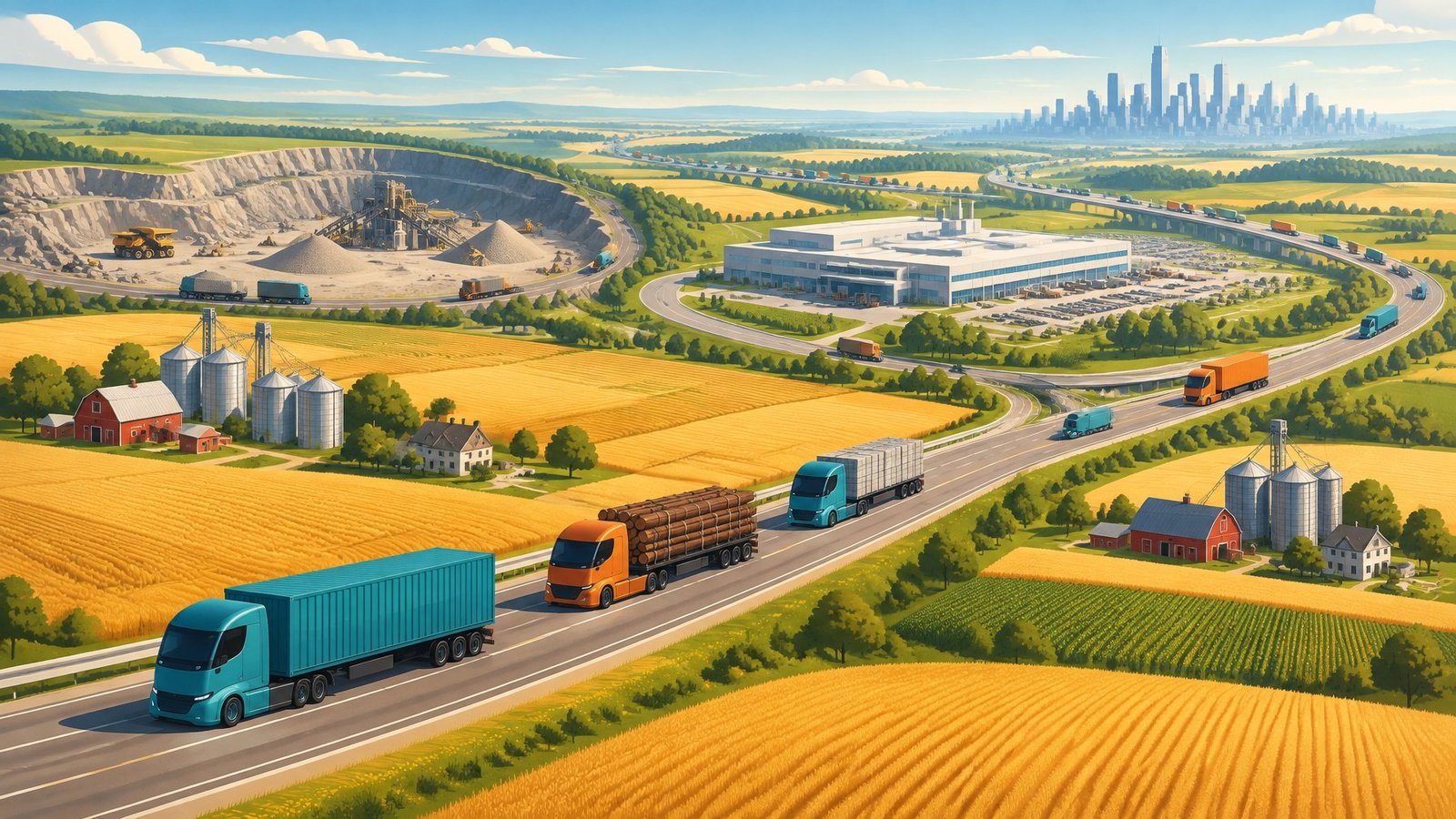
If self-driving trucks cut freight costs as much as projected, trade between US states would grow sharply, and the biggest relative winners would not be the coastal giants. A new simulation finds that the gains would be largest, compared with the size of their economies, in south-central and midwestern states such as Mississippi, Kentucky and Kansas.
The study is by Taejun Mo, Sandy Dall’erba, William Ridley, Yilan Xu and Hyungsun Yim, with funding from the Department of Civil Engineering at the University of Illinois at Urbana-Champaign. It was published in the Journal of Regional Science on May 4, 2026.
Why drivers matter for trade
Driver pay makes up 27% to 41% of US trucking firms’ operating expenses, and trucks carried 72.6% of domestic freight tonnage in 2022. Removing much of the labour cost could reshape where goods flow.
The authors estimated a structural gravity model of trade between the 48 contiguous states, using federal Freight Analysis Framework data on truck shipments in 42 product categories every five years from 1997 to 2017. This told them how strongly each kind of trade responds to transport costs.
They then simulated a nationwide 35% cut in trucking costs, the average net change in published estimates ranging from 21% to 47% for autonomous trucking, and calculated how trade would adjust across the whole network using 2017 as the baseline.
Winners by state
Mississippi led in relative terms, with an estimated $44.4 billion rise in exports to other states, equal to 40.3% of its GDP. Kentucky (38.5%), Rhode Island (36.6%), Kansas (34.2%), Vermont (34.1%) and Arkansas (34.0%) followed.
Florida ranked last at 5.9% of GDP, behind Washington (7.5%), California (8.2%) and New York (8.4%).
In dollar terms the picture flips. California’s exports to other states would rise by $224.6 billion, Texas’s by $180.8 billion, Illinois’s by $178.8 billion and Pennsylvania’s by $145.3 billion. When imports are counted too, Florida, New York and Texas would see their net exports fall.
Heavy, cheap goods react most
Goods with low value for their weight, such as gravel, sand, logs and grain, are the most sensitive to shipping costs, so their trade grows most in percentage terms. Because those goods are cheap, though, the extra volume adds relatively little in dollars.
The largest dollar increases come from high-volume categories. Motorized vehicles and mixed freight each gain more than $300 billion, with the vehicle increase alone equal to about 1.69% of US GDP. At the state level, California’s electronics exports would rise by $47.2 billion, and Michigan’s motor vehicle exports by an amount equal to 7.13% of its GDP.
What the model leaves out
The authors acknowledge several limits. They treat the cost cut as uniform across states and do not model the supply chain for autonomous truck components. They also do not examine how cheaper trucking might pull freight away from rail or river barges, or how environmental rules could respond if autonomous trucks run on diesel rather than electricity.
They argue that states expecting the largest gains should plan highway, bridge and freight hub upgrades, and that policymakers should prepare for job displacement as driver demand falls. Their estimates rest on one central number: a 35% drop in what it costs to move a truckload of goods.
Study Details:
- Title: The Impact of Autonomous Truck Technology on US Interstate Trade
- Authors: Taejun Mo, Sandy Dall’erba, William Ridley, Yilan Xu, Hyungsun Yim
- Journal: Journal of Regional Science
- Publication Date: May 4, 2026
- DOI: 10.1111/jors.70067