
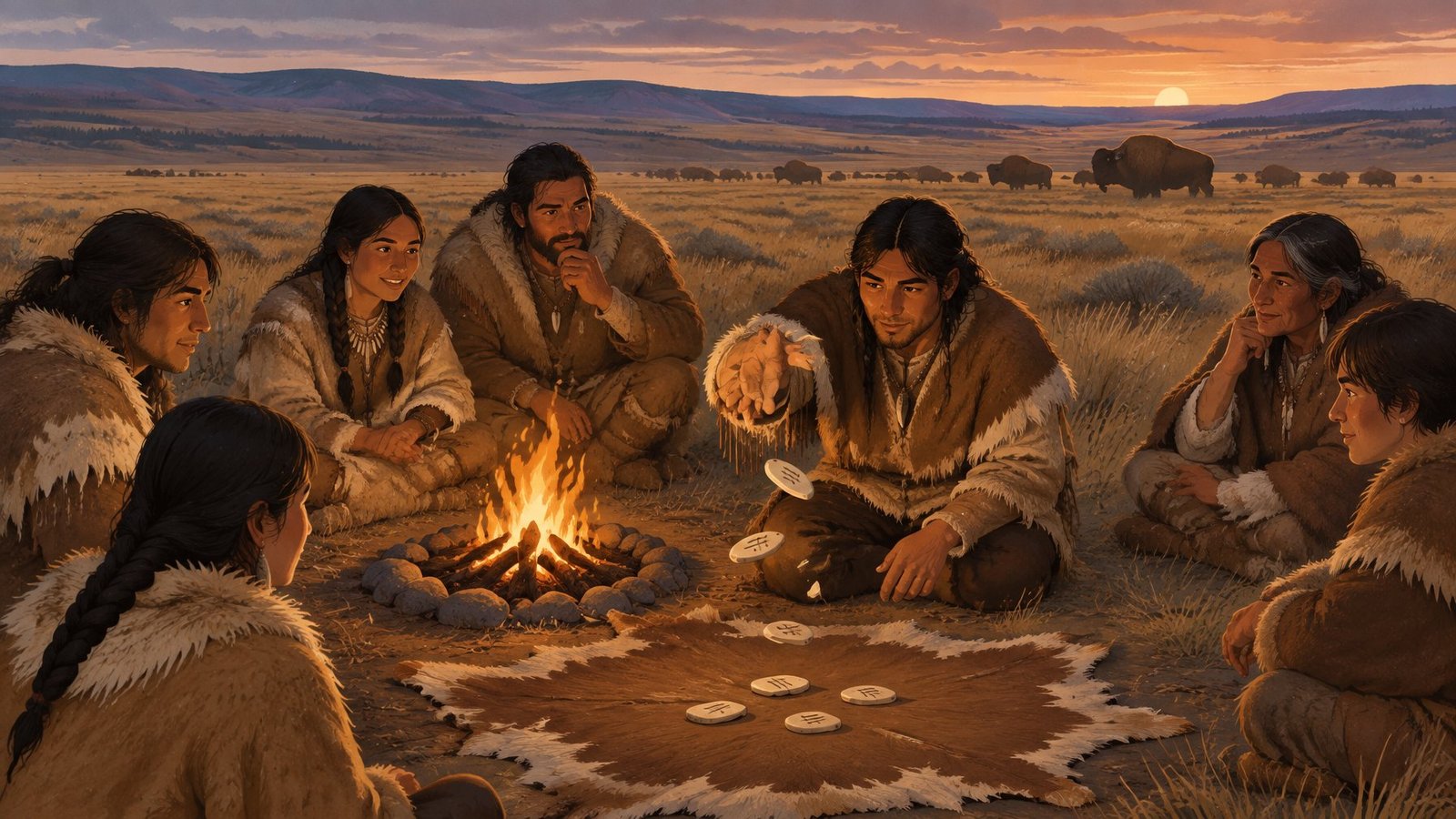
People in North America were rolling dice and playing games of chance at least 12,000 years ago, thousands of years before anyone did so in the Old World, according to a new analysis of the archaeological record. The oldest examples are small, carefully marked pieces of bone found at Ice Age hunting camps on the western Great Plains.
The study is the work of Robert J. Madden of the Center for Mountain and Plains Archaeology at Colorado State University. It was published online in American Antiquity on April 2, 2026, as “Probability in the Pleistocene: Origins and Antiquity of Native American Dice, Games of Chance, and Gambling”, and is open access.
A test built from 293 sets of historic dice
Archaeologists have long found objects that look like gaming pieces, but without firm criteria many have hesitated to call them dice. Madden tackled that problem by going back to Stewart Culin’s 1907 compendium Games of the North American Indians, which documents 293 sets of dice from 130 tribes.
From those examples he distilled a four-part definition. Native American dice, he writes, are two-sided objects of wood or bone that are not perforated, with one side marked by color or incisions, a cross-section that is flat, plano-convex, concave-convex or a marked fruit stone, and a size that lets several be held in the hand and thrown. Of Culin’s two-sided sets, 96% were made of wood or bone and 98% had a marked side.
To avoid false positives, the definition excludes pierced objects that could be beads and unmarked pieces distinguished only by shape. Madden then searched more than a century of published site reports for artifacts that fit.
The oldest dice in the world
The search turned up 659 diagnostic and probable dice from 57 sites in 12 states. The oldest come from Folsom deposits at the Agate Basin site in Wyoming, the Lindenmeier site in Colorado and Blackwater Draw in New Mexico.
All 20 Folsom pieces are two-sided and unperforated, and 19 are made of bone, many bearing incised lines or pigment. Some closely resemble the disk-shaped bone dice and split cane dice that Culin recorded among historic tribes.
For comparison, the earliest known dice in the Old World date to around 3500 BC in Mesopotamia, the Indus civilization and the Maikop culture of the Caucasus. The Folsom dice are more than 6,000 years older. Even later North American finds, such as a roughly 10,000-year-old die from Agate Basin and 7,000 to 8,000-year-old dice from Sudden Shelter and Cowboy Cave in Utah, beat them.
Madden argues this means the makers had a basic working grasp of chance and randomness. In his words, they “were early movers in humanity’s emerging understanding” of probability.
Dice as a signal of gatherings
The finds cluster in a western core region and spread outward over time. No dice older than about 450 years before present turned up in the eastern half of the continent.
Because historic gambling often took place when scattered groups met, Madden suggests dice could serve as an archaeological sign of large gatherings. Multiple dice at Agate Basin and Lindenmeier, he argues, support the contested idea that Folsom bands periodically came together in larger camps.
He cautions that the dataset shows where some dice appeared, not where they were absent, since it depends on what earlier excavators recorded and published. He also notes that his inference about use rests on ethnographic analogy, and that dice may also have served purposes such as divination.
Study Details:
- Title: Probability in the Pleistocene: Origins and Antiquity of Native American Dice, Games of Chance, and Gambling
- Authors: Robert J. Madden
- Journal: American Antiquity
- Publication Date: April 2, 2026
- DOI: 10.1017/aaq.2025.10158