
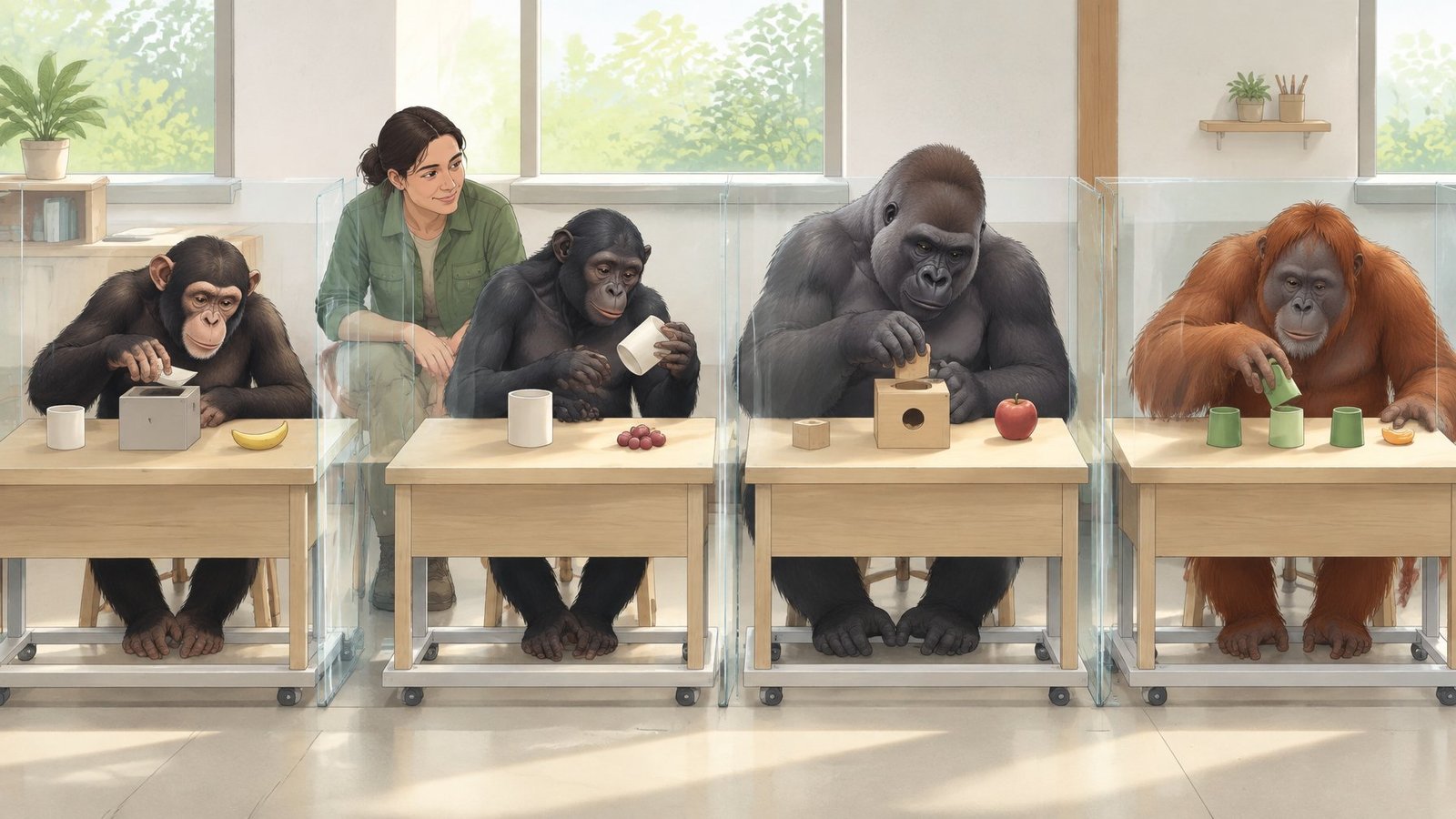
Some apes are consistently better than others at certain mental puzzles, and those differences hold steady over many months. But being good at reasoning about food and quantities says nothing about how well an ape reads the social cues of others, a long-term study of four great ape species has found.
The study was led by Manuel Bohn of Leuphana University Lüneburg and the Max Planck Institute for Evolutionary Anthropology in Leipzig, with Christoph J. Völter, Daniel Hanus, Nico Eisbrenner, Johanna Eckert, Jana Holtmann and Daniel Haun. It was published online in Psychological Science on April 15, 2026, as “Individual Differences in Great Ape Cognition Across Time and Domains: Stability, Structure, and Predictability”.
Six puzzles, ten rounds
The team worked with 48 zoo-housed apes: 12 bonobos, 24 chimpanzees, 6 gorillas and 6 orangutans, aged from about 3 to 58 years. Between April 2022 and October 2023, each ape was offered the same six tasks at 10 time points, roughly every eight weeks, with participation voluntary and food rewards given on top of the normal diet.
The tasks covered several domains. Two tested social cognition, such as following a human’s attention or using communicative cues to find hidden food. Others tested reasoning about quantities, executive functions such as resisting visible food or searching boxes without repeating mistakes, and inferring which container likely held a reward.
Because animal cognition tests are often noisy, the researchers used statistical models that separate stable traits from day-to-day fluctuation and from measurement error. Tracking the same individuals many times made this possible.
Stable traits, not daily moods
For most tasks, a large share of the differences between individuals came from stable traits. In the quantity task, for example, 84% of the true variation between apes was explained by stable individual differences, and in the communicative-cues task the figure was 77%.
Not every test worked well. The probabilistic-reasoning task produced chance-level performance and very low reliability, which the authors interpret as the task failing to measure anything consistently, not as evidence of an isolated ability.
The team also checked 14 possible predictors of performance, from age, sex and rank to illness, time outdoors and daily disturbances recorded by keepers. Easily measured variables largely failed. The only predictor that mattered across all tasks was which group an ape lived in, and the two chimpanzee groups differed substantially from each other.
No single ape IQ
By pooling the results with data from an earlier study of the same apes, the researchers looked for links between abilities. Most nonsocial tasks correlated substantially with one another, pointing to shared mental processes.
Social tasks were different. They were not correlated with each other or with any of the nonsocial tasks, even though some of them measured individual differences reliably. The authors say the overall pattern speaks against a single general intelligence factor in great apes.
They conclude that the roots of these differences probably lie deep in each ape’s developmental and perhaps genetic history. Their next step, they argue, should be computational models of the specific processes behind each task, tested on new tasks predicted to share them.
Study Details:
- Title: Individual Differences in Great Ape Cognition Across Time and Domains: Stability, Structure, and Predictability
- Authors: Manuel Bohn, Christoph J. Völter, Daniel Hanus, Nico Eisbrenner, Johanna Eckert, Jana Holtmann, Daniel B. M. Haun
- Journal: Psychological Science
- Publication Date: April 15, 2026
- DOI: 10.1177/09567976261434817