
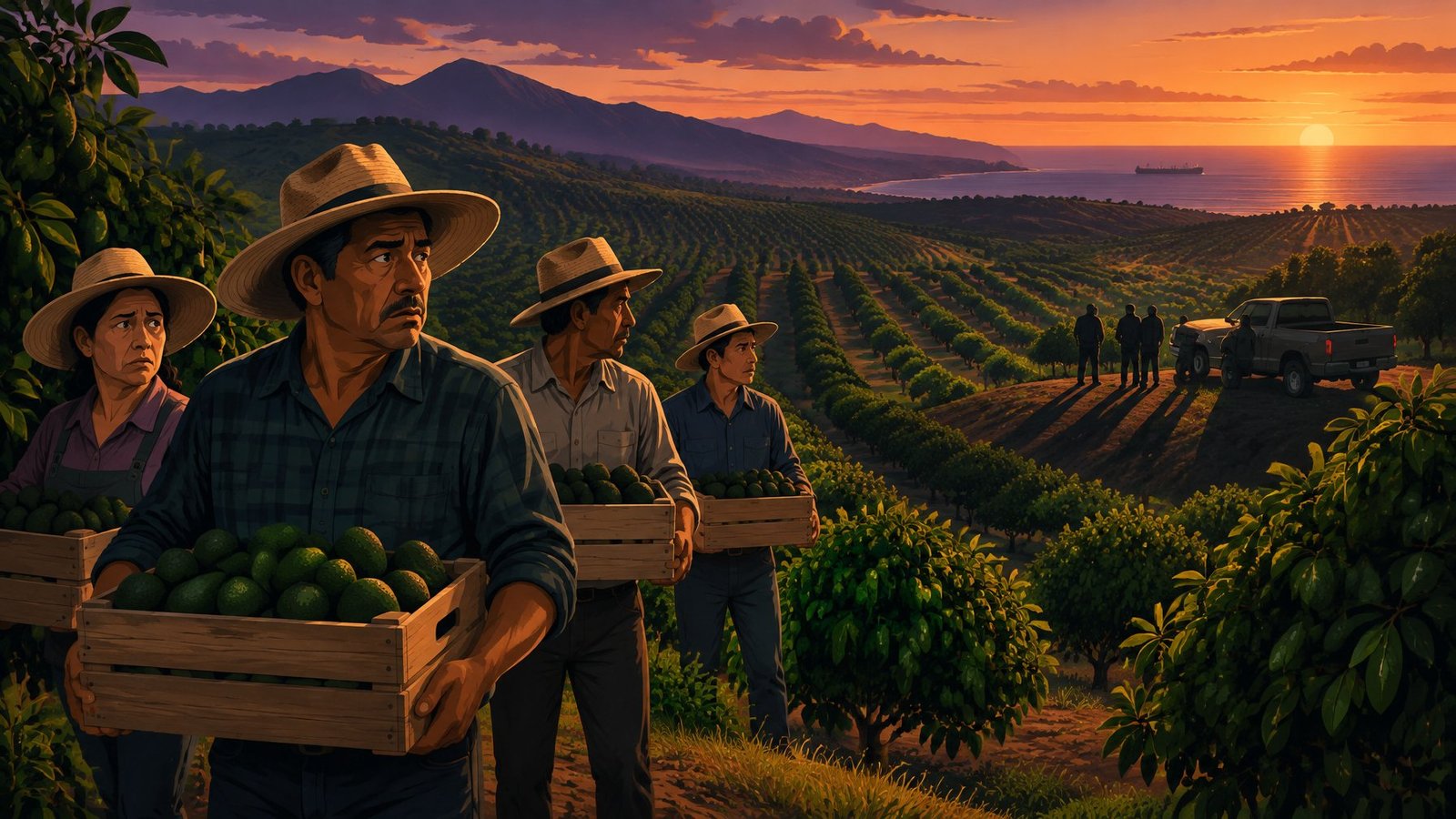
Criminal groups do not only fight over drugs. When a legal crop suddenly becomes far more valuable on world markets, killings rise in the places where organized crime is already present. Elsewhere, the same export boom brings no extra violence.
The study is by political scientists Chelsea Estancona of the University of South Carolina and Lucía Tiscornia of University College Dublin. It was published online in International Organization on September 9, 2025, and appears in the journal’s Summer 2025 issue.
Lemons, artichokes, limes and avocados
The authors start from a puzzle. History offers many examples of criminal groups moving into legal markets: the Sicilian mafia and lemons in the 1800s, the New York mafia and artichokes in the 1900s, Cape Town gangs and abalone in the 1990s, and Mexican cartels and limes and avocados in the 2010s. If drugs pay so well, why bother?
Their answer is that a rapid jump in a good’s share of export value offers both quick profit and a chance to manipulate the market later. Crops tied to particular land, and slow to grow, are especially attractive, because whoever controls the territory controls the supply. Taking that territory, they argue, means violence against producers, the state and rival groups.
Testing it with avocado toast
Mexico supplies roughly 40% of the world’s avocados, most of them to the United States, and production is concentrated in the state of Michoacán. The researchers linked changes in each Mexican municipality’s share of avocado export value to local homicides and to the presence of organized criminal groups.
Municipalities with growing avocado export shares saw more homicides, but only where criminal groups were present. Those that were expanding exports and faced the highest criminal threat were predicted to see more than fifty homicides a year, against a median of zero and a mean of nine per municipality-year.
To rule out the possibility that cartels were driving the export figures themselves, the authors needed a measure of demand that criminals could not control. They used global Google Trends data on searches for “avocado toast” as a stand-in for rising international appetite.
Placebo crops backed the mechanism. Corn had a big price spike, strawberries and limes have large export markets, and limes are tied to territory. Taken one at a time, none of those features was linked to more homicides in growing areas. It was the combination of a booming export share and a crop that cannot easily move that mattered.
The same pattern across countries
The team then compiled data on a global sample of countries from 1993 to 2018, combining the Atlas of Economic Complexity, the V-Dem measure of criminal threats to the state, and UN Office on Drugs and Crime homicide counts.
Increases in a country’s share of global export value for agricultural goods were associated with more homicides, but only where organized criminal groups were present. In countries with even a moderate criminal threat, a 15% change in export value share predicted about 10,000 additional homicides the following year. At the highest threat level, the prediction topped 40,000.
The authors treat the cross-national results as descriptive. Homicide statistics are under-reported and cannot show who killed whom, and the global data lack a direct measure of criminal market capture.
Their policy point is concrete: if a shift in world demand for a legal crop can set off local killing, fighting organized crime cannot stop at drug markets and police operations.
Study Details:
- Title: From Cocaine to Avocados: Criminal Market Expansion and Violence
- Authors: Chelsea Estancona, Lucía Tiscornia
- Journal: International Organization
- Publication Date: September 9, 2025
- DOI: 10.1017/S0020818325100763