
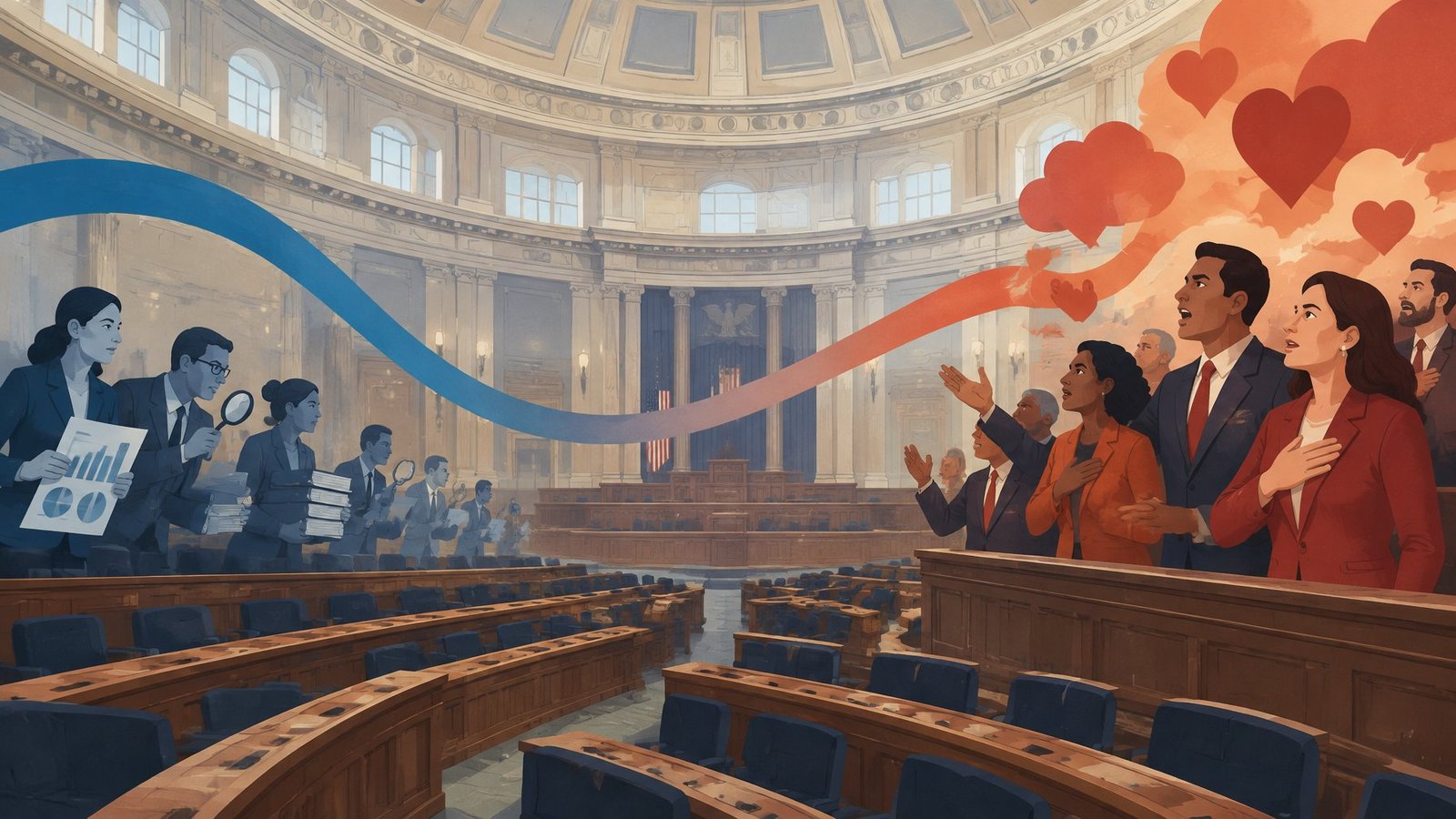
Members of the US Congress talk about facts, data and proof far less than they used to. A computational study of 145 years of floor speeches finds that evidence-based language reached its peak in the mid-1970s and has slid ever since, falling to its lowest level on record in recent sessions.
The decline did not happen in isolation. It moved in step with growing partisan polarization, rising income inequality and a drop in how much legislation Congress actually passes.
The study was carried out by Segun T. Aroyehun and David Garcia of the University of Konstanz, Almog Simchon of Ben-Gurion University of the Negev, Fabio Carrella and Stephan Lewandowsky of the University of Bristol, and Jana Lasser of the University of Graz. It was published online in Nature Human Behaviour on April 10, 2025.
Measuring how politicians pursue truth
The researchers did not check whether individual statements were true. Instead they measured two styles of reaching for the truth. An evidence-based style leans on facts, data and external reality. An intuition-based style leans on feelings, instincts and personal values.
They built two word lists: 49 keywords for evidence-based language, such as “fact” and “proof”, and 35 for intuition-based language, such as “guess” and “believe”. Using word embeddings trained on the speeches themselves, they scored about 8 million congressional speech transcripts from 1879 to 2022.
Each speech received an evidence-minus-intuition score, or EMI. A positive score means evidence-based language dominates; a negative score means intuition-based language does. The team validated the measure against human ratings and checked that word meanings stayed stable over the long time span.
A peak in 1975 and a long slide
The EMI score was high and fairly stable from the late 19th century into the early 20th, with dips during the Gilded Age (the 56th Congress, 1899 to 1901) and the Great Depression (the 73rd Congress, 1933 to 1935). It then climbed from the 1940s to a peak in the 1975 to 1976 session.
Since that peak, the score has fallen along a steady linear trend that explains about 93% of the variation over the period. Both parties moved downward together; their scores were strongly correlated (r = 0.78).
In the most recent session studied, 2021 to 2022, Republicans dropped more steeply. Their median EMI score was -0.753, compared with -0.435 for Democrats, a statistically significant gap.
Polarization, inequality and fewer laws
Evidence-based language and partisan polarization, measured from roll-call voting, were negatively correlated (r = -0.62). The two appear to move together, with polarization predicting later EMI but not the reverse.
The link with income inequality was even tighter. The EMI score of one session was strongly associated with the share of income going to the top 1% two years later (r = -0.95), and EMI changes tended to come before shifts in inequality.
Congress also got less done when it spoke less in the language of evidence. EMI correlated positively with three productivity measures: a major legislation index (r = 0.45), a broader legislative productivity index (r = 0.84) and the number of laws passed (r = 0.80). After controlling for polarization and public mood toward regulation, the association remained significant for major legislation.
The authors stress that their results are correlational and do not prove that one trend causes another. They point to possible contributors including party leaders controlling who speaks on the floor, pressure to play to the base, and live C-SPAN coverage, introduced in the House in 1979 and the Senate in 1986, which may have turned speeches into performances for the cameras.
They also note an earlier analysis of Congress members’ posts on Twitter/X from 2011 to 2022, which linked authentic “belief-speaking” to sharing lower-quality sources, particularly among Republicans.
Study Details:
- Title: Computational analysis of US congressional speeches reveals a shift from evidence to intuition
- Authors: Segun T. Aroyehun, Almog Simchon, Fabio Carrella, Jana Lasser, Stephan Lewandowsky, David Garcia
- Journal: Nature Human Behaviour
- Publication Date: April 10, 2025
- DOI: 10.1038/s41562-025-02136-2