
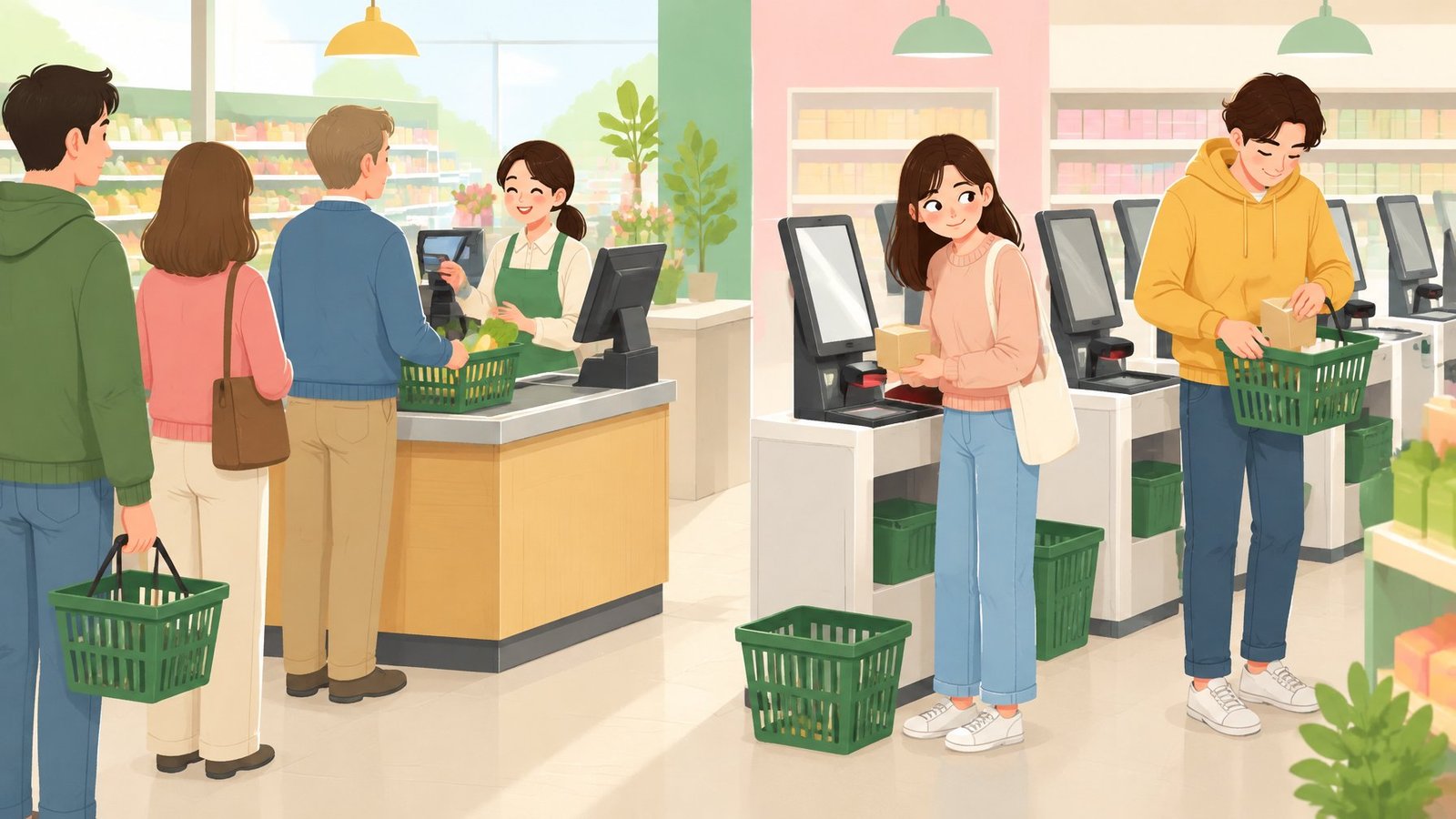
When a supermarket installs self-checkout, shoppers start routing their most embarrassing purchases through it. Condoms and pregnancy tests in particular move to the machines, and customers accept a measurable time cost to avoid handing those items to a cashier.
The study is by Rebecca Cardinali and Sofia B. Villas-Boas of the University of California, Berkeley, Lester Lusher of the University of Pittsburgh and Rebecca L.C. Taylor of the University of Illinois Urbana-Champaign. It was published online in the Journal of Economic Behavior & Organization on July 20, 2025, in the journal’s September 2025 volume.
Scanner data from a staggered rollout
The researchers used transaction data from a large grocery chain with stores in Washington, D.C., Maryland and Virginia, covering December 2008 to February 2011. During that time, stores adopted self-checkout at different moments, typically replacing one cashier lane with four self-checkout registers.
That staggered rollout let the team compare stores before and after adoption with stores that never adopted, using event study and difference-in-differences methods. One data set held a random 10% of all transactions in 30 stores. A second covered every peak-hour transaction in 51 stores and recorded the exact register used, which is unusual in grocery data.
The team built a list of potentially stigmatized items from public polls and earlier research, including condoms, pregnancy tests, yeast infection and bowel treatments, sanitary pads and incontinence products. Laundry products served as a placebo.
Same purchases, different lane
Did self-checkout make people buy more embarrassing items overall? The answer was only a weak yes. In the working paper version, the share of sales for condoms rose 17%, yeast infection treatments 22% and bowel treatments 11%, but the published abstract describes these extensive-margin effects as positive but noisy. Other items, such as sanitary pads and incontinence products, did not change.
The clearer effect was where people paid. Stigmatized items were much more likely to be bought at self-checkout than at a cashier, especially condoms and pregnancy tests. In the working paper, 18% of all items shifted to self-checkout after adoption, compared with 44% of pregnancy tests and 42% of condoms. The pattern held when the researchers tracked the same loyalty card holders, so it was not just a different crowd showing up.
Putting a price on privacy
Self-checkout is slower. The working paper found that cashiers processed transactions 99 seconds faster than customers scanning their own goods, a gap that grew with basket size. Weighing that time against the switch to the machines, the authors estimate shoppers are willing to pay 8.5 cents in extra time cost for the privacy of buying stigmatized items at self-checkout.
The authors note other patterns that cut the other way. Fresh produce, which is harder to scan, was less likely to go through self-checkout, as were incontinence products, which are often bought by older adults. Alcohol and tobacco showed no change, likely because an employee must still check ID.
The working paper also argues that adding self-checkout as an option looks good for shoppers buying sensitive items, but that replacing every cashier may not be. For condoms and pregnancy tests, though, the data are clear: given a private lane, customers take it.
Study Details:
- Title: Does automation reduce stigma? The effect of self-checkout register adoption on purchasing decisions
- Authors: Rebecca Cardinali, Lester Lusher, Rebecca L.C. Taylor, Sofia B. Villas-Boas
- Journal: Journal of Economic Behavior & Organization
- Publication Date: July 20, 2025
- DOI: 10.1016/j.jebo.2025.107126