
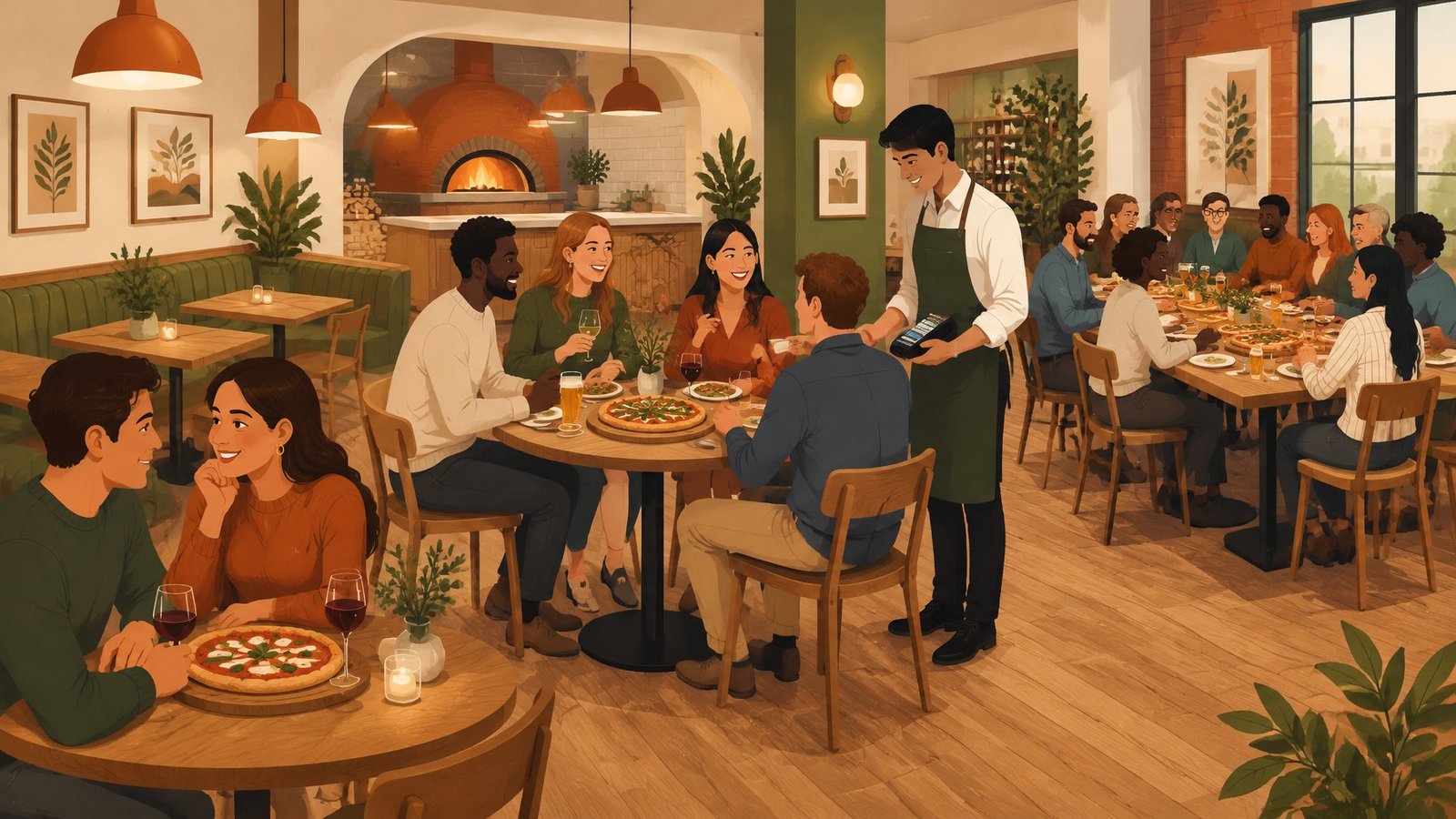
The chance that diners leave a tip does not simply climb as the table gets bigger or the meal gets longer. In a huge set of restaurant bills, it rose to a peak and then fell on both counts.
The study is by Erik Haugom and Christer Thrane of the University of Inland Norway. It was published online in the Journal of Behavioral and Experimental Economics on May 21, 2025, and is open access.
A hill, not a ramp
The authors first set out a theory: both the size of the party and the time spent dining should have hill-shaped effects on tipping, so they need to be modeled as curves rather than straight lines.
To test it, they used a large transaction database from a Norwegian restaurant chain, with more than 800,000 bills. They linked those records to information about the waiters and to customer ratings for the 60 pizza restaurants in the sample.
The results matched the prediction. Party size and dining duration both affected the probability of tipping in a nonlinear way, and the relationship was mostly an inverted U.
Alcohol changes the picture
The two effects were not independent. Each depended on the other, and both also depended on the size of the bill, on how customers rated the restaurant, and on whether alcohol was consumed with the meal.
That means the same table size or the same meal length can come with a different chance of a tip once drinks are on the bill, or once the bill itself is larger.
For a restaurant, the practical point is that the very largest tables and the longest meals are not where a tip is most likely. In this chain, the peak sat somewhere in the middle.
Study Details:
- Title: The effects of party size and dining duration on tipping behavior
- Authors: Erik Haugom, Christer Thrane
- Journal: Journal of Behavioral and Experimental Economics
- Publication Date: May 21, 2025
- DOI: 10.1016/j.socec.2025.102386