
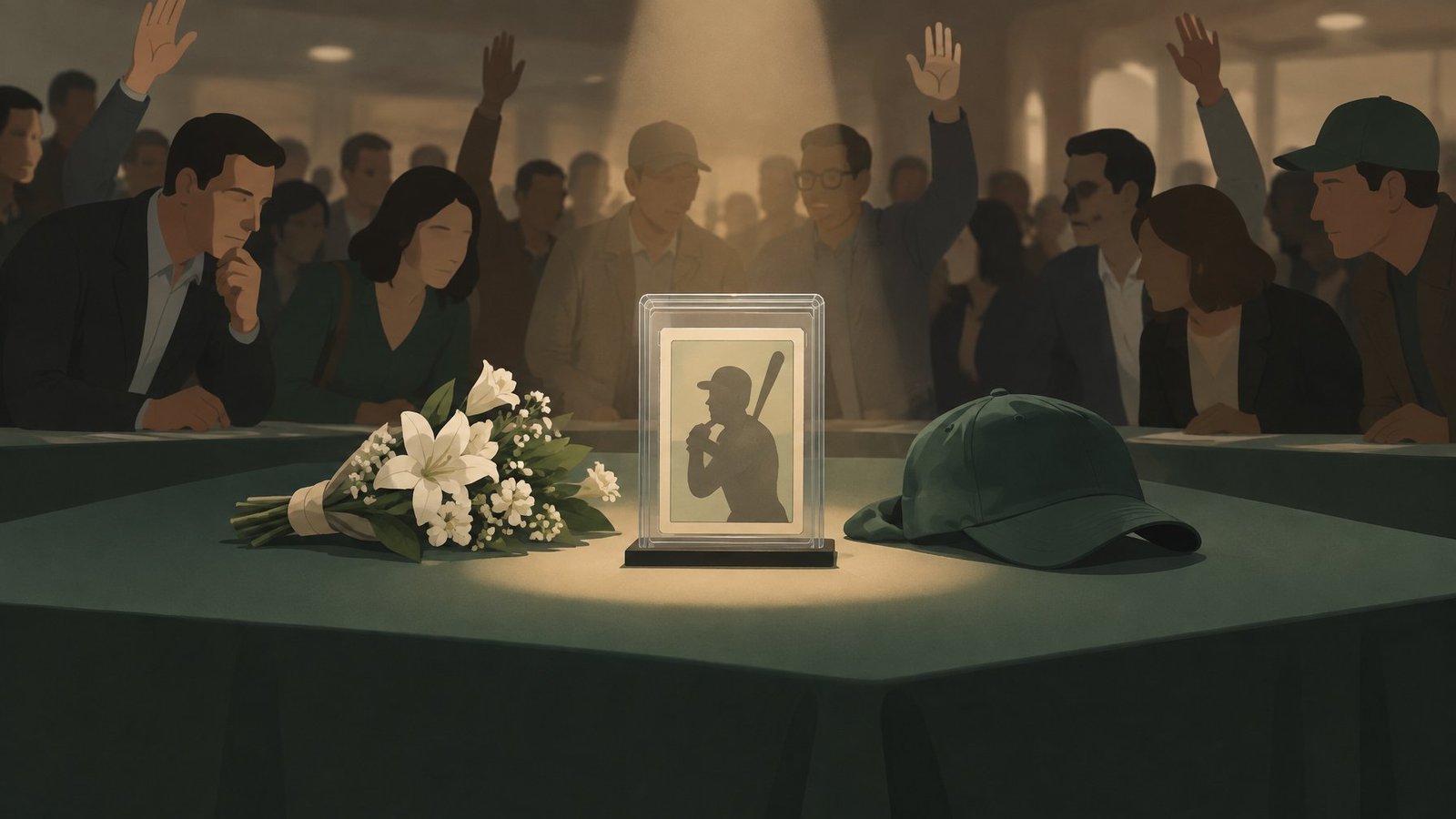
When a baseball legend dies, the price of his rookie card goes up by about 20%, and it stays up for weeks. Since every player’s death is inevitable, economists say that bump should not exist in an efficient market.
The study is by Michele J. Aquino and Seth Gershenson of American University’s School of Public Affairs. It was published online on April 7, 2024 in the Journal of Sports Economics.
Nine Hall of Famers, 2,161 sales
The authors picked their sample by fixed rules. They took members of the Baseball Hall of Fame whose rookie cards came out during Topps’ monopoly on licensed baseball cards and who died between 2017 and 2021, when online card sales were well established.
That produced nine players: Willie McCovey, Frank Robinson, Lou Brock, Joe Morgan, Bob Gibson, Tom Seaver, Don Sutton, Jim Bunning and Phil Niekro. Their Topps rookie cards were issued between 1957 and 1967.
The researchers collected every verified sale of these cards graded by PSA, the leading grading service, from September 2016 to December 2021. That came to 2,161 transactions, with an average price of $1,291 and an average grade of 5.8 out of 10. Forty-two percent of the sales happened in 2020, during the pandemic card boom.
They used an interrupted time series design, looking for a break in each card’s price trend at the date of death. The models controlled for card grade and scarcity, day of the week, month and the overall state of the card market, which grew, corrected and recovered over the period.
A bump that fades but does not vanish
Across specifications, a player’s death raised the sale price of his rookie card by 18 to 20%. The effect held up whether the authors used quarter-by-quarter market controls or a smooth time trend.
The jump was biggest right after the news. In narrower windows around each death, from 90 days down to 15, the estimated increase rose to between 28 and 31%. Prices then eased back but remained significantly above pre-death levels, staying elevated for at least 60 days.
Sales also spiked in the days immediately after a death, against a typical pace of about five a day.
The effect was positive for every player, with most individual estimates between 20 and 50%. It was smaller and statistically uncertain for Tom Seaver and Jim Bunning. The authors note that the public knew about the serious illnesses of Seaver and Gibson before they died, which may have dulled the surprise.
Position players saw an effect about 70% larger than pitchers. The authors suggest the news shock may be magnified in the bigger market for hitters’ cards.
Money left on the table
The efficient markets hypothesis says an asset’s price already reflects all public information. A player’s eventual death is the most predictable information there is, so the authors read the jump as a pricing anomaly and a profit opportunity that collectors are leaving unexploited.
They interpret the pattern as a nostalgia effect: a celebrity’s death revives demand for the things associated with him. For a card investor, the lesson is uncomfortably concrete. The best time to sell a legend’s rookie card has been the weeks after his obituary runs.
Study Details:
- Title: Expecting the Expected? Documenting Nostalgia Effects on Baseball Card Prices
- Authors: Michele J. Aquino, Seth Gershenson
- Journal: Journal of Sports Economics
- Publication Date: April 7, 2024
- DOI: 10.1177/15270025241245638