
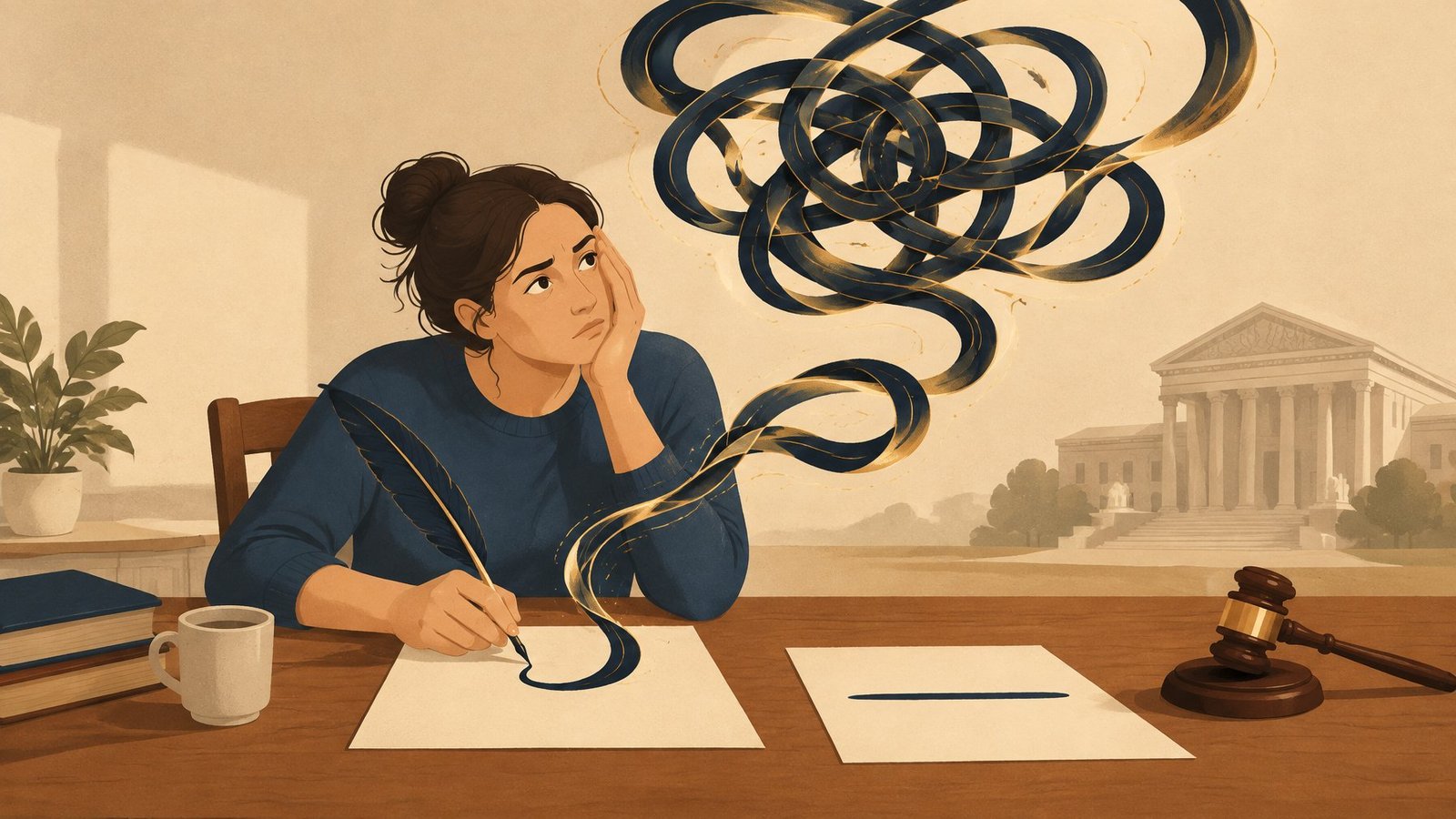
Ask ordinary people to write a law and they start writing like lawyers. In two experiments, nearly half of the sentences people wrote as official laws had a clause wedged into the middle, compared with about 6% when they described the same crime as a story.
The study, “Even laypeople use legalese”, was published online on August 19, 2024, in the Proceedings of the National Academy of Sciences. Its authors are Eric Martínez of the University of Chicago Law School, Francis Mollica of the University of Melbourne and Edward Gibson of the Massachusetts Institute of Technology.
Laws are built differently from other English
The hallmark of legalese is what linguists call center-embedding: one clause stuffed inside another, so the reader has to hold the start of a sentence in memory until it finally resolves. The authors cite a Massachusetts drunk driving law in which more than 100 words separate the subject “Whoever” from the verb “shall be punished”.
The team first checked how common this is. Using natural language processing tools, they compared the 2021 United States Code with six kinds of everyday English from the Corpus of Contemporary American English, including academic writing, fiction, news, magazines, spoken transcripts and TV and film scripts. Laws contained several times more center-embedded clauses than any of them, and much longer distances between related words.
Writing a law triggers the style, editing does not
The researchers then tested two explanations. The “copy-and-edit” idea holds that legal sentences become tangled because drafters keep inserting extra conditions into existing text. The “magic spell” idea holds that convoluted structure is a signal, marking a text as an authoritative act that changes the world, in the way rhyme or foreign words mark a spell.
In the first preregistered experiment, 204 participants recruited online wrote both laws prohibiting crimes such as arson, bribery and drunk driving, and stories about someone committing those crimes. In some trials they wrote from scratch; in others they wrote a draft and then had to add new details. Some 48.1% of sentences in the laws were center-embedded, against 5.8% in the stories. Having to edit a draft made no significant difference.
A second experiment with 82 participants used a tighter comparison: an official law versus an unofficial description of the same law. The gap shrank but held, at 54.6% versus 25.7% of sentences. Changing whether the punishment or the conditions of guilt were presented first had no significant effect. The results also held when the team accounted for how much legal content each answer contained.
The authors read this as support for the magic spell hypothesis, describing law as “a rare exception to the general tendency in human language toward communicating efficiently.” Because the convoluted structure appears to be a stylistic signal rather than a by-product of complex content, they argue, laws could be rewritten in plain style without losing or distorting what they say.
The participants were not lawyers, which is the point: the same people produced the tangled style only when told they were lawmakers.
Study Details:
- Title: Even laypeople use legalese
- Authors: Eric Martínez, Francis Mollica, Edward Gibson
- Journal: Proceedings of the National Academy of Sciences, Vol. 121, No. 35
- Publication Date: August 19, 2024
- DOI: 10.1073/pnas.2405564121