
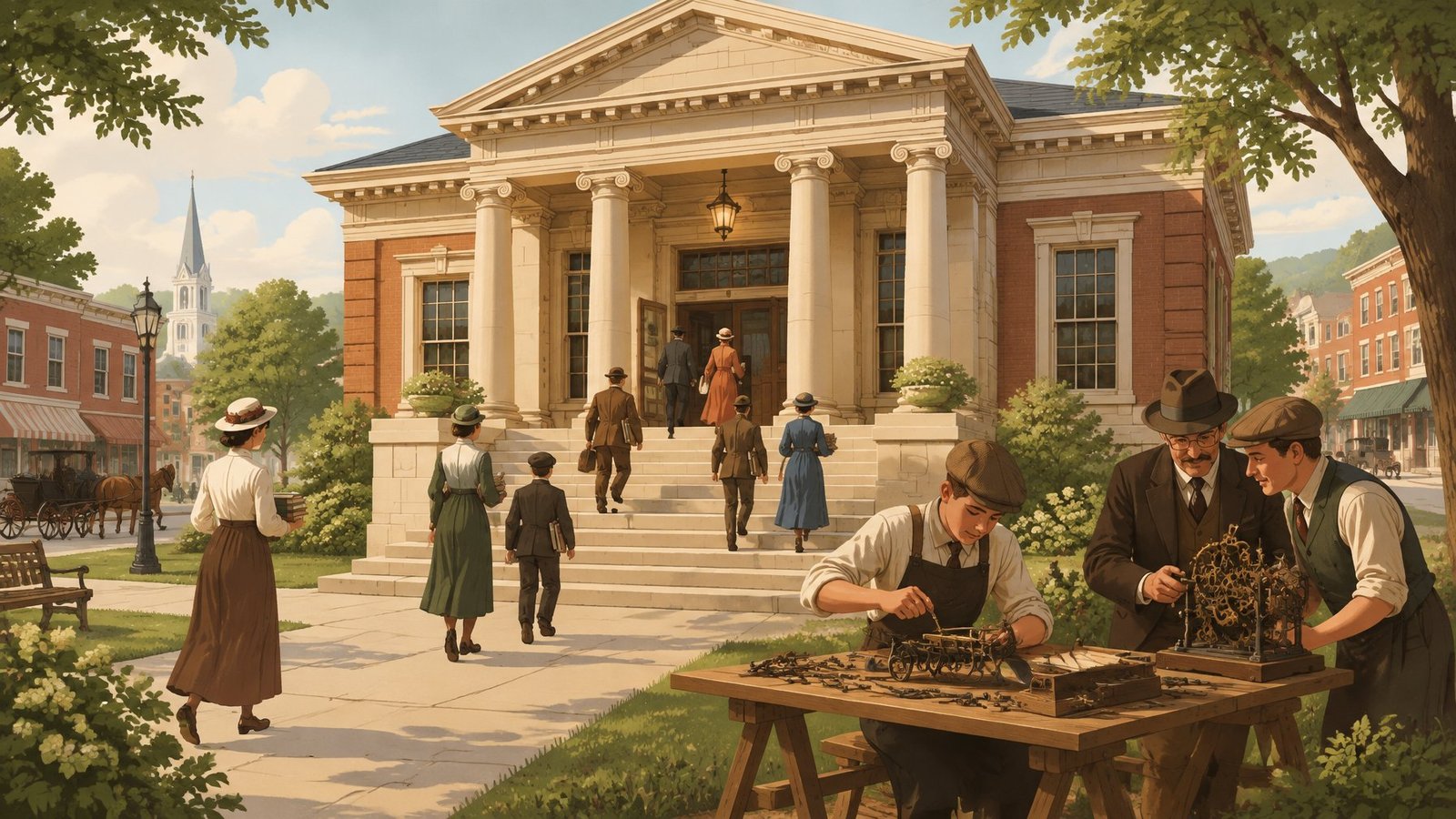
A free public library in town made Americans more inventive. Cities that accepted one of Andrew Carnegie’s library grants saw patenting climb by 10 to 12 percent over the following two decades, compared with similar cities that turned the money down.
The study is by economists Enrico Berkes of the University of Maryland, Baltimore County and Peter Nencka of Miami University. It appeared in the Review of Economics and Statistics on July 17, 2026, in volume 108, issue 4.
A natural experiment built from rejection letters
Between 1883 and 1919, the steel magnate paid for more than 1,500 public library buildings across the United States. Before the program, the country had roughly 600 public libraries, many squeezed into basements, attics or, in one Ohio town, a fire department horse stall.
Comparing towns with and without libraries is tricky, because places that want a library may differ in other ways. So the authors built an unusual control group: more than 200 cities that applied, qualified, and won preliminary approval for a Carnegie grant, but never built the library.
Many of those cities said no because Carnegie was unpopular, especially with organized labor. A union leader in Wheeling, West Virginia, which rejected the offer, called a proposed library a “disgraceful monument.” Others balked at Carnegie’s demand that towns pledge 10 percent of the grant each year for upkeep.
The authors show that accepting and rejecting cities looked alike on demographic and economic measures before the grants, and followed parallel patenting trends. They then tracked patents filed by inventors living in each city.
Practical trades gained most
Patenting in library towns began pulling ahead soon after a grant was awarded, which matches typical construction times of one to three years. In an earlier working paper version, the gap peaked between 5 and 15 years after the grant.
The rise was not driven by low-quality patents or by population growth, according to that version. Both women and foreign-born residents patented more after libraries opened, though their share of all patents changed little.
The biggest gains came in practical fields such as farming, construction and mechanical engineering, which fits what library shelves of the era held. Effects were smaller in highly technical areas such as chemistry and physics.
Books and meetings
The authors point to two channels. Patents from library towns were somewhat more likely to cite books, magazines or earlier patents, suggestive evidence that inventors were reading. And patents with multiple inventors increased, which the authors link to libraries serving as meeting places for clubs, reading groups and civic organizations.
In St. Louis, one 1924 account listed groups meeting at the library that ranged from mothers’ clubs and socialists to dance classes and political meetings.
Study Details:
- Title: Knowledge Access: The Effects of Carnegie Libraries on Innovation
- Authors: Enrico Berkes, Peter Nencka
- Journal: Review of Economics and Statistics
- Publication Date: July 17, 2026
- DOI: 10.1162/rest_a_01446