
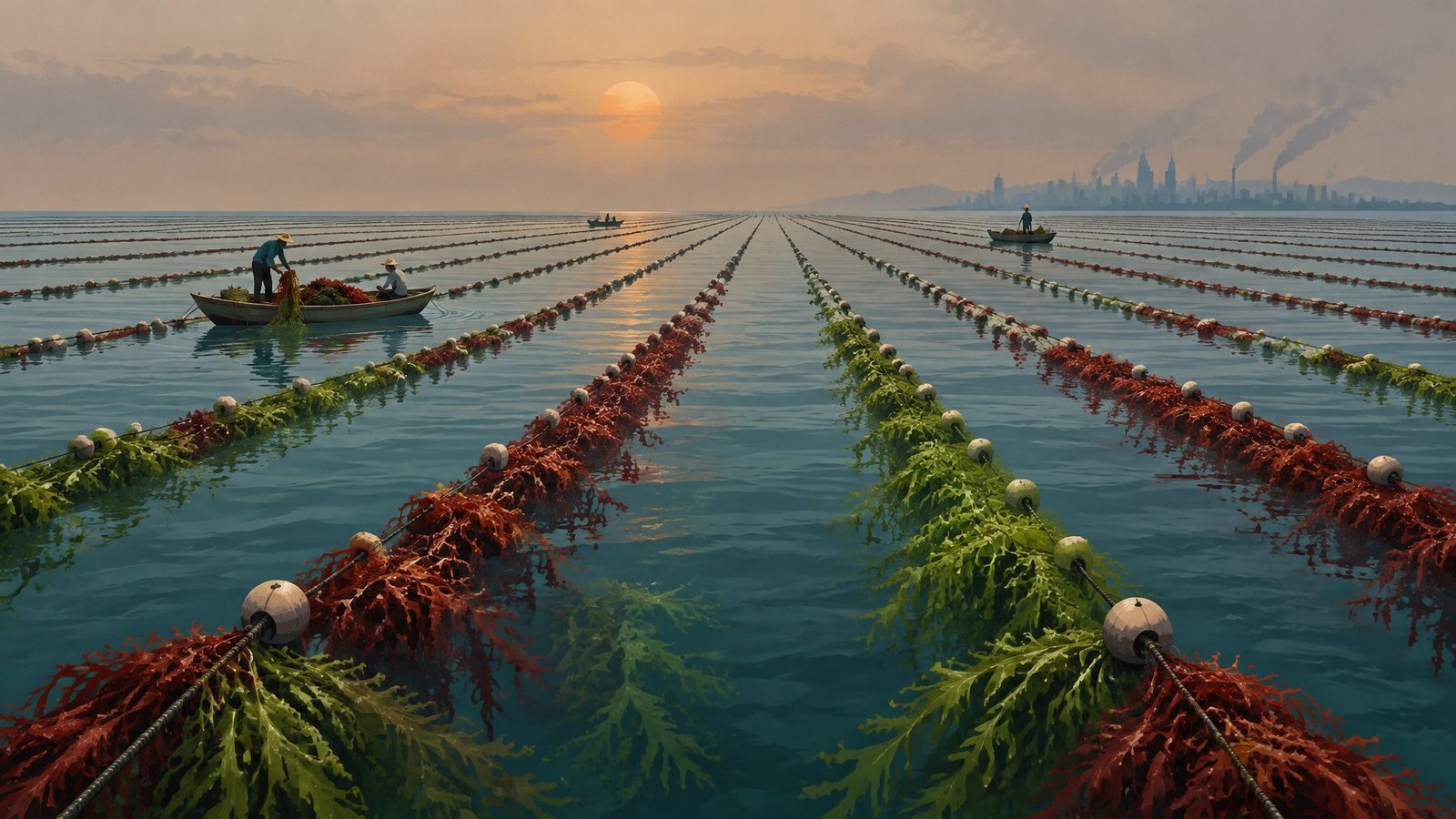
If a nuclear war blotted out the sun and crops failed, seaweed farms in tropical oceans could be scaled up to supply the equivalent of 45% of global human food demand within about 9 to 14 months. Strangely, the worse the war, the faster the seaweed grows.
That is the conclusion of a modelling study led by Florian Ulrich Jehn of the Alliance to Feed the Earth in Disasters (ALLFED), with co-authors at Louisiana State University, the Leibniz Institute for Astrophysics Potsdam, the University of the Philippines Diliman and other institutions. “Seaweed as a Resilient Food Solution After a Nuclear War” was published in the journal Earth’s Future on January 9, 2024.
Why seaweed
Soot from burning cities, a large volcanic eruption or an asteroid strike could cut the sunlight reaching Earth for years. Earlier work cited by the authors suggests that after an all-out war between Russia and the US, agriculture could fall by up to 90% in the worst year, while the world’s wheat stores would last only a few months.
Seaweed grows fast, needs no freshwater, land, fertiliser or pesticides, and can be farmed with simple ropes, anchors and buoys. The team simulated the growth of Gracilaria tikvahiae, an edible red seaweed farmed in places such as Brazil and China, across the world’s oceans for ten years after nuclear wars of different sizes, using existing nuclear winter climate simulations.
Stirred-up nutrients feed the farms
Seaweed growth rose with the severity of the war, peaking in the second year. The main brake on seaweed in today’s oceans is a shortage of nutrients at the surface. Cooling after a nuclear war would churn the ocean and bring nutrients up from below, more strongly the bigger the war.
The authors focused on a US-Russia war injecting 150 million tons of soot. They found two kinds of ocean worth farming. One band near the equator covers about a third of the ocean and would take about 14 months to deliver food, needing some 1,572,000 square kilometres of farms. A more productive zone, mostly in the Pacific and off coasts such as Chile and Peru, covers 13% of the ocean and could start feeding people after about 9 months on roughly 416,000 square kilometres, about the size of Colombia.
The 45% target was split among uses: seaweed would replace 15% of human food, 10% of animal feed and 50% of biofuel production. In the 150 million ton scenario, the authors calculate this would raise available food from 0.25 times human needs to 0.7.
Building farms fast enough is the hard part
The model’s limit was never the seaweed. It was how quickly new farms could be built, which would mean hundreds to thousands of square kilometres a day. The authors also flag a lack of seaweed spores, a shortage of skilled labour and the risk of maintenance lapses, problems they say would need preparation beforehand.
Health is another constraint. Seaweed can carry high levels of iodine and heavy metals such as arsenic, and many people may not digest large amounts well. That is why the team capped seaweed at 15% of human food, below the roughly 20% that has caused health problems.
Not every country would benefit. New Zealand, often seen as well placed to ride out a nuclear winter, has coastal waters the model found too cold or nutrient-poor to add much seaweed.
Study Details:
- Title: Seaweed as a Resilient Food Solution After a Nuclear War
- Authors: Florian Ulrich Jehn, Farrah Jasmine Dingal, Aron Mill, Cheryl Harrison, Ekaterina Ilin, Michael Y. Roleda, Scott C. James, David Denkenberger
- Journal: Earth’s Future
- Publication Date: January 9, 2024
- DOI: 10.1029/2023EF003710