
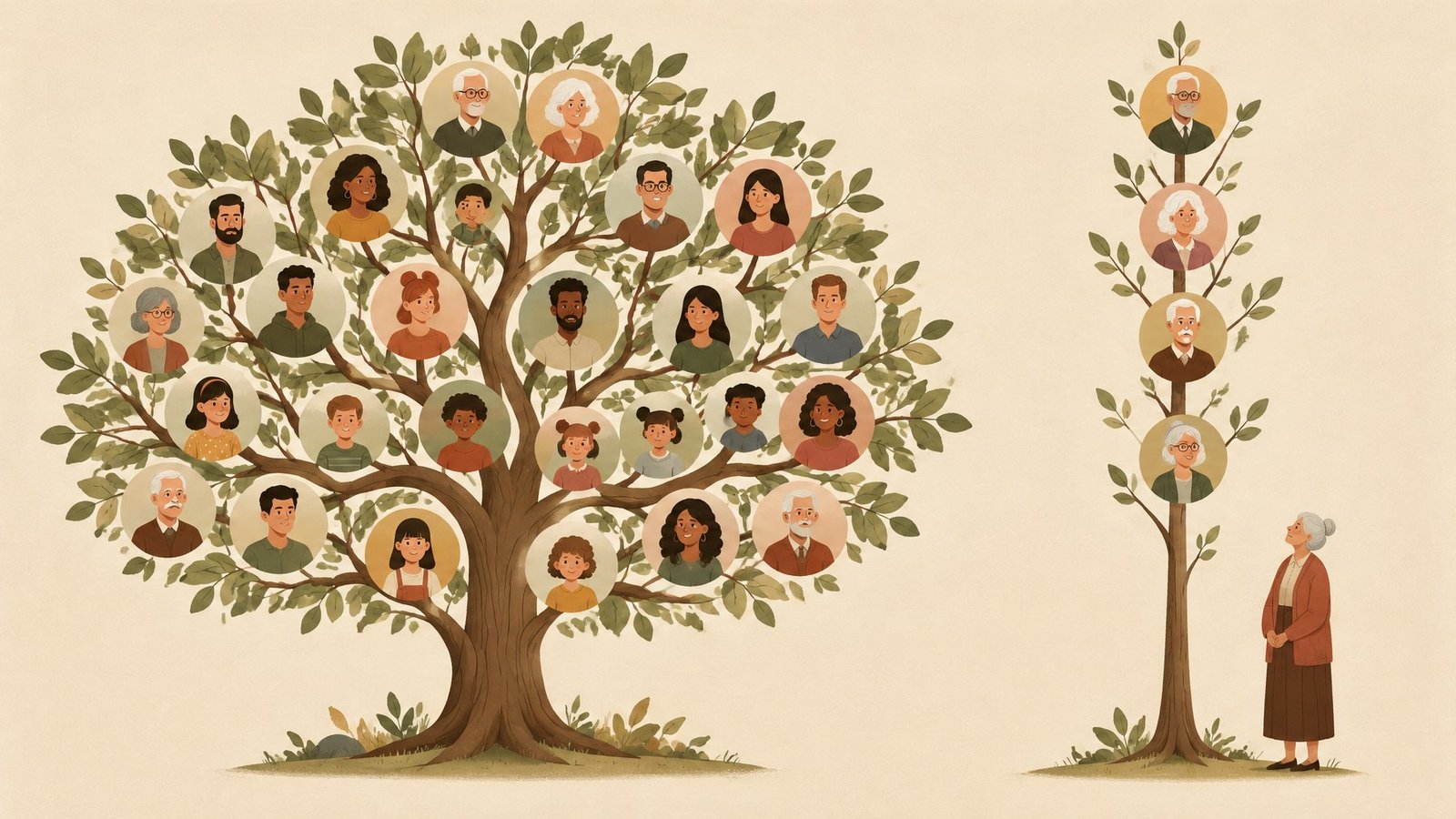
Families around the world are shrinking, and fast. A woman aged 65 in 1950 could expect to have 41 living relatives. A woman of the same age in 2095 is projected to have about 25, a global decline of 38%.
The projections come from Diego Alburez-Gutierrez of the Max Planck Institute for Demographic Research in Rostock, Iván Williams of the University of Buenos Aires and Hal Caswell of the University of Amsterdam. Their study was published in the Proceedings of the National Academy of Sciences on December 19, 2023.
Counting kin for every country
Population projections usually stop at headcounts. The authors went a step further and asked what changing birth and death rates mean for the size and shape of each person’s family. They combined matrix kinship models with the United Nations’ 2022 World Population Prospects, covering every country from 1950 to 2100, and ran 1,000 probabilistic trajectories per country.
They tracked a typical woman, whom they call Focal, and counted her living great-grandparents, grandparents, parents, children, grandchildren, great-grandchildren, aunts and uncles, nieces and nephews, siblings and cousins. They focused on women because women provide most informal care in most countries and are more likely to end up without kin in old age.
Smaller, older, more vertical families
The global figure for a 65-year-old falls from 41 relatives to 25, with a projection interval of 18.8 to 34.7. The steepest drop is in Latin America and the Caribbean, from about 56 relatives to 18.3, a fall of 67%. In Europe and North America, where families were already smaller, the figure goes from 25 to 15.9.
Country differences are dramatic. A 65-year-old woman in Zimbabwe in 1950 could expect 82 living relatives; her counterpart in 2095 is projected to have 24.1, a 71% decline. In Italy, the smallest case shown, the figure slips from 18 to 12.7.
The mix of relatives changes too. In China, cousins made up 39% of a newborn girl’s family network in 1950, about 11 cousins. In 2095 she is projected to have just 1.1 cousins, 7% of her network. Meanwhile great-grandparents multiply: a Chinese newborn in 2095 can expect 5.3 living great-grandparents, about three times as many as in 1950. A 65-year-old Chinese woman, who in 1950 had around 15 grandchildren, is projected to have 1.3.
Families also age. For an Italian woman of 35, her grandmother’s average age rises from 77.9 years in 1950 to a projected 87.7 years in 2095.
Who will provide the care
The authors warn that more grandparents does not mean more help. Those older relatives “may be too old and frail to provide support” and could instead need care themselves, adding to the load on middle-aged people looking after parents and grandparents at once.
They list the model’s simplifications. Male fertility was set equal to female fertility because data are missing for many countries, migration is not included, and the model assumes everyone in a country faces the same birth and death rates. It also counts only biological kin, leaving out spouses, in-laws and chosen family.
Their conclusion is concrete: with family networks thinning, the authors call for more investment in childcare and old-age care, because for much of the world relatives remain the main source of support.
Study Details:
- Title: Projections of human kinship for all countries
- Authors: Diego Alburez-Gutierrez, Iván Williams, Hal Caswell
- Journal: Proceedings of the National Academy of Sciences
- Publication Date: December 19, 2023
- DOI: 10.1073/pnas.2315722120