
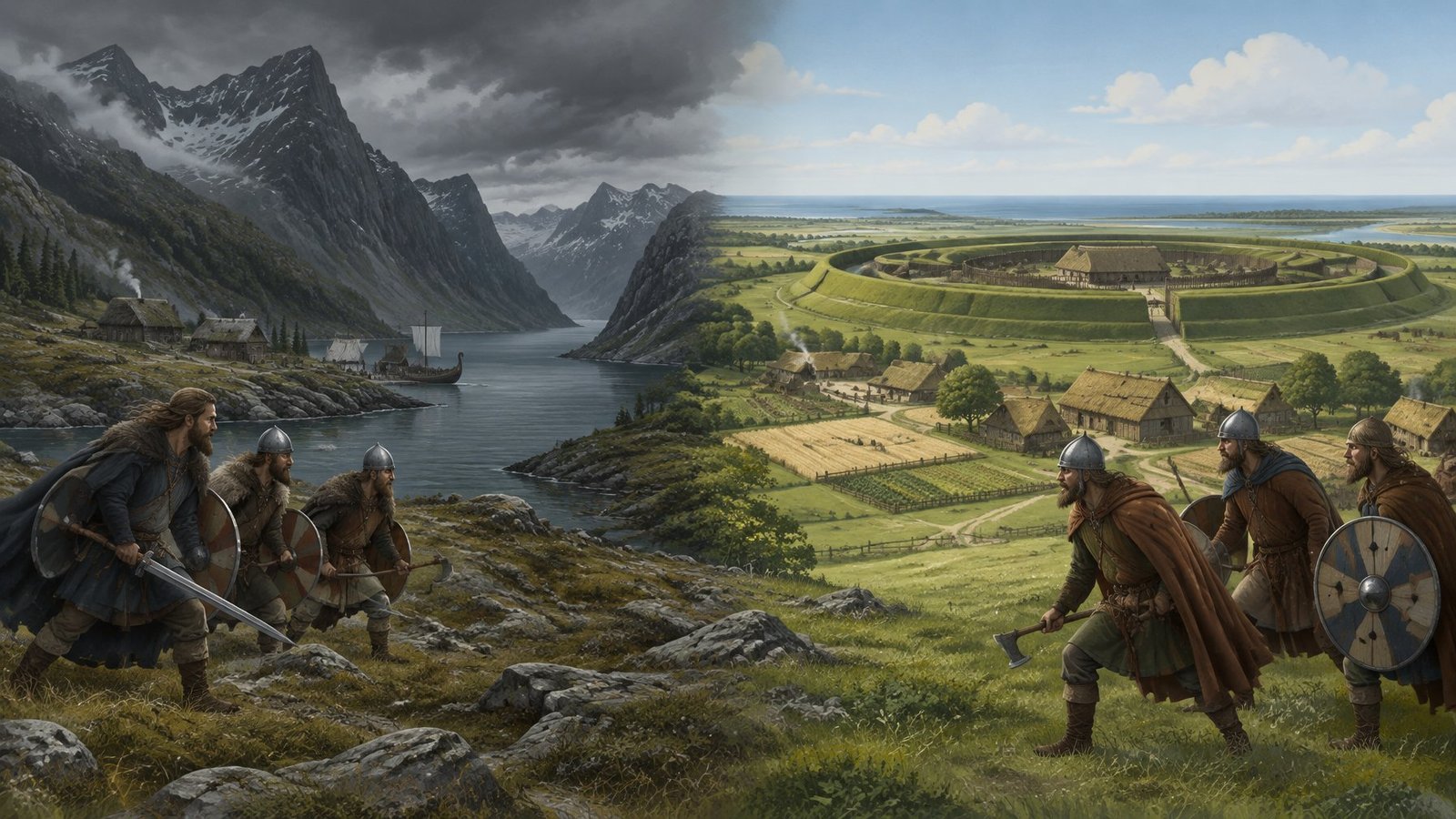
Vikings are famous for exporting violence across Europe, but at home the two big Scandinavian societies were very different places to live. A new study of skeletons, swords and monuments finds that Viking Age Norway was far more violent than Denmark, where most killings appear to have been punishments handed out by those in power.
The study is by Jan Bill of the Museum of Cultural History at the University of Oslo, sociologist David Jacobson of the University of South Florida, Susanne Nagel of the Deutscher Verband für Archäologie in Berlin and Lisa Mariann Strand of the NTNU University Museum in Trondheim. It was published online on June 26, 2024, in the open-access Journal of Anthropological Archaeology.
Skeletons tell two stories
The team combined archaeology, bone analysis, the study of old texts and sociology. Their central idea is a long-standing one: as central authority grows stronger, everyday violence should shrink.
The skeletal evidence came from 30 Norwegian individuals, previously selected for genetic analysis, and 82 Danish skeletons examined in an earlier study. Of the Norwegians, 18, or 60%, showed injuries from weapons, including 72% of the men and 42% of the women. Eleven of them, or 37%, had died violently, all struck with bladed or pointed weapons.
Among the Danes, only 7% had died violently. And the character of those deaths was different. Five of the six Danish killings were executions, four by beheading and one by hanging. None of the Norwegian deaths looked like executions; all appeared to be slayings. The differences in trauma were large enough to be statistically significant despite the small samples.
Swords and soil
Weapons point the same way. Norwegian museum databases hold 2,095 swords firmly dated to the Viking Age. In Denmark’s extensive Viking Age burials, the researchers counted 80 swords in graves.
To measure how steep the social pyramid was, the team looked at runestones, which mark status and wealth, and at large building projects, which show who could command labour. Denmark built ring fortresses such as Aggersborg, Fyrkat and Trelleborg, each of which consumed an estimated 12,000 to 20,000 cubic metres of soil. The authors argue that Danish society grew progressively more stratified and complex than Norway’s.
A more civilian society
Taken together, the authors describe Denmark as the more “civilianized” society, where an elite had largely taken control of the means of violence and used it in standardised punishments. In Norway, without that kind of central power, violence was more widespread and less uniform.
They suggest that Denmark and Norway were sociologically distinct societies, which fits recent genetic findings that the two regions had distinct, though similar, genetic profiles.
The authors note that the skeleton samples are small and mostly represent the landowning farmers who dominated Viking Age society, rather than groups found in military mass graves or execution sites. Still, the contrast was stark: in their samples, a Norwegian was more than five times as likely as a Dane to have died a violent death.
Study Details:
- Title: Violence as a lens to Viking societies: A comparison of Norway and Denmark
- Authors: Jan Bill, David Jacobson, Susanne Nagel, Lisa Mariann Strand
- Journal: Journal of Anthropological Archaeology
- Publication Date: June 26, 2024
- DOI: 10.1016/j.jaa.2024.101605