
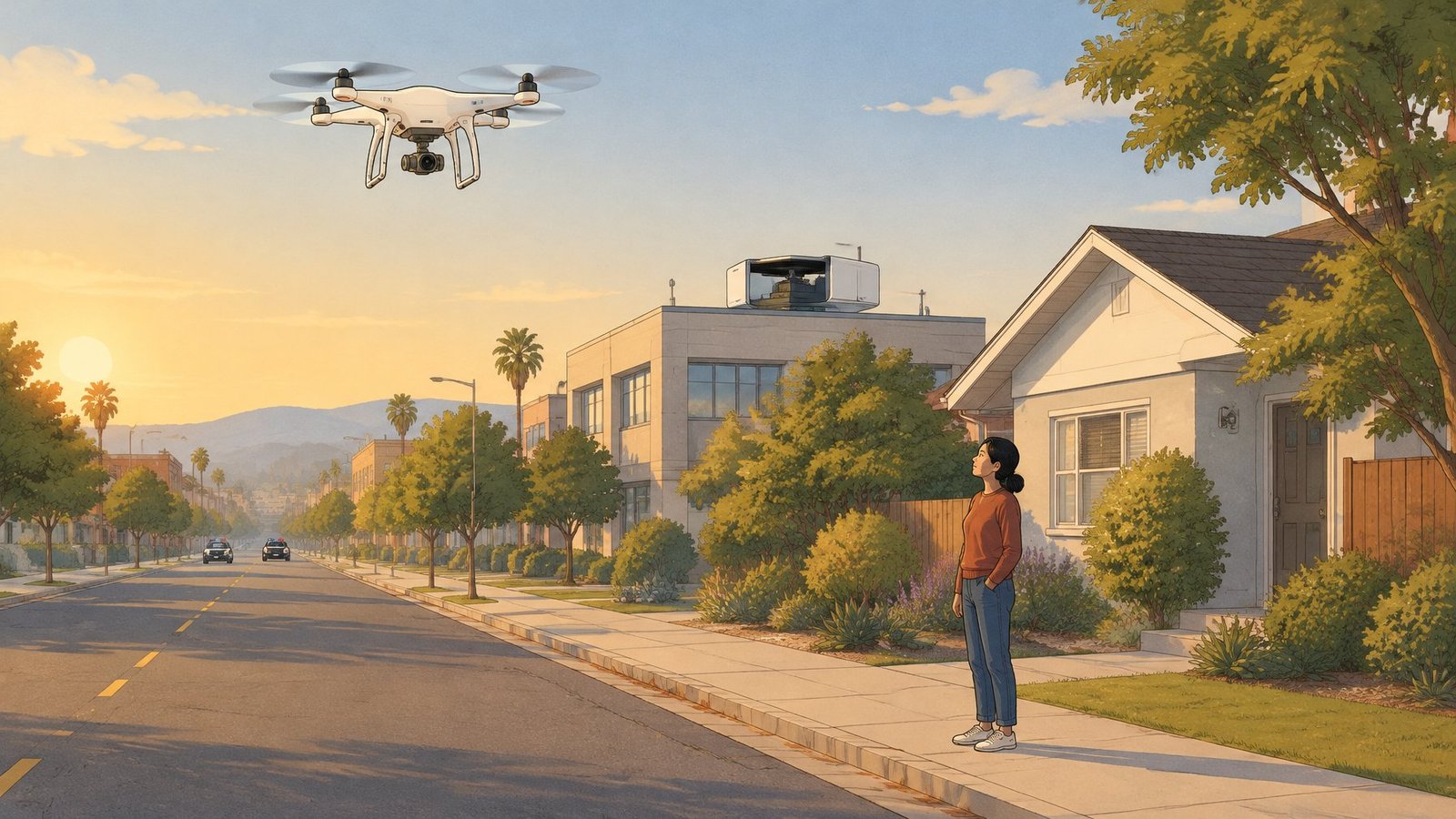
Police drones sent straight to 911 calls reached the scene in a little over two minutes on average, and they got there before any officer on the ground in about three out of four calls, according to a study of one California police department.
In some cases the drone handled the call entirely on its own, and no officer had to go out at all.
The study, “Drone as First Responder (DFR): A Short Report on a DFR Program in an American Police Agency,” was written by Rylan Simpson. It was published in the American Journal of Criminal Justice on August 22, 2026, and is one of the first studies of these programs in American policing.
Drones that launch themselves
Police drones used to go up only when officers asked for one, to find a person or take photos of a scene. In “drone as first responder” programs, the drone flies to a call right away, without anyone on the ground requesting it.
The department in the study, which is not named, polices a city of about 320,000 people spread over nearly 70 square miles, with about 255 sworn officers. It started its program in 2023.
It runs 12 drones from boxes on the roofs of 11 buildings across the city. One full-time pilot, working from the department’s real-time crime center, flies them from 1 p.m. to 11 p.m., Wednesday through Saturday.
The pilot can listen to 911 calls live as dispatchers take them, before a call is even entered into the dispatch system. Once launched, a drone can fly itself to the address at up to 33 mph, and it returns to its box to recharge when the job is done.
Ten calls a day
Simpson analyzed dispatch and records data from October 11, 2025 to January 30, 2026. In that time a drone reached the scene of 650 calls, about 10 per working day.
The calls covered 75 different types. The most common were reports of something suspicious, requests to check on someone, and disturbances.
Average response time was 134 seconds. The pilot almost always launched the drone on their own initiative, and a dispatcher formally sent it in only about 2% of calls.
When officers also responded to a phone call, the drone got there first about 73% of the time. In 13% of phone-initiated calls the drone was the only unit to respond, and the call was closed without an officer attending.
Not just minor calls
Many of the calls were serious. About 31% led to a written report, most of those involved a documented offense, and most of the calls with an offense ended in an arrest.
Simpson concludes that the program appears to be delivering on its promise of a fast response, and that it works closely with the department’s other technology, including license plate readers and its live 911 feed.
What it does not show
The report describes one program in one city over three and a half months. It cannot say whether the drones change what happens on a call, make anyone safer or affect crime rates.
Simpson calls for research on those questions, and on how the public and officers see the programs, including what they cost compared with what they deliver.
Study Details:
- Title: Drone as First Responder (DFR): A Short Report on a DFR Program in an American Police Agency
- Author: Rylan Simpson
- Journal: American Journal of Criminal Justice, Volume 51, pages 1184-1191
- Publication Date: August 22, 2026
- DOI: 10.1007/s12103-026-09944-w