
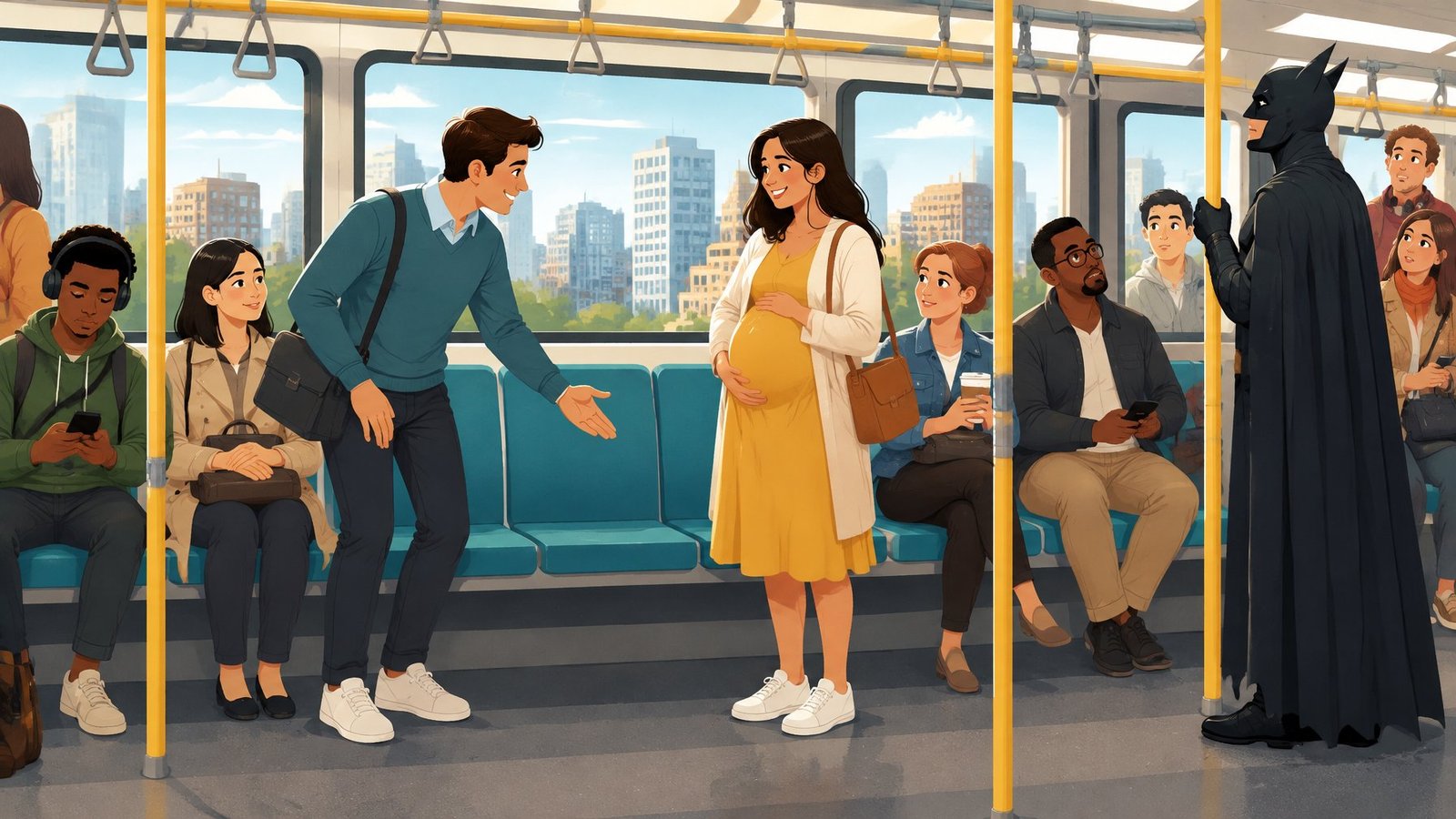
An unexpected superhero on the train made strangers kinder. When a person in a Batman costume stepped onto Milan metro cars, passengers became far more likely to give their seat to a woman who appeared to be pregnant.
The field experiment was run by Francesco Pagnini and colleagues at the Department of Psychology of Università Cattolica del Sacro Cuore in Milan. It was published in npj Mental Health Research on November 3, 2025.
The team set out to test whether a surprising event, by breaking people out of routine, could make them more attentive to the people around them.
A staged pregnancy and a caped stranger
The researchers used a quasi-experimental design on crowded trains. In the control condition, a female experimenter wearing a prosthetic belly boarded with a silent observer.
In the experimental condition, the setup was identical except that a second experimenter dressed as Batman entered through another door about three meters away. He never interacted with the woman. For ethical reasons he skipped the full face mask, but wore the cape, logo and pointed cowl.
An observation only counted if every seat in the car was taken and no more than five people were standing between the seats. Each session lasted one stop, roughly two to four minutes. Both teams worked at the same time in different cars to rule out effects of time and place.
The study was registered in advance on ClinicalTrials.gov on July 1, 2024.
Seats offered far more often
Across 138 rides, 61 with Batman and 77 without, someone offered a seat in 67.21% of Batman rides compared with 37.66% of control rides. The odds of help were about 3.4 times higher when Batman was present.
Most helpers in both conditions were women, about 68% with Batman and 66% without, with an estimated average age of around 41 to 42.
When asked why they gave up their seat, most people cited the importance of recognising pregnancy, or social norms, upbringing and safety. Nobody linked their gesture to Batman.
Many helpers never saw him
Of the 32 helpers interviewed in the Batman condition, 14, or 43.75%, said they had not seen him at all. The authors speculate that a shift in attention triggered in some passengers may spread socially through a carriage, reaching people who never noticed its cause.
They also offer a more modest reading. The superhero may simply have acted as a prosocial prime, though they note that many priming effects have failed to replicate.
The authors list clear limits. The study covered one transit system, used one positive and very recognisable character, and relied on observers to estimate passengers’ age and sex. Whether other unexpected figures would have the same effect remains untested.
Study Details:
- Title: Unexpected events and prosocial behavior: the Batman effect
- Authors: Francesco Pagnini, Francesca Grosso, Cesare Cavalera, Valentina Poletti, Giacomo Andrea Minazzi, Anna Missoni, Laura Bogani, Mauro Bertolotti
- Journal: npj Mental Health Research
- Publication Date: November 3, 2025
- DOI: 10.1038/s44184-025-00171-5