
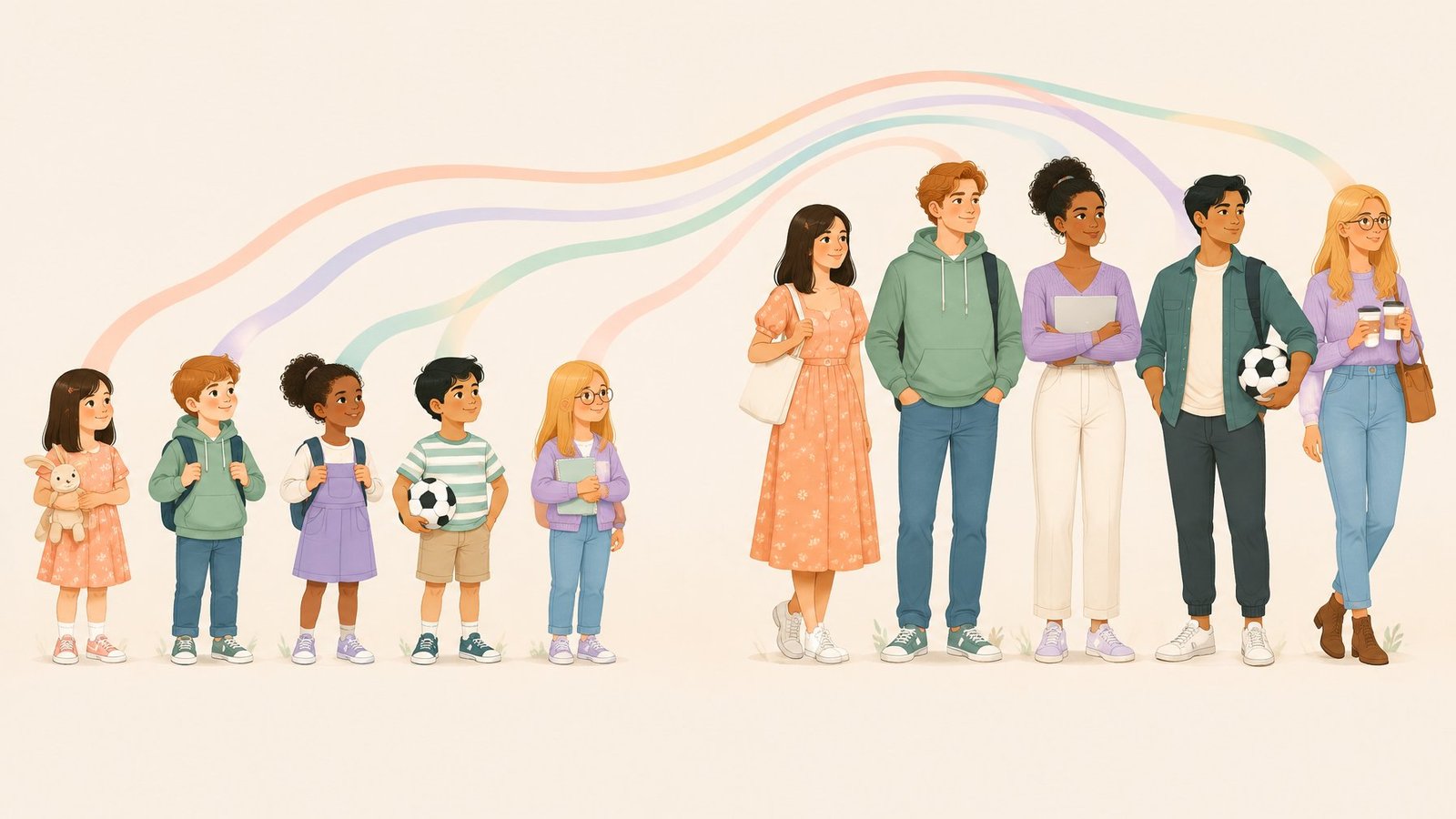
Adults seem to grow into their names, but children have not done so yet. Strangers could pick an adult’s real first name from a list of four at better than chance rates, and a neural network found that adults sharing a name look more alike. Neither worked for children’s faces, which points to names shaping appearance over time rather than parents picking names to fit a baby’s looks.
The paper, “Can names shape facial appearance?”, was published online on July 15, 2024, in the Proceedings of the National Academy of Sciences. Its authors are Yonat Zwebner and Moses Miller of the Arison School of Business at Reichman University, Noa Grobgeld and Ruth Mayo of the Hebrew University of Jerusalem, and Jacob Goldenberg of Reichman University and Columbia Business School.
Matching names to faces works only for adults
The team built on an earlier finding called the face-name matching effect: shown a headshot and four possible first names, people pick the right one more often than the 25% expected by chance. The question was whether this reflects how babies look at birth, or how people change as they live with a name and its social expectations.
In the first study, 117 Israeli students matched names to the faces of adults and of 9-year-olds. They got the adults right 30.4% of the time but the children only 23.6% of the time, no better than guessing. Children recruited at a science museum showed the same pattern. A preregistered replication with a new set of photos found adults matched in 27.0% of cases and children in 22.4%, and child participants again matched adult faces above chance but not children’s.
That children could match adult faces rules out the idea that the effect is just people being better at reading faces from their own age group.
A neural network sees the same thing
To take human judgment out of the loop, the researchers trained a type of neural network that learns facial similarity on 1,164 faces from U.S. sources, 607 adults and 557 children, sharing the same 20 first names. Faces were cropped so that hardly any hair was visible.
For adults, two faces with the same name were more alike than two faces with different names in 60.05% of test comparisons, well above the 50% chance level. For children, the figure was 51.88%, not distinguishable from chance.
Artificially aged children do not match their names
The final test used software to age children’s photos so they looked like adults. If names are matched to inborn features, these digitally aged faces should still fit their names. They did not. People matched real adult faces to their names 27.98% of the time but the aged children’s faces only 24.25% of the time, and the network’s same-name similarity for aged faces was 51.41%, essentially chance.
The authors argue that people may absorb the expectations attached to their name and act on them, through choices like hairstyle and glasses or through habitual expressions. They suggest a direct test of the alternative: comparing people named before birth with people named after their parents had seen them.
Study Details:
- Title: Can names shape facial appearance?
- Authors: Yonat Zwebner, Moses Miller, Noa Grobgeld, Jacob Goldenberg, Ruth Mayo
- Journal: Proceedings of the National Academy of Sciences, Vol. 121, No. 30
- Publication Date: July 15, 2024
- DOI: 10.1073/pnas.2405334121