
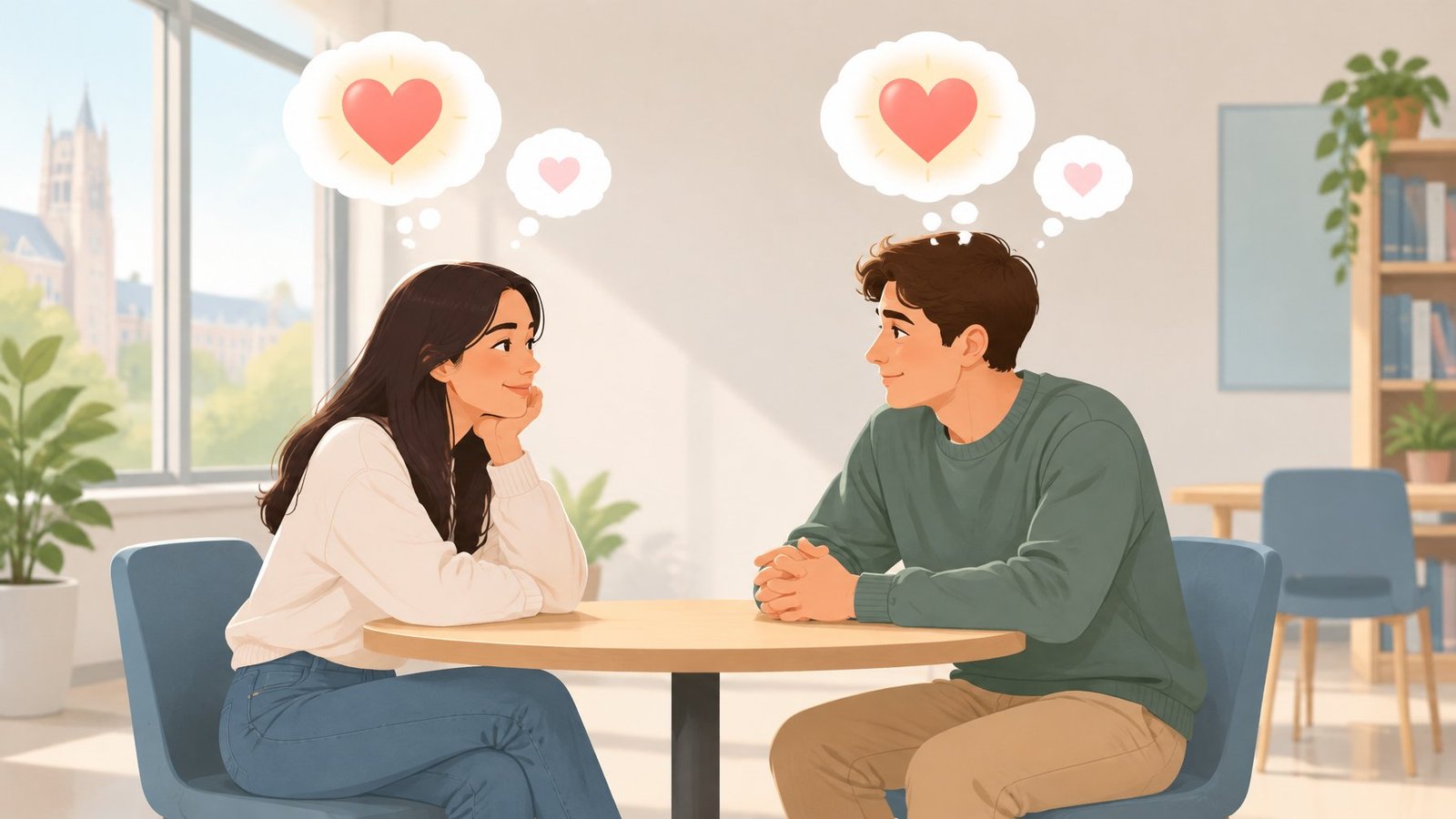
After a first conversation with a stranger, most people walk away thinking they liked the other person more than the other person liked them. In fact, the other person usually liked them more than they guessed.
That pattern, known as the liking gap, held up in a large replication covering 1,835 young adults across 12 separate getting-acquainted studies.
The analysis is by Susan Sprecher, a Distinguished Professor in the Department of Sociology and Anthropology at Illinois State University. It was published online in The Journal of Social Psychology on October 23, 2025.
Twelve studies, one question
All the data came from social interaction studies run in Sprecher’s laboratory at a large public university in the US Midwest. The participants were students, 83.0% of them women, with an average age of 19.82.
Pairs of strangers arrived in separate rooms, each greeted by their own experimenter. They then got to know each other, either face to face or over video, usually with a structured self-disclosure task built from established closeness-generating procedures. Some studies used free conversation or varied the type of disclosure.
Afterwards, each person answered two questions on a 1 to 7 scale: “How much did you like the Other?” and “How much do you think the Other liked you?”
The size of the gap
Participants reported liking their partner at an average of 5.26. They thought their partner liked them at only 4.71, a statistically strong difference with an effect size of d = .70.
The same 4.71 also fell short of how much partners actually said they liked them, which averaged 5.26. So people underestimated both relative to their own feelings and relative to the partner’s real rating.
The gap appeared in every one of the 12 studies. It held across video and in-person meetings, small talk and closeness tasks, and whether a person was mainly listening or disclosing.
At the individual level, the most common pattern for both versions of the gap was underestimating how much one was liked. Overestimating was more common when people’s guesses were compared with the partner’s actual rating than with their own feelings.
Small but persistent
Sprecher points out that the gap was only about half a point on the 7-point scale. She notes that people may be absorbed in their own thoughts and miss friendly cues, or be too self-critical about how they come across.
She also offers a less gloomy reading: the gap could reflect people seeing themselves as someone who likes others. The sample was limited to young college students in a lab, and the gap could be larger or smaller in other ages, cultures or real-world settings.
The practical risk is that believing in a gap that does not exist can stop people from following up on a connection that was in fact likely to work.
Study Details:
- Title: Liking gap(s) in getting-acquainted interactions
- Authors: Susan Sprecher
- Journal: The Journal of Social Psychology
- Publication Date: October 23, 2025
- DOI: 10.1080/00224545.2025.2576765