Full Moon Effects: Unveiling the Night’s Mystique

The full moon has been studied for its potential impact on sleep, mental health, and various myths and beliefs surrounding its influence.

Space exploration, studies of celestial bodies, and theories related to the universe and its phenomena.
The full moon has been studied for its potential impact on sleep, mental health, and various myths and beliefs surrounding its influence.
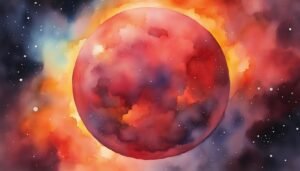
Betelgeuse is a red supergiant star in Orion, known for its size, temperature, red hue, and brightness variability.

Asteroids pose a potential but rare threat to Earth; NASA and other agencies track these objects, developing defenses like DART to mitigate potential risks.

Galaxies, classified as spiral, elliptical, and irregular, are complex systems of stars, gas, and dark matter evolving since shortly after the Big Bang.

The universe's first moments started with a singularity, then the Big Bang triggered by quantum fluctuations, followed by rapid expansion during the inflationary epoch, and the emergence of different epochs.

The largest stars, like UY Scuti, are immensely large and bright, influencing galaxy dynamics.

The largest planet discovered in the universe so far is DENIS-P J082303.1-491201 b, a brown dwarf estimated to be between 12 to 14 times the size of Jupiter.

Closest known black hole, 1,600 light-years away in Ophiuchus, stellar-mass, detected by effects on nearby stars, challenging traditional detection methods.

Scientists use telescopes like Hubble and the upcoming James Webb to study the universe's origin and search for life-sustaining water on other celestial bodies.

Comet 2024 has captivated both amateur and professional astronomers alike, offering an exciting opportunity to observe a unique celestial event as it blazes through the night sky.