Hubble’s New Cosmic Wonders: 14 Space Oddities Revealed
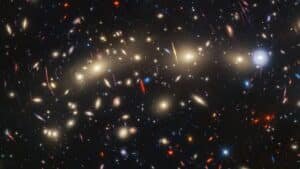
Funding new Hubble projects through Kickstarter can lead to exciting cosmic discoveries, expanding our knowledge of the universe.

Space exploration, studies of celestial bodies, and theories related to the universe and its phenomena.
Funding new Hubble projects through Kickstarter can lead to exciting cosmic discoveries, expanding our knowledge of the universe.

TL;DR: Inside a black hole, traditional physics don't apply, and conditions are beyond our current understanding due to extreme gravity and density.

TL;DR: The multiverse concept is a theoretical possibility in physics, not yet proven or disproven by empirical evidence. It suggests multiple or infinite universes exist beyond our own.

2023 experienced significant solar activity, impacting Earth and space weather with numerous solar flares.

NASA's asteroid redirection test has offered surprising insights into the dynamics of celestial bodies and the efficacy of planetary defense strategies.

Zero-point energy is a fundamental concept in quantum mechanics, shaping our understanding of the universe at the smallest scales.

Wormholes are hypothetical tunnels in space-time connecting two separate points in the universe, merging the realms of theoretical physics and science fiction.

During the Cold War, the US and the Soviet Union competed in the Space Race, culminating in Apollo 11's historic 1969 moon landing.

The bright star often seen in the west after sunset can vary depending on the time of year, but it is frequently Venus, known as the "Evening Star" when it appears in the western sky.

X-Points are pivotal sites where magnetic fields converge and reconnect, vital for comprehending space phenomena.