
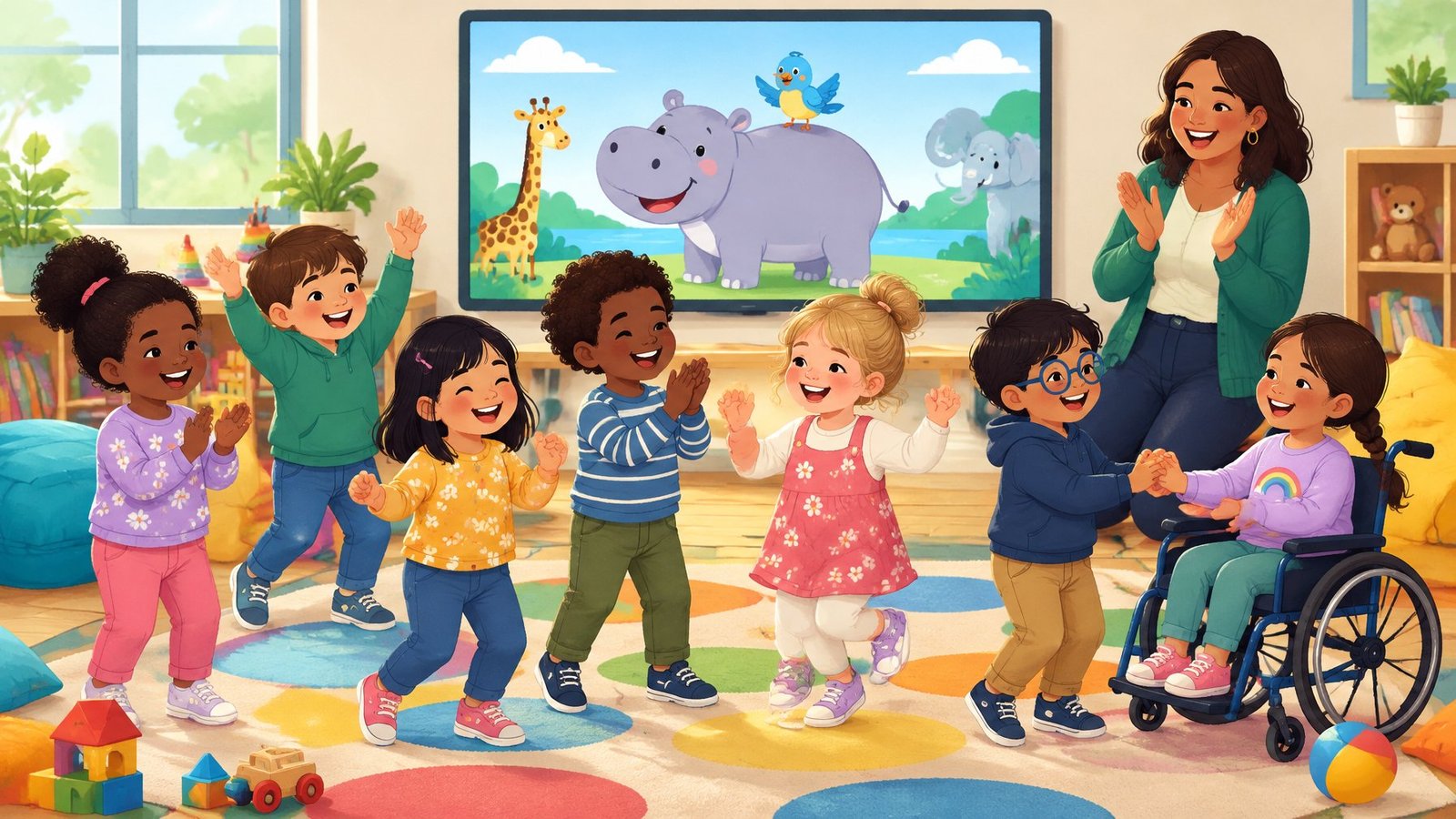
A few minutes a day of singing and dancing along to cartoon videos can teach young children words like “gargantuan”, “primate” and “equator”. In a randomized trial, preschool and kindergarten children whose schools used the program scored 0.30 standard deviations higher on a test of the words it covered.
The study was carried out by Ariel Kalil, Susan Mayer and Rohen Shah of the University of Chicago’s Harris School of Public Policy and Philip Oreopoulos of the University of Toronto. It was released as NBER Working Paper No. 32132 in February 2024.
A word a day, set to music
The program is Big Word Club, a series of animated music videos meant to introduce one new word per school day. Animal characters dance and sing original songs with simple instruments, so the lyrics stay front and centre. In one video, a hippo carries a bird on its back to illustrate “symbiotic”.
Each week, teachers get nine short videos built around five words: one per day, plus an animated book, a music video, a dance video and a review. Each lasts one to four minutes, so the program takes about 3 to 5 minutes of class time a day. It needs no teacher training. At the time of the study, it cost schools $60 per classroom.
A randomized trial in three states
The researchers recruited teachers through Facebook and concentrated on schools around Denver, Phoenix, Houston and San Antonio. They randomly assigned 53 schools to use the program or not. The analysed sample included 818 preschool and kindergarten children in 47 schools.
After four months, the children took a test of 38 words the program had covered. Two months later they took it again, along with a standard broad vocabulary test, the PPVT.
Children in program schools scored 0.30 standard deviations higher on the targeted words. On the follow-up two months later, the advantage was 0.27 standard deviations, so most of the learning stuck.
On the general vocabulary test, the program group scored 0.08 standard deviations higher, a difference too small to be statistically meaningful. The authors read this two ways: the targeted words did not crowd out other vocabulary, but the data cannot show a broader boost either.
Light touch, modest gains
Exploratory comparisons hinted that the effect was larger for older children and for children in better-off schools, but those differences were not statistically significant. Girls showed a larger effect on the later tests, which the authors say may partly reflect an unusually weak test day for girls in the control group.
The authors flag two limitations. There was no reliable record of how faithfully each teacher used the videos, and children were not tested before the program began, which made the estimates less precise.
They describe the result as “a modest amount of sustained learning.” Their argument is about cost. A program that takes 30 to 60 minutes a day may achieve more, but it eats into everything else in the school day. A five-minute program, they note, probably does not change how a teacher spends the rest of the class day.
Study Details:
- Title: Making a Song and Dance About It: The Effectiveness of Teaching Children Vocabulary with Animated Music Videos
- Authors: Ariel Kalil, Susan E. Mayer, Philip Oreopoulos, Rohen Shah
- Journal: NBER Working Paper No. 32132
- Publication Date: February 2024
- DOI: 10.3386/w32132